DISARMAMENT AND SECURITY .
Special to CPN from Nawal Amjad
On Thursday, 2 July 2026, people from two countries with one of the greatest global flashpoints came together — India and Pakistan. These countries fought a war last year, but here is thing about the need to pursue peace: it is not a permanent end goal but a continuous process — and every worthwhile process has to be revived like it did not exist, but also like it never stopped.
The event was hosted in collaboration by civil society organizations like, Socialist Yuvjan Sabha (India), Socialist Students’ Union (India) with Centre for Peace and Secular Studies (Pakistan), including luminaries like Dr. Sandeep Pandey, Ms. Lalita Ramdas and Ms. Diep Saeeda, who enabled the space for a discussion between people of the two countries.
The event was moderated by Rumaan Mecci (India) and Ahmad Raza (Pakistan), who navigated the event with all their light whether there was no electricity or internet (quite literally), or there were other bleak moments from some trolls in the audience that the moderators’ fellow, Rishi Anand helped keep away seamlessly.
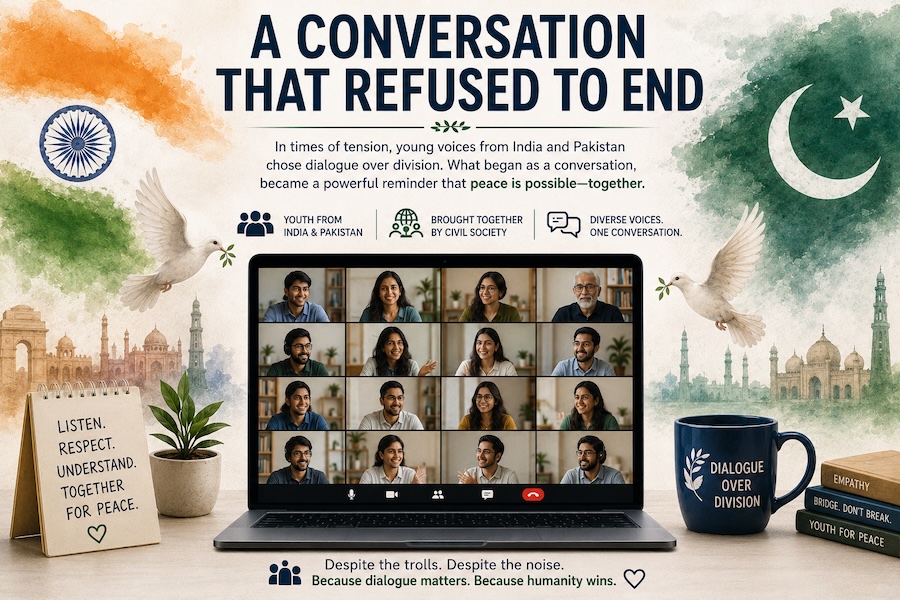
If I have to begin with introducing this event, so it was a virtual dialogue themed on, ‘How can young people lead a new chapter of peace-building, democratic engagement and people-to-people diplomacy between Pakistan and India and create a shared future?’ Young changemakers along with individuals that have dedicated a substantial part of their lives to a Culture of Peace were there. And what is particularly special about this event is how it had enthusiastic participation from citizens from both countries, even expats who have spent years nurturing their and their polities’ identities abroad.
I was also honored to have been invited there because of my background with helping nourish a Culture of Peace in the last few years, and more recently, through my affiliation with Peace Manifesto 2025 and the Culture of Peace Corporation since last year.
When I had attended this dialogue, I did not maintain notes (something that I seldom forget when attending every webinar till date, even if I am a passive part of it), but in hindsight, I realized that perhaps making notes would have been a good way to document every noteworthy sentence that I heard in the discussion, however, some things need to be experienced — and so having chosen to be my usual geeky self would not have been this helpful.
What I in turn realized was that this event was indeed a watershed moment. Not because in the most academically fancy terms, changemakers, particularly young changemakers from two ‘archrivals’ came together one evening, but because an originally envisioned two-hour-long event went on for about almost four hours. If that surprised you, I’m not surprised, because that was the exact reaction of my mentor-boss, Professor David Adams, who has been one of the pioneers at UNESCO to have conceived the idea of a Culture of Peace for the whole world, decades ago and since then, he has not looked back from working for it despite what his friend-colleague described to him to be an increasingly apocaloptimistic world.
The need for a shared future
Monica Wahi, a prominent child film specialist from India opened the discussion by her reflections emphasizing upon the need for a ‘shared future’ — to this, I both responded and opened my address by saying that we would only need to have a shared future, if we had been divided — we were never really divided. I began by speaking about our ‘shared challenges’ as two struggling domestic polities: India, whom we clearly looked up to before the world’s greatest democracy increasingly began to deconsolidate, and our own democracy in Pakistan, having struggled to consolidate since forever.
Take the recent student protests in India for example. The National Eligibility cum Entrance Test (NEET)’s leak in India is the same as the Medical and Dental College Test (MDCAT)’s leaks in Pakistan; besides, the unfair grading replete with discrepancies that led to reconduct of the former in Pakistan only speaks volumes of how ‘we are always in this together’ is an apt phrase to describe most of what we both suffer. In fact, when I saw the police dragging protesters and even India’s seasoned politician Rahul Gandhi upon the country’s streets, I asked my own audience on my private Instagram the other day that, ‘Can I also say that our democracies are Sanjhi? Sanjhi is a Punjabi language word used commonly by people of both sides of the border which translates to as, ‘shared’.
Now back to the dialogue. I spoke of our many commonalities using very distinct set of things, but each weaving into why or how we are not that divided, if only we admit to realize. For instance, I spoke of my childhood familiarization with the word, ‘actor’ through watching Shah Rukh Khan, Indian superstar whom I referred to as, ‘Sharo Khan’ for the longest time — my first vivid TV memory of childhood.
Similarly, when women in India and Pakistan, both have to constantly register their existence through apparently needing to ‘break a glass ceiling’ rather than realizing that the latter only concretizes it, and when the news of women’s abuse of any nature circulates in the media or otherwise, the reasons and ramifications on both sides of the border are not different. In fact, even when a 150-year-old tree in Lahore is cut and so is a 100-year-old tree in Nashik, India — the hue of cry in the civilized people of both sides of the border is the same — and the vested interests of the powers that be responsible and or complicit in these cases are also the same.
During the dialogue, I also drew attention to my belief in the power of SDG 4.7: the seventh target of the fourth Sustainable Development Goal, Education, which is about working for and embodying values and practices of Global Citizenship Education and Sustainability; the non-exceptionalist nature of climate change sparing no one; my love for what all India has done and continues to do for entrepreneurship — thanks to me marveling at (Shark Tank India) as one of the many emblems of what we got to learn from them; a need for a Joint Pakistan-India Parliament where the youth could discuss the day-to-day issues of ‘shared interest’; a Public Diplomacy Centre to deepen people-to-people connectivity between both nations and some form of a Public Interest Promotion Centre/ Declaration, that enables us to teach each other best practices on governance, foreign policy, education, public health-care, technology, entrepreneurship, media and of course, art, culture and entertainment — no matter our piercing differences continue to stare into our faces.
If I begin to describe everything said by everyone, the article would never end, but I still deem it necessary to share brief takeaways from my fellow youth panelists from within my country and across the border.
Opportunities for dialogue
Tiya Mhatre, a student based in AliBaugh near Mumbai, who is about to join UWC Pearson University and is passionate about UN simulation conferences (just like I used to be) said something really helpful, Tiya pointed out that while student diasporas are one of those key scarce spaces remaining for youth of both countries to connect to each other, there are more opportunities through universities and student communities that ought to be explored; may it be collaborating through dialogues like these; joint projects; cultural exchanges on areas like, climate change, public health-care, sustainability and innovation — because in Tiya’s eyes, lasting peace begins with trust and trust begins with conversation, and while the former cannot resolve complex regional issues, it can indeed preserve something essential, the willingness to ‘keep talking’.
(Article continued in right column)
Can peace be established between India and Pakistan?
Solidarity across national borders, What are some good examples?
(Article continued from left column)
Another fellow panelist, Kabir Rao, who is a student of philosophy and Arabic at the University of St Andrews from India, and besides his interests in politics and military affairs for the Middle East, he is also attempting to learn Urdu and Farsi — yes, you heard that right. A Hindu in India studying philosophy and Arabic. Learning Urdu and Farsi. Kabir emphasized on his turn about the organic link between our shared struggles for a non-militaristic, non-violent and democratic outlook and better relations with neighbors at home. He also highlighted the similarities between India and Pakistan’s ‘connected histories’ and our present-day struggles. He further argued that the working class in both countries, especially the young people within it ought to understand these similarities and base their struggles on them.
A poem than transcends national boundaries
Kabir ended his points by reciting a verse from a poem, ‘Black Out’ by Faiz Ahmed Faiz, a poet with ‘Pakistani origins’ and whose services for the country were oxygen for the progressive and democratic lungs of the country. The verse reads as,
ایک پل ٹھہرو کہ دریا کا کہیں پاٹ لگے
اور نیا دل میرا
زہر میں دھل کے، فنا ہو کے
کسی گھاٹ لگے
پھر پئے نذر نئے دیدہ و دل لے کے چلوں
حسن کی مدح کروں شوق کا مضمون لکھوں
Which translates to English as, ‘Wait a moment, so the river may somewhere find its shore, and my tender heart, washed in poison and dissolved, may reach a landing place.
Then I shall walk on, offering the lit lamps of my heart’s anguish, singing praises to beauty, and penning the treatise of longing.’
Such is our ‘shared’, or dare I say, inseparable history and legacy of our people, that is only telling of how profoundly we need a deliberate and a very consistent cultivation of a Culture of Peace.
Science and health transcend national boundaries
Another panelist, Iqra Preet, who is a PhD Biochemistry scholar and a researcher in nanotechnology-based treatment for multiple diseases based in Lahore, Pakistan said something that every other participant from (even within the audience) kept echoing till the end: how shared scientific research and investment in public health-care does not need to see who belongs to which nation. In my understanding, how a sample on a microscope, a DNA or a virus should override our very fragile fixation with our yet-to-understand fantasies of our so-called perfected nation-states.
Culture transcends national boundaries
Then it was Ritu Das, who is a queer feminist activist from Uttar Pradesh, based in Lucknow, India and is also a poet and has been active in the movement spaces for almost a decade. She utilized her turn by recalling her stay experience in a hotel in London. Among her hotel staff were two individuals — one, a Hindu Indian from Rajasthan — the other who was a Muslim from Bangladesh. To Ritu’s surprise, the connection felt and built more deeply and meaningfully with the Muslim from Bangladesh than her own fellow citizen.
According to Ritu, it was because of the cultural and linguistic boundaries that transcended the political border separating the region. It helped Ritu reinforce an important sociological insight: it is often our shared cultural and historical inheritances that sustain solidarities. In fact, Ritu’s grandmother’s narration of the violence events during partition taught Ritu something very poignant: she recounted violence with extreme ethical sensitivity and the latter was quoted by Ritu to have told them, ‘People of every community were killed and people of every community were forced to leave their homes, foregrounding human suffering rather than communal identity.’ As a member of a marginalized community, Ritu has witnessed Bangladeshi transgender communities drawing parallels between India’s Transgender Card Framework and Bangladesh’s Hijra Identity recognition, despite different political and legal systems — proving in the words of Ritu that, ‘struggles for dignity, recognition and justice frequently transcend national borders, producing what may be understood as transnational communities of care and resistance.’
The webinar was also attended by celebrated practitioners like, Sachendra Pratap Yadav, President of the Socialist Students’ Union and a PhD scholar at the BITS Pilani, Hyderabad Campus, India; Sanjay Gadhalay, an engineer, entrepreneur and Climate activist from Hyderabad India; Mazher Hussain, who runs Confederation of Voluntary Agencies (COVA) from Hyderabad, India and is a long-time peace activist; Shivi Upadhyay, recent PhD scholar in social work from Delhi University and a development activist who works in Goa at present; Razi Raziuddin, who can be uniquely distinguished because he studied at both Aligarh University and Banaras Hindu University and now works as a scientist in the United States of America and runs a diaspora forum; Cedric Prakash, a Catholic priest and a prominent human rights activist from Ahmedabad, India; Father Anand, Catholic activist, priest and playwright from Varanasi, India; Sheema Kermani, prominent classical dancer, actor and social activist from Pakistan among others.
The conversation refuses to end
This convergence was not easy owing to trolls constantly trying to keep the moderators on their toes, and even us attendees wondering if it would go on smoothly? There was, of course, a shared anxiousness around letting the audiences also participate by risking giving them a mic. Some of them were trolls, but most of them were also equally or even more elated than us to have been there, and it is these same people, the common people, with whom the discussion went on for almost four hours. Some of these people contributed by narrating tales of being constantly anxiety-ridden because of growing up in a military background — and the very solid and legitimate fear of losing their loved ones. But there were also those that wanted to call a spade a spade, and hence demanded us to not pretend like everything was hunky dory, but to both acknowledge and embrace the discomfort — talk out loud about the elephant in the room, issues like cross-border terrorism and Kashmir to name a few. Others simply encouraged and looked forward to more honest and uncomfortable conversations regularly in the future.
Before the article’s title starts to influence me (and it literally never ends), I am thinking of concluding this piece just when I have heard about the education minister in India resigning — if this is true victory for people of India is premature to say because systemic changes have a long way to go before they bear fruits. Notwithstanding that the ‘cockroaches’ in India were heard, and a seed has to be planted somewhere for it to appear to be bearing fruits later — and that gives me: a cockroach in Pakistan — a glimmer of relief for the justice of the dozens of those innocent students, who lost their lives just because their system failed them. But whether it is the cockroaches in India or in Pakistan, the conversation hopefully refuses to end.
– – – – – –
If you wish to make a comment on this article, you may write to coordinator@cpnn-world.org with the title “Comment on (name of article)” and we will put your comment on line. Because of the flood of spam, we have discontinued the direct application of comments.