FREE FLOW OF INFORMATION .
An article by Biswo Ulak
In 2015, the Global Peace Index highlighted a decline in global peace, marked by rising terrorism, growing refugee crises, and increasing inequality. At the same time, Nepal was recovering from a decade-long armed conflict while continuing to face political instability, economic challenges, and social uncertainty despite the adoption of the 2015 Constitution. In response to these challenges, the Nepal Peace Walk emerged as a cultural journey that welcomes people of all religions, races, nationalities, and backgrounds to celebrate diversity, heritage, and human connection. Through mindful walking, cultural exchange, and community engagement, the initiative promotes healing, dialogue, tolerance, reconciliation, and unity by connecting participants with heritage sites, local communities, and shared human values.
Origin of Peace Walk
An informal group of cultural activists and peace advocates, including Biswo Ulak, spiritual leader Naresh Prasad Manandhar, and campaigners such as Deva Sainju, Palden Lama, Anil Raj Bajracharya, Subarna Shrestha, Chandra Badan Bijukchhe, Rajaram Karmacharya, Sunita Shahi, and Hem Kumar Shrestha, along with many like-minded individuals, came together to launch a symbolic Peace Walk promoting peace and coexistence. The journey begins at Swayambhunath, which has a history spanning over 3,000 years and continues to Namo Buddha Temple, a site with more than 6,000 years of history associated with compassion and selfless sacrifice through the story of Prince Mahasattva.
Inspired by Nepal’s cultural heritage, the route passes through historic settlements and sacred sites including Pashupatinath Temple, Boudhanath Stupa, Bhaktapur, and Panauti, symbolizing cultural continuity, dialogue, reconciliation, and peace.
Focus of the Journey
The Nepal Peace Walk and Peace Festival aims to celebrate cultural diversity, promote social engagement, and strengthen the tourism industry, contributing peace and harmony in society through:
Sharing the inspiring, often untold history of Avayadan—the spirit of selfless compassion—with the world, to help promote the value of saving lives, supporting ecological balance in nature, and raising awareness about organ donation as a modern reflection of this noble tradition.
Promoting the value of peace, unity, harmony and healing to help ease internal conflicts and foster awareness of the vital need to preserve our shared human civilization.
This walk is not a search for peace, but a gentle reminder that peace has always been with us. Through times of challenge, loss, and solitude, it has remained present, patiently awaiting our awareness. As we walk together in shared purpose, our steps offer an invitation to pause, reflect, and reconnect with the peace that lives within each person. May this collective journey unfold like the sunrise after a long night, bringing renewed understanding, quiet strength, and hope for a more harmonious and compassionate world.
Commencing the Movement
The movement began on Nepal New Year, 16 April 2017, with a bicycle rally organized in collaboration with World Cycle Tour. The journey connected the historic Swayambhunath Stupa and Namo Buddha Temple, promoting peace, compassion, and cultural harmony. What started with an expectation of 80 participants grew into a powerful gathering of more than 160 cyclists from diverse backgrounds, united through shared movement and human connection. This experience inspired a deeper vision — transforming fast-paced rallies into mindful cultural journeys focused on reflection, community bonding, cultural exchange, and the spread of peace through meaningful shared experiences.
Nepal Peace Walk
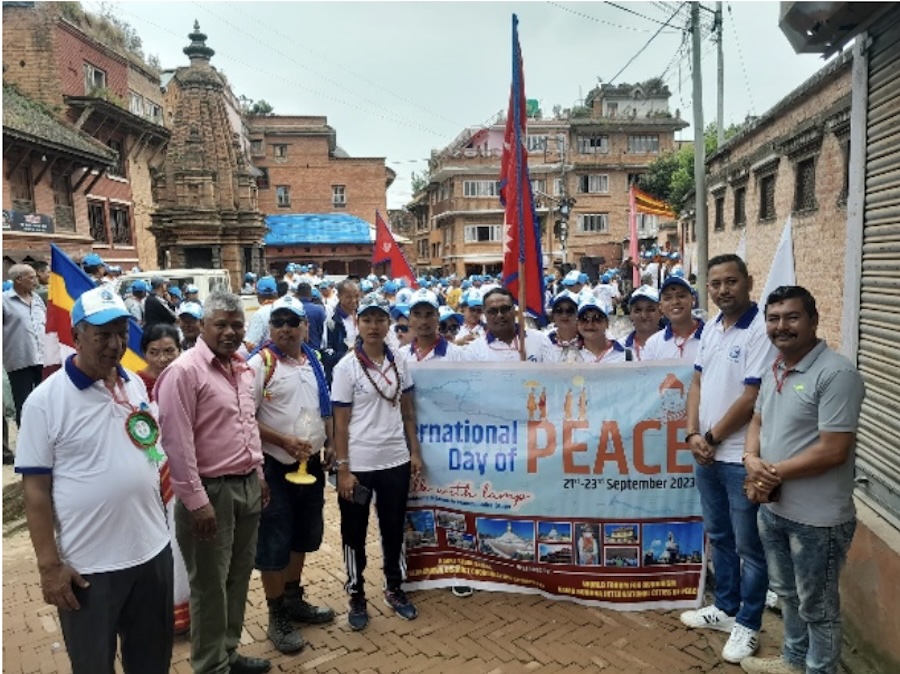
The first Walk with the Cultural Peace Lamp was held from 21–23 September 2017 to celebrate the International Day of Peace. The three-day journey connected Swayambhu Stupa and Namo Buddha Temple, promoting peace, compassion, and cultural harmony. Along the route, participants stayed at the historic Muni Vihar in Bhaktapur and Dhyanakuti Vihar in Banepa, experiencing local traditions, spiritual reflection, and meaningful cultural exchange that strengthened unity among communities.
The event was successfully organized by the GCPW team, inspired by the momentum of the April 2017 Bicycle Rally. In 2018, Tergar Monastery helped expand the peace movement with support from Education Foundation on Buddhism (EFoB), Namo Buddha International Cities of Peace (NBCP), and World Forum for Buddhists (WFfB). Together, these organizations strengthened the initiative into an ongoing platform promoting peace, compassion, cultural preservation, and global solidarity, which continued in the following years.
How can we be sure to get news about peace demonstrations?
(article continued from left column)
Resilience in the Time of Pandemic
During the COVID-19 pandemic in 2020 and 2021, large public peace talks were paused due to health restrictions. Despite these challenges, local communities, heritage sites, and peace organizations continued organizing small-scale and symbolic programs under the message “Peace Energy to Fight Aagainst COVID-19.” Through community support, reflection, and peace activities at sacred and cultural sites, these initiatives spread hope, compassion, healing, and solidarity, proving that human connection and the spirit of peace can endure even in difficult times.
Restoration of the Campaign
In 2022, after two years of pandemic restrictions, Education Foundation on Buddhism (EFoB) successfully revived the Walk with the Cultural Peace Lamp, reconnecting communities through peace, culture, and compassion. The return of the journey was warmly welcomed by local communities and symbolized resilience, healing, and renewed social harmony.
In 2023, the campaign reached a major milestone under the leadership of Kavre Sewa Samaj, in collaboration with World Forum for Buddhists (WFfB) and Namo Buddha International Cities of Peace (NBICP). What began with only five walkers from Boudhanath gradually grew into a powerful movement, with more than 1,500 participants joining the final walk from Panauti to Namo Buddha Temple, reflecting growing public support for peace, cultural unity, and community connection.
For more about Nepal’s cultural peace initiatives and destinations, visit https://peacetourist.com/nepal/. The community participation and highlights of the 2023 walk can also be viewed through Facebook Reel @GCPW Nepal.
International Recognition and Expansion
Nepal, a beautiful Himalayan nation between India and China, is renowned for its rich biodiversity, ancient cultural heritage, and breathtaking landscapes. In 2024, the Nepal Peace Walk programme, led by World Forum for Buddhists with support from partner organizations, was officially launched through an international webinar, generating strong global engagement among peace advocates, cultural communities, and international participants. The programme was officially launched on June 2024 through an international webinar, which created significant momentum and engagement among peace advocates, cultural organizations, and global participants.
The 2024 Nepal Peace Walk brought together 120 participants from 8 countries across Asia, Europe, and the United States, making it one of the most internationally diverse gatherings in the programme’s history. Beyond a physical journey, the walk became a platform for intercultural dialogue, friendship, peacebuilding, and community connection, while digital outreach and documentary coverage expanded its global visibility and impact.
In 2025, the Nepal Peace Walk programme was organized in two phases due to the Dashain festival in Nepal. The first phase, the Peace Festival, was held on 21 September 2025 at Patan Durbar Square, bringing together cultural performers and peace advocates for the International Day of Peace. The second phase, held from 3–5 November 2025, covered nearly 70 kilometers from Swayambhu Mahachaitya to Namo Buddha Temple and attracted over 100 participants, reflecting growing support for peacebuilding, cultural exchange, and community connection.
Looking Ahead: 2026 and Beyond
The success of the 2024 and 2025 Nepal Peace Walk programmes highlighted the growing importance of deeper connections between international participants and local communities through cultural exchange, shared learning, and meaningful human interaction. In a world facing conflict, division, and uncertainty, the Nepal Peace Walk promotes peacebuilding through mindful walking, cultural understanding, and compassionate community engagement.
Building on this momentum, the 2026 programme will feature a Peace Festival at Patan Durbar Square on 21 September, followed by a five-day Cultural Peace Walk from 21–25 November, connecting sacred and cultural heritage sites including Swayambhu Mahachaitya and Namo Buddha Temple. Open to people from all backgrounds, the initiative encourages peace, dialogue, compassion, and global solidarity through shared cultural experiences and mindful journeys.
Together, We Walk for Peace
The Nepal Peace Walk is a living expression of peace, compassion, and cultural harmony that brings together people from different cultures, communities, and nations in a shared journey toward understanding and unity. Inspired by the timeless values of empathy, selflessness, and mutual respect, the walk promotes dialogue, cultural preservation, and humanitarian awareness. The spirit of modern organ transplantation in health science reflects the ancient compassion demonstrated by Avayadan Prince Mahasattva over 6000 years ago, symbolizing the profound act of giving life to others. In a world increasingly affected by conflict, division, and social challenges, the Nepal Peace Walk serves as a powerful reminder that lasting peace begins with mindful steps, compassionate hearts, and the willingness of humanity to walk together toward a shared and harmonious future.
For more information about the Nepal Peace Walk, participation opportunities, partnerships, or event details, please contact GCPW.Nepal@gmail.com
– – – – – –
If you wish to make a comment on this article, you may write to coordinator@cpnn-world.org with the title “Comment on (name of article)” and we will put your comment on line. Because of the flood of spam, we have discontinued the direct application of comments.