. HUMAN RIGHTS .
An article from Telesur English
The Global Sumud Flotilla is departing today [April 14] from the Port of Barcelona in what organizers describe as the largest civilian-led maritime initiative in history aimed at breaking Israel’s long-standing blockade of the Gaza Strip.
Comprising more than 70 boats and over 3,000 participants from more than 100 countries, the fleet includes a dedicated medical contingent of 1,000 healthcare professionals carrying essential supplies for Gaza’s devastated health system.
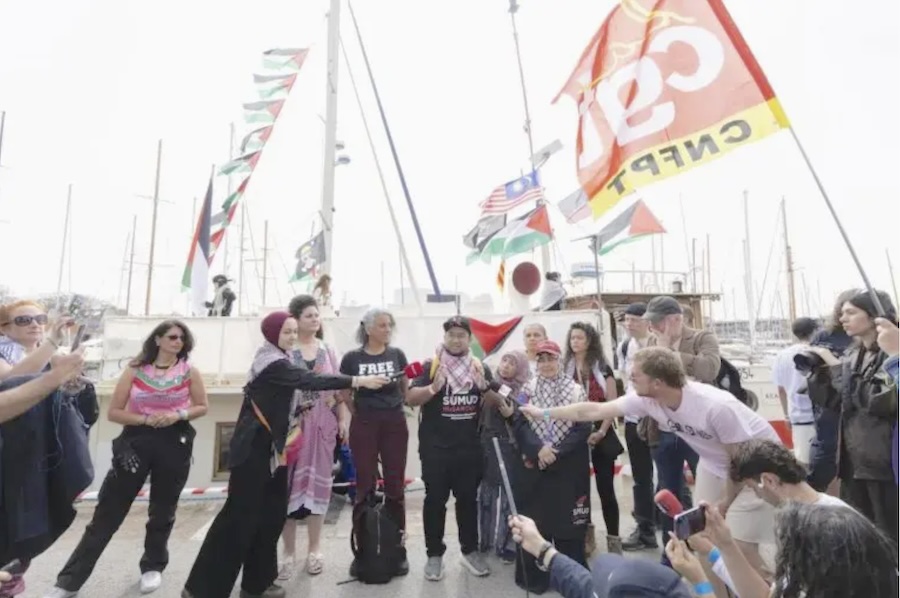
Saif Abukeshek, the Palestinian activist based in Barcelona and spokesperson for the Global Sumud Flotilla, has emphasized that this is a peaceful civilian action responding to ongoing aggressions against Palestinian and Lebanese populations.
Over 70 vessels and thousands of international volunteers are sailing to pressure governments worldwide.
The mission combines sea and land components, including solidarity convoys from Asia and North Africa.
Greenpeace’s Arctic Sunrise and Open Arms vessels are joining the effort from Barcelona.
This Spring 2026 mission builds directly on previous attempts, including the 2025 Global Sumud Flotilla that was intercepted by Israeli forces.
The Global Sumud Flotilla Mission: Scale and Objectives
The Global Sumud Flotilla represents a coordinated alliance of four major coalitions: the Global Sumud Flotilla itself, the Global Freedom and Sumud Flotilla, Thousand Madleens to Gaza, and the Freedom Flotilla Coalition.
Organizers state the goal is to deliver humanitarian aid, assert the right of navigation in international waters, and highlight the dire conditions in Gaza more than six months after a fragile ceasefire took effect in October 2025.
Saif Abukeshek has described the flotilla as “civilian boats” in response to what he calls systematic human rights violations in the Middle East, including continued strikes in Lebanon and restrictions in Gaza despite the truce.
The fleet carries medical supplies, food, and reconstruction materials while featuring doctors, engineers, legal experts, and activists ready to establish an unarmed protective presence if permitted.
Medical fleet of 1,000 professionals targets Gaza’s collapsed healthcare infrastructure.
Participants include parliamentarians, journalists, and civil society leaders from every continent.
The mission seeks to open a humanitarian sea corridor and challenge the 19-year blockade.
→ External link: Amnesty International: States must ensure safe passage for Global Sumud Flotilla
→ External link: Freedom Flotilla Coalition joint statement on largest flotilla yet
Historical Context of Efforts to Break the Gaza Blockade
Maritime activism to challenge Israel’s blockade of Gaza dates back to 2008 with the Free Gaza Movement, which successfully delivered aid in several voyages before 2010.
The 2010 Freedom Flotilla, including the MV Mavi Marmara, ended in tragedy when Israeli forces raided the vessels in international waters, resulting in nine activist deaths and widespread international condemnation.
Subsequent attempts — Freedom Flotilla II in 2011, III in 2015, the Women’s Boat in 2016, and multiple missions through 2018 — were all intercepted, with activists detained and deported.
In 2025, smaller missions like the Madleen and Handala faced drone attacks and boarding in international waters. The first large-scale Global Sumud Flotilla in September-October 2025 involved over 40 vessels and 500 participants but was fully intercepted, with hundreds detained.
(continued in right column)
How can we best express solidarity with the people of Gaza?
(continued from left column)
No flotilla has reached Gaza since 2010 despite repeated non-violent efforts.
The 2025 Global Sumud Flotilla marked the largest attempt until this 2026 spring mission.
Patterns show consistent Israeli interceptions, even in international waters, drawing UN and human rights criticism.
These actions have consistently raised global awareness about the blockade’s humanitarian impact, even when physically prevented from docking.
Current Situation in Gaza Six Months into the Fragile Ceasefire
The October 10, 2025 ceasefire, brokered with international involvement, promised a halt to major hostilities, hostage-prisoner exchanges, and increased aid flows. Yet Gaza remains in a state of “neither war nor peace.”
Official Palestinian sources report more than 2,073 Israeli violations between October 2025 and March 2026, including airstrikes and incursions, resulting in over 700 Palestinian deaths — the majority civilians.
Aid deliveries have fallen far short of commitments, with only about 21% of planned trucks entering. Reconstruction has barely begun, and restrictions on “dual-use” materials continue to hinder recovery.
Over 60% of children under two face food poverty amid persistent malnutrition.
Nearly 60% of the Gaza Strip remains a no-go zone under Israeli military control.
Thousands of pregnant women and breastfeeding mothers suffer from acute malnutrition.
The health system lies in ruins, with limited medical evacuations and ongoing shortages of medicine and equipment.
Geopolitical Context and Broader Regional Implications
The launch of the Global Sumud Flotilla occurs against a backdrop of fragile truces across the Middle East. A short-lived US-Iran ceasefire announced in early April 2026 followed intense strikes that disrupted regional stability, affecting aid routes and energy supplies.
Continued Israeli operations in Lebanon, even during truce periods, and tensions involving Iran have compounded the crisis. These dynamics underscore how the Gaza blockade fits into wider patterns of conflict and external intervention.
Civilian initiatives like the flotilla highlight growing frustration with governmental inaction.
By asserting rights under international law, participants aim to pressure states to fulfill obligations regarding humanitarian access and accountability.
The blockade, now in its 19th year, is widely viewed as unlawful by human rights organizations.
International Court of Justice provisional measures remain unheeded.
Grassroots movements fill the vacuum left by stalled diplomacy.
This mission tests the commitment of the international community to protect non-violent activists and enforce humanitarian principles amid shifting alliances.
Challenges Ahead and Potential Impact of the Global Sumud Flotilla
Organizers have prepared for possible interceptions, framing the effort as a legal and moral challenge rather than confrontation. Past experiences show risks of detention, equipment seizure, and physical harm.
Yet the unprecedented scale — uniting diverse coalitions and drawing support from figures across civil society — amplifies its potential to influence public opinion and policy debates in Europe, the Americas, and beyond.
Success or high-visibility failure could bolster calls for lifting the blockade entirely.
Medical and reconstruction teams signal a focus on long-term solidarity.
The flotilla exposes the gap between international rhetoric and action on Palestine.
Amnesty International has urged states to guarantee safe passage, warning against repeats of 2025 abuses.
In a region marked by unresolved conflicts, the Global Sumud Flotilla keeps the humanitarian cost of the blockade in sharp focus. It demands justice, dignity, and an end to collective punishment for Gaza’s two million residents.
As vessels leave Barcelona today, the world watches whether this bold civilian stand will mark a turning point or another chapter in the long struggle for Palestinian rights.
– – – – – –
If you wish to make a comment on this article, you may write to coordinator@cpnn-world.org with the title “Comment on (name of article)” and we will put your comment on line. Because of the flood of spam, we have discontinued the direct application of comments.