DISARMAMENT & SECURITY .
An article from Just Security
The United States and Israel initiated strikes on Iran over one month ago, on February 28, 2026. The attack was a clear violation of the United Nations Charter. The conduct of the war, and statements of U.S. officials, also raise serious concerns about violations of international humanitarian law, including potential war crimes. We have written the below statement together with over 100 U.S.-based international law experts, to detail our profound concerns about the war. The letter is signed by international law experts across the United States, including senior professors; leaders of prominent international law associations, non-governmental organizations, and legal clinics; former government legal advisors; and military law experts and former Judge Advocates General (JAGs).
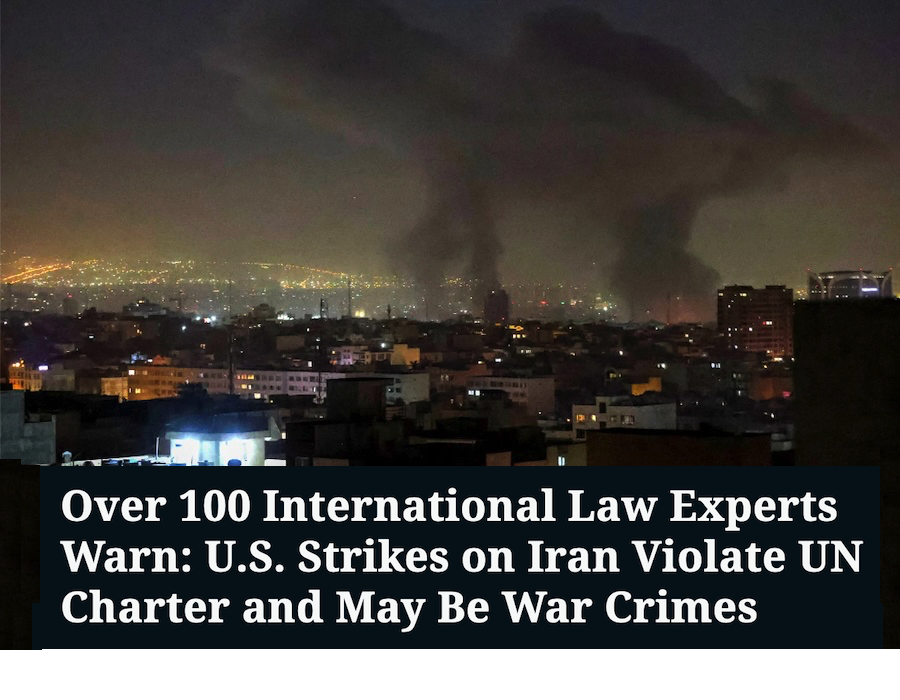
Letter of over 100 international law experts on Iran war
We, the undersigned U.S.-based international law experts, professors, and practitioners write to express profound concern about serious violations of international law and alarming rhetoric by the United States, Israel, and Iran in the present armed conflict in the Middle East.
Due to our connection to the United States, our focus here is on the conduct of the U.S. government, but we remain concerned about the risk of atrocities across the region including the continuing risks posed by the Iranian government to Iranians through violent crackdowns on dissent, and to civilians across the Middle East through Iran’s ongoing unlawful strikes on civilian infrastructure using explosive weapons in densely populated areas.
One month has passed since the United States and Israel launched strikes across Iran. The initiation of the campaign was a clear violation of the United Nations Charter, and the conduct of United States forces since, as well as statements made by senior government officials, raise serious concerns about violations of international human rights law and international humanitarian law, including potential war crimes.
We collectively affirm the importance of equal application of international law to all, including countries that hold themselves out as global leaders. Recent statements from senior U.S. government officials describing the rules governing military engagement as “stupid” and prioritizing “lethality” over “legality” are profoundly alarming and dangerously short-sighted. These claims, particularly in combination with the observable conduct of U.S. forces, are harming the international legal order and the system of international law that we have devoted our lives to promoting.
The war, which is costing U.S. taxpayers between $1-2 billion each day, is imposing significant harm to civilians in the region, has resulted in the loss of hundreds of civilian lives across the Middle East, and is causing serious environmental and economic harms.
We write to express our concern about 1) jus ad bellum, or the decision to go to war, 2) jus in bello, or the conduct of hostilities, 3) rhetoric and threats from senior U.S. officials and their allies, which portend further abuses, and 4) the decimation of civilian harm mitigation structures within the U.S. government as a part of U.S. Secretary of Defense Pete Hegseth’s “gloves off” approach to warfare.
1. Jus ad bellum concerns: The strikes launched by the United States and Israel on February 28, 2026 clearly violated the United Nations Charter prohibition on the use of force. Force against another state is only permitted in self-defense against an actual or imminent armed attack or where authorized by the UN Security Council. The Security Council did not authorize the attack. Iran did not attack Israel or the United States. Despite the Trump administration’s varied and sometimes conflicting claims to the contrary, there is no evidence that Iran posed an imminent threat that could ground a self-defense claim. Many international law experts have concluded that Israel and the United States’ actions violate the UN Charter, including the President and President-elect of the American Society of International Law, and the President of the American Branch of the International Law Association; UN Secretary-General António Guterres also condemned the attacks as undermining international peace and security.
2. Concerns about violations of international humanitarian law: The laws of armed conflict constrain the conduct of hostilities of all parties to the ongoing conflict. We are concerned that these fundamental rules may have been violated, including in the context of reported strikes on civilians and civilian objects such as political leaders who have no military role, oil and gas infrastructure, including South Pars, and water desalination plants. On March 19, UN High Commissioner for Human Rights Volker Türk condemned strikes on energy infrastructure, noting their “disastrous” impacts for civilians.
We are seriously concerned about strikes that have hit schools, health facilities, and homes. The Iranian Red Crescent reports that “67,414 civilian sites have been struck, of which 498 are schools and 236 health facilities.” A report by leading civil society organizations found that at least 1,443 Iranian civilians, including 217 children, were killed by U.S. and Israeli forces between February 28 and March 23.
The strike on Minab primary school is particularly concerning. On February 28, Shajareh Tayyebeh Primary School in Minab, Iran, was struck, resulting in the deaths of at least 175 people, many of them children, according to Iranian officials. Based on easily accessible online information and commercially available satellite imagery, it appears the building had been used as a school for a decade. President Trump denied U.S. responsibility, falsely stating that “It was done by Iran.” However, a preliminary investigation by the Department of Defense reportedly determined that the U.S. conducted the strike, and the targeting had been based on outdated intelligence. The strike likely violates international humanitarian law, and if evidence is found that those responsible were reckless, it could also be a war crime. The strike is among the deadliest single attacks by the U.S. military on civilians in recent decades.
3. Concerns about rhetoric and threats from senior officials. We are deeply concerned about the dangerous rhetoric government officials have engaged in during the war, including:
a. Threatened denial of quarter: On March 13, Secretary of Defense Pete Hegseth stated “We will keep pushing, keep advancing, no quarter, no mercy for our enemies.” In international law, it is “especially forbidden” to “declare that no quarter will be given,” a prohibition also set out in the Department of Defense’s own law of war manual. Hegseth’s statement likely violates international humanitarian law as well as the U.S. War Crimes statute 18 U.S.C. 2441. Ordering or threatening no quarter is a war crime.
b. Dismissal of rules of engagement and international law: Secretary of Defense Hegseth’s “no quarter” statement followed similarly alarming statements by the Secretary, including on September 25, 2025 and March 2, 2026 that the U.S. does not fight with “stupid rules of engagement.” On January 8, 2026 President Trump had made the disturbing comment that “I don’t need international law.” On March 13, he stated that the U.S. may conduct strikes on Iran “just for fun.”
c. Threats on energy infrastructure: President Trump threatened on March 13, 2026: “I could take out things within the next hour, power plants that create the electricity, that create the water… We could do things that would be so bad they could literally never rebuild as a nation again.” International law protects from attack objects indispensable to the survival of civilians, and the attacks threatened by Trump, if implemented, could entail war crimes. On March 21, President Trump further threatened to “obliterate” power plants in Iran. U.S. Ambassador to the United Nations, Mike Waltz, defended power plant attacks the next day, and also said that striking nuclear power plants was not off the table. It is prohibited to attack civilian energy infrastructure. If a power plant has both civilian and military purposes (“dual-use”), it may be considered a military objective where it makes “an effective contribution to military action” and the attack “offers a definite military advantage.” However, any strike must respect the principles of proportionality and precautions in attack. The proportionality principle prohibits attacks expected to cause incidental civilian harm that would be excessive in relation to the military advantage. The civilian harm to be considered includes foreseeable reverberating or indirect harm. In any attack, “all feasible precautions” must be taken to avoid civilian harm.
Attacks on nuclear power plants, even if they have a military purpose, require particular care because of the high risk of releasing radiation and radioactive material and consequent severe harm to the civilian population. Such a strike could harm the health and safety of millions of civilians. On March 23, 2026, the ICRC President Mirjana Spoljaric Egger expressed her deep concern, noting that “War on essential infrastructure is war on civilians” and described threats to nuclear power plants as “Most alarming.”
4. Concerns about institutional safeguards against further violations: Since the start of the second Trump administration, the Defense Department under Secretary Hegseth has deliberately and systematically weakened the protections meant to ensure compliance with international humanitarian law. This includes removing senior military lawyers without publicly citing misconduct, and replacing the Army, Navy, and Air Force judge advocates general, directly undermining legal oversight of combat operations. It has also abolished “civilian environment teams” and other mechanisms specifically designed to limit harm to civilians during operations. The 2026 National Defense Strategy omits references to civilian protection and international law entirely. These changes are especially concerning in light of Defense Secretary Pete Hegseth’s comments that rules of engagement interfere with “fighting to win.”
We are gravely concerned that the conduct and threats outlined here are causing serious harm to civilians in the Middle East, and that they also contribute to escalating the conflict, damaging the environment and the global economy, and that they risk degrading the rule of law and fundamental norms that protect every nation’s civilians. Public statements by senior officials indicate an alarming disrespect for the rules of international humanitarian law accepted by states, and which protect both civilians and members of the armed forces.
We urge U.S. government officials to uphold the UN Charter, international humanitarian law, and human rights law at all times, and to publicly make clear U.S. commitment to and respect for norms of international law.
We remind all states of their legal obligations not to aid or assist the United States, Israel, or Iran in the commission of internationally wrongful acts, as well as to cooperate to bring to an end through lawful means serious breaches of peremptory norms of general international law (jus cogens) including the prohibition of aggression and the basic rules of international humanitarian law.
We also urge the U.S. governments’ allies and cooperating partners to take steps to respect and ensure respect for international humanitarian law, in line with Common Article 1 of the Geneva Conventions and associated customary international law. The United States has itself acknowledged that states should seek to promote adherence by others to international humanitarian law. The International Committee of the Red Cross 2016 Commentary on the First Geneva Convention of 1949 provides that a state is “in a unique position to influence the behavior” of partner states where the state “participates in the financing, equipping, arming or training of the armed forces of a Party to a conflict, even plans, carries out and debriefs operations jointly with such forces.”
Signed,*
William J. Aceves
Chief Justice Roger Traynor Professor of Law
California Western School of Law
E. Tendayi Achiume
Professor of Law
Stanford Law School
Rabiat Akande
Wilson H. Elkins Chair and Associate Professor
University of Maryland School of Law
Susan Akram
Clinical Professor of Law
Director, International Human Rights Clinic
Boston University School of Law
Philip Alston
John Norton Pomeroy Professor of Law
NYU School of Law
José E. Alvarez
Herbert and Rose Rubin Professor of International Law
NYU School of Law
Faculty Director, US-Asia Law Institute
Diane Marie Amann
Visiting Professor, LSE Law School
Special Adviser to the International Criminal Court Prosecutor on Children in & affected by Armed Conflict (2012-2021)
Baher Azmy
Legal Director
Center for Constitutional Rights
Sandra L. Babcock
Clinical Professor of Law
Director, International Human Rights Clinic
Cornell Law School
Aslı Ü. Bâli
Howard M. Holtzmann Professor of Law
Yale Law School
Carolyn P. Blum
Clinical Professor of Law, Emerita
Berkeley Law, University of California
Christine Bustany
Senior Lecturer in International Law
Fletcher School of Law and Diplomacy
Charli Carpenter
Professor of Political Science
University of Massachusetts Department of Political Science
Christina M. Cerna
Adjunct Professor of Law (ret.)
Georgetown University Law Centre
Inter-American Commission on Human Rights (ret.), OAS
Sandra Coliver
Former Executive Director
Center for Justice and Accountability
Jorge Contesse
Professor of Law
Rutgers Law School
Cody Corliss
Associate Professor of Law
West Virginia University College of Law
Avidan Y. Cover
Professor of Law
Case Western Reserve University School of Law
Rebecca Crootof
Nancy Litchfield Hicks Professor of Law
University of Richmond School of Law
Jamil Dakwar
Director, ACLU Human Rights Program
Adjunct Professor, New York University and Hunter College
Tom Dannenbaum
Professor of Law, Stanford Law School
Frank Stanton Professor of Nuclear Security
Senior Fellow, Freeman Spogli Institute for International Studies, Stanford University
Frederick T. Davis
Lecturer in Law, Columbia Law School
Principal,
Fred Davis Law Office
Christian M. De Vos
Visiting Assistant Professor
City University of New York School of Law
Laura Dickinson
Lyle T. Alverson Professor of Law
The George Washington University Law School
Stephanie Farrior
Professor of Law (ret.)
Eugene R. Fidell
Visiting Lecturer in Law
Senior Research Scholar
Yale Law School
Martin S. Flaherty
Charles and Marie Robertson Visiting Professor
School of Public and International Affairs,
Princeton University
Laurel Fletcher
Chancellor’s Clinical Professor of Law
UC Berkeley, School of Law
Claudia Flores
Clinical Professor of Law
Director, Allard K. Lowenstein International Human Rights Clinic
Faculty Co-Director, Orville H. Schell Jr. Center for International Human Rights
Yale Law School
Idriss Fofana
Assistant Professor of Law
Harvard Law School
Barbara Frey
Director Emerita, Human Rights Program
University of Minnesota
Hannah R. Garry
Clinical Professor of Law
Founding Faculty Director, Donna and Spencer Gilbert Global Justice & Human Rights Center
Founding Director, International Human Rights Clinic
University of Southern California (USC) Gould School of Law
James A. Goldston
Executive Director
Open Society Justice Initiative
Jonathan Hafetz
Professor of Law
Seton Hall Law School
Lisa Hajjar
Professor of Sociology
University of California – Santa Barbara
Rebecca Hamilton
Professor of Law
American University, Washington College of Law
Hurst Hannum
Professor Emeritus of International Law
Fletcher School of Law and Diplomacy
Tufts University
Oona A. Hathaway
Gerard C. and Bernice Latrobe Smith Professor of International Law, Yale Law School
Professor, Yale University Department of Political Science
Faculty, Jackson School of Global Affairs, Yale University
Director, Center for Global Legal Challenges, Yale Law School
President-elect, American Society of International Law
Adil Haque
Distinguished Professor of Law and Judge Jon O. Newman Scholar
Rutgers Law School
(Continued in right column)
How can war crimes be documented, stopped, punished and prevented?
(Continued from left column)
Hadar Harris
Founder and Principal
Rights and Justice Consulting
Lindsay M. Harris
Professor of Law
Director, International Human Rights Clinic
University of San Francisco School of Law
Sarah Harrison
Former Associate General Counsel
Department of Defense
J. Benton Heath
Associate Professor of Law
Temple University School of Law
Paul Hoffman
Director, Defending Democracy Clinic
University of California at Irvine School of Law
Partner, Schonbrun DeSimone Seplow Harris & Hoffman, LLP
David B. Hunter
Professor Emeritus
American University Washington College of Law
Deena R. Hurwitz, Esq.
Founder of the International Human Rights Clinic at the University of Virginia
Rebecca Ingber
Professor of Law
Cardozo Law
Co-Director, Floersheimer Center for Constitutional Democracy
Senior Fellow, Reiss Center on Law and Security,
NYU School of Law
Former Counselor, Office of the Legal Advisor, U.S Department of State
Tejal Jesrani
Human Rights Clinical Instructor
Director, TrialWatch Project
Columbia Law School
Brett Jones
Charles E. Scheidt Human Rights Visiting Assistant Clinical Professor
Benjamin N. Cardozo School of Law
Dr Ioannis Kalpouzos
Visiting Professor
Harvard Law School
Jeffrey Kahn
Professor of Law
Director, Program on Law and Government
American University Washington College of Law
David Kaye
Clinical Professor of Law
UC Irvine School of Law
UN Special Rapporteur on freedom of opinion and expression (2014 – 2020)
U.S. Member, European Commission for Democracy through Law (“Venice Commission”)
Pardiss Kebriaei
Senior Staff Attorney
Center for Constitutional Rights
Michael J. Kelly
Professor of Law
Senator Allen A. Sekt Endowed Chair in Law
Director, Kaiman Center for International Criminal Justice & Holocaust Studies
Creighton University
Jocelyn Getgen Kestenbaum
Professor of Law
Benjamin N. Cardozo School of Law
John H. Knox
Henry C. Lauerman Professor of International Law
Wake Forest University School of Law
Former UN Special Rapporteur on human rights and the environment
Harold Hongju Koh
Sterling Professor of International Law
Yale Law School
Steven Arrigg Koh
R. Gordon Butler Scholar in International Law
Boston University School of Law
Jeremy Konyndyk
President, Refugees International
David A. Koplow
Scott K. Ginsburg Professor of Law
Georgetown University Law Center
Christopher Kutz
C. William Maxeiner Distinguished Professor of Law
Philosophy and Political Science (by courtesy)
Berkeley Law School, UC Berkeley
Beatrice Lindstrom
Senior Clinical Instructor and Lecturer on Law
Harvard Law School
Katerina Linos
I. Michael Heyman Professor of Law
Co-Faculty Director, Miller Institute for Global Challenges and the Law
UC Berkeley, School of Law
Bert Lockwood
Distinguished Service Professor
Director of the Urban Morgan Institute for Human Rights
University of Cincinnati College of Law
Editor-in-Chief, Human Rights Quarterly
David Luban
Distinguished University Professor
Georgetown University Law Center
Kate Mackintosh
Executive Director, Professor from Practice
UCLA’s The Promise Institute for Human Rights (Europe)
David G. Mandel-Anthony
Faculty Instructor, Binghamton University Institute for Genocide and Mass Atrocity Prevention (I-GMAP)
Former Deputy to the Ambassador-at-Large for Global Criminal Justice, U.S. Department of State
Sarah Margon
Founder and Principal, Windsong Advisory
Former Director of US Foreign Policy at Open Society Foundations
Joseph Margulies
Professor of the Practice of Government
Cornell University
Craig Martin
Professor of Law
Co-Director, International and Comparative Law Center
Washburn University School of Law
Elisa Massimino
Visiting Professor of Law
Executive
Director, Human Rights Institute
Georgetown University Law Center
Daniel Maurer
Associate Professor of Law, Ohio Northern University Pettit College of Law
Advisor, Center for Military Law & Policy, Texas Tech University School of Law
Board of Directors, National Institute of Military Justice
Lieutenant Colonel, U.S. Army (ret.)
Juan E. Mendez
Professor of International Law (ret.)
Former UN Special Rapporteur on Torture (2010-2016)
Washington College of Law, American University
Gay J. McDougall
Former Vice Chair and 3-term Member, UN Committee on the Elimination of Racial Discrimination
Former UN Special Rapporteur on Minorities (2005-2011)
MacArthur Award Fellow, 1999
Senior Fellow and Distinguished Scholar-in-Residence
Leitner Center for International Law and Justice / Center for Race, Law and Justice
Fordham University School of Law
Margaret E. McGuinness
Professor of Law
Co-Director, Center for International and Comparative Law
St. John’s University School of Law
Chi Adanna Mgbako
Clinical Professor of Law
Director, Walter Leitner International Human Rights Clinic
Fordham Law School
Zinaida Miller
Professor of Law & International Affairs
Northeastern University
Saira Mohamed
Agnes Roddy Robb Chair in Jurisprudence, Ethics, and Social Responsibility
Professor of Law
UC Berkeley, School of Law
Bridget Moix
General Secretary, Friends Committee on National Legislation
Priyanka Motaparthy
Director, Center for International Human Rights
Clinical Professor
Northwestern Pritzker School of Law
Karen Musalo
Bank of America Foundation Chair in International Law
Professor & Director, Center for Gender & Refugee Studies
U.C. Law, San Francisco
Aryeh Neier
President Emeritus, Open Society Foundations
Former Executive Director, Human Rights Watch
Former Executive Director, American Civil Liberties Union
Mary Ellen O’Connell
Robert and Marion Short Professor of Law
Concurrent Professor of International Peace Studies
University of Notre Dame
Diane Orentlicher
Professor Emerita
American University Washington College of Law
Arzoo Osanloo
Professor of Anthropology
Co-Director of the Human Rights Initiative
Princeton University
Jessica Peake
Director, International & Comparative Law Program
UCLA School of Law
Stephen J. Rapp
Senior Fellow, Center for National Security Law, Georgetown Law School
Former US Ambassador-at-Large for Global Criminal Justice (2009-2015)
Paul Rink
Associate Professor of Law
Seton Hall Law School
Francisco J. Rivera Juaristi
Clinical Professor of Law
Santa Clara Law
Scott Roehm
Adjunct Professor of Law
Georgetown Law School
Dr. Cesare P.R. Romano
Professor of Law
W. Joseph Ford Fellow
Loyola Law School, Los Angeles
Gabor Rona
Professor of Practice
Cardozo Law School
Naomi Roht-Arriaza
Distinguished Professor of Law Emerita
UC Law San Francisco
Brad R. Roth
Professor of Political Science and Law
Wayne State University
Kenneth Roth
Charles and Marie Robertson Visiting Professor
Princeton School of Public and International Affairs
Former Executive Director, Human Rights Watch
Susana SáCouto
Professorial Lecturer-in-Residence
Director, War Crimes Research Office
Director, Summer Law Program in The Hague
American University Washington College of Law
Leila Nadya Sadat
James Carr Professor of International Criminal Law
Washington University School of Law
Director, Crimes Against Humanity Initiative
Chair, International Law Association (American Branch)
Former Special Advisor on Crimes Against Humanity to the ICC Prosecutor (2013-2023)
Margaret L. Satterthwaite
Professor of Law
, NYU School of Law
Beth Van Schaack
Former Ambassador-at-Large for Global Criminal Justice, U.S. State Department
Visiting Fellow (Feb. 2026 – June 2026)
European University Institute
Distinguished Fellow
Center for Human Rights & International Justice,
Stanford University
Michael P. Scharf
President of the American Branch of the International Law Association
Joseph C. Hostetler – BakerHostetler Professor of Law
Case Western Reserve University School of Law
Michael N. Schmitt
Professor of International Law, University of Reading
Professor Emeritus, US Naval War College
Former G. Norman Lieber Distinguished Scholar, West Point
Steven M. Schneebaum
Adjunct Professor
Johns Hopkins School of Advanced International Studies
Visiting Professor, Tashkent State University of Law, Uzbekistan
Eric Schwartz
Professor of Public Affairs
Chair, Global Policy
University of Minnesota
Elizabeth Shackelford
Distinguished Lecturer
Dartmouth College
Gregory Shaffer
Scott K. Ginsburg Professor of International Law
Georgetown University Law Center
Dinah Shelton
Manatt/Ahn Professor of Law (Emeritus)
The George Washington University Law School
Rebecca Shoot
Co-Convener, Washington Working Group for the International Criminal Court
Co-Convener, ImPact Coalition on Strengthening International Judicial Institutions
James Silk
Binger Clinical Professor Emeritus of Human Rights
Yale Law School
Matiangai Sirleaf
Nathan Patz Professor of Law
University of Maryland Francis King Carey School of Law
Professor, Department of Epidemiology and Public Health
University of Maryland School of Medicine
David Sloss
John A. and Elizabeth H. Sutro Professor of Law
Santa Clara University School of Law
Stephan Sonnenberg
Associate Professor of Practice
Wesleyan University
Milena Sterio
James A. Thomas Distinguished Professor of Law & LLM Programs Director
Cleveland State University College of Law
Jonathan Tracy
Former Judge Advocate, U.S. Army
Jennifer Trahan
Clinical Professor and Director of the Concentration in International Law and Human Rights
NYU Center for Global Affairs
Convenor, The Global Institute for the Prevention of Aggression
Rachel E. VanLandingham
Lieutenant Colonel (USAF) (ret.)
Professor of Law & Associate Dean for Research, Southwestern Law School
President Emerita & Director, National Institute of Military Justice
* Signatories are signing in their individual capacities and affiliations are for identification purposes only.
– – – – – –
If you wish to make a comment on this article, you may write to coordinator@cpnn-world.org with the title “Comment on (name of article)” and we will put your comment on line. Because of the flood of spam, we have discontinued the direct application of comments.