… HUMAN RIGHTS …
An article from APTN National News
Canada is guilty of committing cultural genocide against Indigenous people, the Truth and Reconciliation Commission said in a summary of its final report released Tuesday.
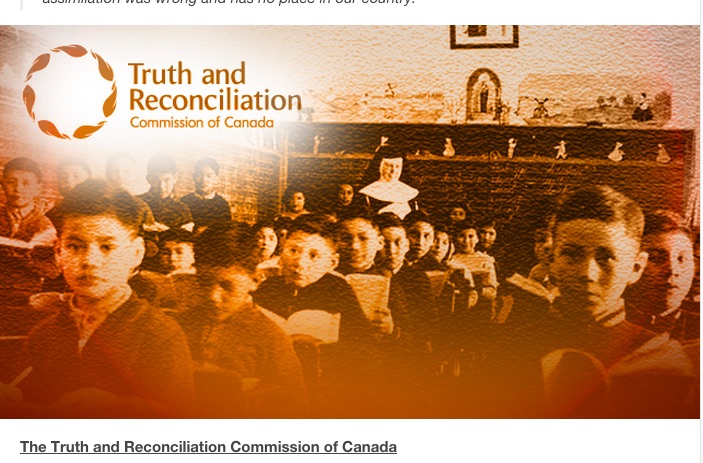
The TRC builds a case that leads it to conclude Canada committed cultural genocide against Indigenous peoples and used Indian residential schools used as its main weapon.
“These measures were part of a coherent policy to eliminate Aboriginal people as a distinct peoples and to assimilate them into the Canadian mainstream against their will,” said the TRC report. “Residential schooling quickly become a central element in the federal government’s Aboriginal policy.”
The TRC unveiled two volumes and a summary of its final report which is expected to be released later this year. One volume was titled, What We Have Learned, and the other was titled, The Survivors Speak.
The TRC was created as part of the multi-billion dollar settlement agreement between Ottawa, the churches and survivors. About 150,000 Indigenous children went through Indian residential schools throughout the systems over century-long existence.
The TRC’s report said cultural genocide is defined as the “destruction of those structures and practices that allow the group to continue as a group.”
States that engage in cultural genocide aim to destroy political and social institutions by seizing land, persecuting spiritual leaders, banning languages, outlawing cultural practices, restricting movement and disrupting families so cultural values can’t be passed on to successive generations, said the report.
“In its dealing with Aboriginal people, Canada did all these things,” said the report.
The TRC report said Canada’s negotiation of treaties with First Nations were “marked by fraud and coercion.” The report said the federal government continues to stall on the implementation of treaties to this day.
The TRC suggests the only reason Canada bothered to enter treaties was because it couldn’t afford to subdue the Indigenous population through war. In 1870, the total of Canada’s budget was about $19 million. Across the border during the same time period, the U.S. was spending $20 million just to fight its “Indian Wars,” said the report.
Early post-Confederacy Canada had one goal in mind when it began negotiating treaty, said the TRC.
“The intent of the government’s policy…was to assimilate Aboriginal people into broader Canadian society,” said the report. “At the end of this process, Aboriginal people were expected to have ceased to exist as a distinct people with their own governments, cultures and identities.”
Canada’s first prime minister, Sir John A. Macdonald told the House of Commons in 1883 that residential schools would be one of the main weapons used to eliminate the “savage” before it grew to become incorrigible.
“When the school is on the reserve the child lives with its parents, who are savages, he is surrounded by savages, and though he may learn to read and write his habits and training and mode of thought are Indian,” said Macdonald, in a passage quoted by the report. “He is simply a savage that can read and write.”
(Article continued in right column)
Question related to this article:
Truth Commissions, Do they improve human rights?
(Article continued from left column)
The policy persisted into the 20th Century and was supported by Church leaders of all denominations running residential schools, the report said.
Supreme Court Justice Beverley McLachlin echoed the TRC’s findings in a speech delivered last Thursday when she said Canada committed cultural genocide.
The Harper government, however, has stated it does not support the view.
Canada’s attempts to wipe out Indigenous culture failed, but not without leaving deep wounds, said the report.
“Despite coercive measures that the government adopted, it failed to achieve its policy goals. Although Aboriginal peoples and cultures have been badly damaged, they continue to exist,” said the report. “Aboriginal people have refused to surrender their identity.”
The TRC report said Canada is getting another chance at reconciliation. The report notes that the 1996 Royal Commission on Aboriginal Peoples called on Canada to begin a process of reconciliation. That commission was triggered by the 1990 Oka crisis that saw armed Mohawks face down the Canadian military to protect a burial site from being turned into a golf course.
“In 2015, as the Truth and Reconciliation Commission of Canada wraps up its work, the country has a rare second chance to seize a lost opportunity for reconciliation,” said the report. “The urgent need for reconciliation runs deep in Canada. Expanding public dialogue and action on reconciliation beyond residential schools will be critical in the coming years.”
The TRC report said the relationship between Canada and Indigenous peoples is “deteriorating.” The report lists First Nations education, child welfare and justice as sources of “divisive conflicts” and “barriers” to reconciliation.
Prime Minister Stephen Harper has failed to live up to the promise of the 2008 apology, the report said.
“The promise of reconciliation, which seemed so imminent back in 2008 when the prime minister, on behalf of all Canadians, apologized to survivors, has faded,” said the report.
The report said too many Canadians are still ignorant of First Nations, Inuit and Metis history and it bleeds into the government sphere.
“In the public realm, it reinforces racist attitudes and fuels civic distrust between Aboriginal peoples and other Canadians,” said the report. “Too many Canadians still do not know the history of Aboriginal peoples’ contributions to Canada, or understand that by virtues of the historical and modern Treaties negotiated by our government, we are all Treaty people.”
The TRC lays out 94 recommendations it believes help mark the path toward reconciliation. The recommendations include:
Ottawa, the provinces and territories should fully adopt the UN Declaration on the Rights of Indigenous peoples.
Ottawa, in conjunction with Indigenous peoples, should develop a new Royal Proclamation on Reconciliation.
Ottawa should repudiate the Doctrine of Discovery and the concept of terra nullius.
Ottawa and Treaty nations should renew the Treaty relationship.
Ensure Indigenous peoples are full partners in Confederation by reconciling Crown and Indigenous legal orders.
The parties to the Indian residential school settlement agreement should sign a Covenant of Reconciliation.
A National Council for Reconciliation should be created.
The Pope should issue an apology to survivors of Indian residential schools.
Canada should mark the 150th anniversary of the country by creating a fund for reconciliation commemoration projects.
Ottawa should commit $10 million for the funding the National Centre for Truth and Reconciliation over the next seven years.
The Oath of Citizenship should be changed to include the following passage, “I will faithfully observe the laws of Canada including Treaties with Indigenous peoples, and fulfill my duties as a Canadian citizen.
(Thank you to Janet Hudgins, the CPNN reporter for this article.)