. EDUCATION FOR PEACE .
An article by the Court of Justice of the State of Roraima
Teachers and administrators from the municipal school system completed a Restorative Justice training course on Friday, August 7. The program focused on implementing practices that encourage dialogue, active listening, and a culture of peace within schools.
The methodology employed by Restorative Justice aims to create spaces for dialogue, strengthen bonds, and contribute to conflict prevention and resolution. Valeska Carvalho, head of the Restorative Justice Unit—coordinated by Judge Marcelo de Oliveira of the Court of Justice of Roraima (TJRR)—explained that the goal is to prepare school professionals themselves to share the knowledge gained during the training with others.
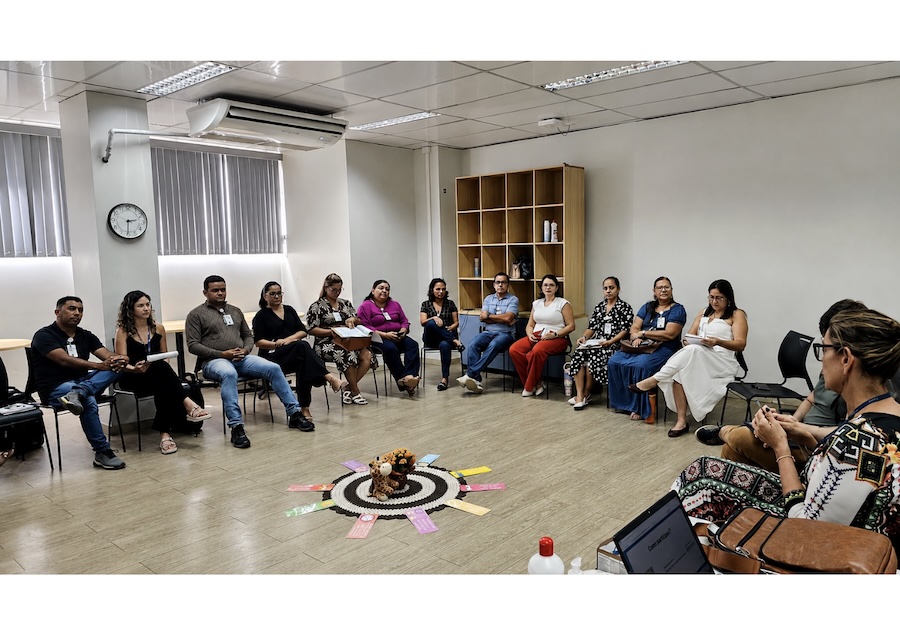
“The intention is for them to be prepared to transfer this knowledge to their own environments—their schools. It was a 40-hour course where they learned about the ‘peace-building circles’ methodology, which is the approach we use in schools. This gives schools the autonomy to manage their own projects.”
(article continued in right column)
Restorative justice, What does it look like in practice?
(article continued from left column)
For those who have participated in previous sessions, the impact of the training is directly visible in daily school life. Teacher Conceição Rebouças, from the José David Feitosa Neto Municipal School, participated in a Restorative Justice training program for the third time; she notes that the practices she has learned have contributed to the children’s development.
“We have achieved good results at the school because the children are developing a culture of peace. Whenever we bring the experiences shared here and the guidelines we’ve worked on into the classroom, we notice the school making progress and seeing significant benefits—especially for the children,” she stated. According to the educator, student participation also demonstrates their interest in the activities developed based on the techniques they learned.
“The results are visible. Parents come to praise the work we do, and the children actually ask when we’ll be back in the classroom to apply the techniques learned in the course. So, that is rewarding for us,” she said.
The training also covered topics such as assertive communication, listening, mediation, and conflict resolution. For Adélio Gomes, a teacher at the Senador Darcy Ribeiro Municipal School, the knowledge gained expands the educators’ options for handling common situations in the school environment.
“This is a very comprehensive course that teaches us how to communicate and listen correctly. Often, we listen but interrupt, without waiting for our colleague to finish speaking. We worked on assertive communication, conflict resolution, and how to act as mediators,” he explained.
Spanning 40 hours, the course took place over two weeks and introduced participants to the peace-building circles methodology.
Armed with this new knowledge, teachers and administrators return to their schools with tools they can apply in their daily routines—especially in conflict situations and in building relationships grounded in dialogue and listening.
– – – – – –
If you wish to make a comment on this article, you may write to coordinator@cpnn-world.org with the title “Comment on (name of article)” and we will put your comment on line. Because of the flood of spam, we have discontinued the direct application of comments.