. . SUSTAINABLE DEVELOPMENT . .
An article by Laura Galvis Santacruz from Debates Indígenas
Leonor Zalabata Torres is a Colombian Indigenous leader of the Arhuaco people from the Sierra Nevada de Santa Marta. She participated in the 1991 constitutional process and is currently Colombia’s permanent representative to the United Nations. She is the first Indigenous woman to hold this position and represent the country on the Security Council. Talking about conflict and peace with Leonor Zalabata means thinking outside of the usual boxes. In her opinion, peace is not a legal armistice or a pact between “parties” but a deeper condition: the stability of life.
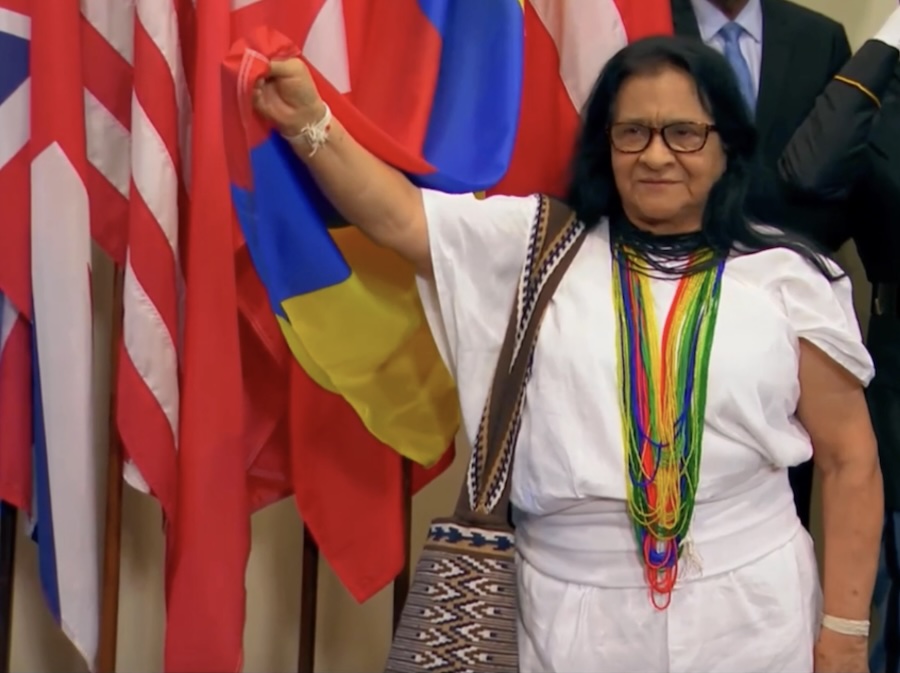
Author’s note: The interview was conducted on 06 December 2025. Weeks later, the United States implemented unilateral military actions against Venezuela. These events were subsequent to this dialogue and so the discussion does not cover them.
Laura Galvis (LG): When we talk about conflict and peace, we tend to do so from State or legal categories. What Indigenous principles do you consider fundamental to understanding the deep roots of violence against Indigenous Peoples?
Leonor Zalabata Torres (LZT): In order to talk about conflict, we need to start from the thinking and ways of life that exist in the world. Indigenous Peoples are cultures of peace. Our peaceful way of living is disrupted when external factors negatively transform our way of being in the world. Conflict has nothing to do with an alleged vulnerability of Indigenous Peoples but rather with external factors that undermine our way of thinking and living. Our way of life has developed over time and is still valid today. Indigenous Peoples have ancient traditions that are not stuck in the past; on the contrary, they are deeply contemporary to the evolution of humanity. We have learned other languages, we have been able to adapt without abandoning who we are. This capacity to adapt does not imply renouncing our principles but rather dialoguing with the world without losing our balance.
In Colombia, there are more than 60 Indigenous languages and, paradoxically, Indigenous Peoples are the most bilingual population in the country. Many of us have learned Spanish as the national language, without ceasing to speak, when it was not taken away from us, our mother tongue. This condition does not form an automatic loss of identity; it is also a form of cultural continuity. Spanish has become a vehicle through which Indigenous thought continues to be transmitted to Colombian society. Even though some languages have weakened, the spirit of Indigenous cultures continues to circulate, adapt and dialogue, without disappearing.
The problem arises when these balances are upset, sometimes even when there is no bad intent. When we intervene without knowing or understanding what a culture means, we interrupt already existing human development processes. This is when deep conflicts are generated. Territorial dispossession is one of the clearest expressions of this rupture: by separating peoples from their territories, a historical relationship with life is also broken.
Our knowledge is neither abstract nor merely symbolic. We are people with a deep knowledge of the territory, of the plants, of the climate, of the energies that sustain life. These practices have been effective for centuries, long before the Conquest, although we do not always explain them in the dominant languages. The fact that they are not understood from the outside does not mean that they do not work; it means that they answer to another rationale.
LG: How do Indigenous Peoples understand the concept of peace?
LZT: For us, peace is not something that is decreed. It has to do with the stability of life, with our customs, with the way we relate to the territory, to others and to the world. Values such as water, air and land are not individual goods; they are the common building blocks of collective life. When these values are subordinated to an idea of development that measures everything in terms of production or profitability, that balance is broken. Any recognition that does not understand peace as a deep relationship with life is therefore incomplete. It is like trying to recognize a spirit without a body: it is named but not sustained. Without territory, language and living practices, peace becomes an empty idea, disconnected from the real experience of the people.
LG: In Colombia, the armed conflict is usually referred to as a six-decade phenomenon. How does this change if we view the conflict from an Indigenous timeframe, in which the war does not begin with the armed actors but with older ruptures?
LZT: When the conflict is viewed from an Indigenous timeframe, the starting point changes radically. We are not talking about 60 years but centuries: a period in which we were not allowed to continue our own development, and were forced to defend ourselves permanently in order to exist. The Indigenous identity turned inwards. It has to do with knowledge, practices and a deep relationship with nature, the territory and the cosmos. This identity has been maintained despite the imposition of a single system of thought, the forced abandonment of our languages and customs and the denial of our knowledge systems.
Instead of allowing each culture to develop from its own thinking, a single idea of development and economic evolution was imposed. This generated a profound disruption of our ways of life and reduced us, for centuries, to permanently defending the right to be. The right to have came later, when the tangible elements began to be recognized. From an essential point of view, human development should be based on the recognition that we are different brothers and sisters. The lack of such recognition continues to fuel a conflict that is not only historical but also structural and global.
LG: Throughout your career, you have insisted that the constitutional recognition of Colombia as a multiethnic, multicultural and legally pluralistic country has opened the way for broader Indigenous participation. How do you view the impact of this recognition, both in national life and in multilateral spaces?
LZT: From our experience as Indigenous Peoples, Colombia’s constitutional recognition in 1991 was not only an internal legal change; it marked a turning point. For many years there was talk of “integration into national life” as if it implied ceasing to be what we were. With the 1991 Constitution, it was understood that the idea was not to integrate by subordinating ourselves but rather to recognize cultural diversity and legal pluralism as principles that the State must protect. This recognition also opened up an international outlook. It allowed us, the Colombian Indigenous Peoples, to relate to other peoples of the world without renouncing our own governments and ways of thinking. In this sense, the world became smaller and we began to recognize ourselves in common struggles with Indigenous Peoples from other regions.
LG: Given this experience, what role do international frameworks and mechanisms, particularly the United Nations System, now play in protecting Indigenous Peoples and in global peacebuilding?
LZT: The Permanent Forum on Indigenous Issues, the Expert Mechanism on the Rights of Indigenous Peoples, and the Special Rapporteur on the rights of Indigenous Peoples have been instrumental in expanding rights. These spaces are gaining value because they make a real contribution to peace and respect for Indigenous Peoples. They have helped to raise the visibility of and confront a deep political conflict related to territory, development and recognition of Indigenous Peoples, one which for decades was treated only as problem of internal governance. In contexts such as Colombia’s, this political conflict ended up turning into an armed conflict.
(Article continued in right column)
Question for this article
Indigenous peoples, Are they the true guardians of nature?
What is happening in Colombia, Is peace possible?
(Article continued from left column)
Human rights were long thought of almost exclusively from an individual logic. For Indigenous Peoples, this view is incomplete. Our rights are also collective and environmental because water, air, land and the stability of the territory do not belong to just one person: they sustain the life of all. International mechanisms have contributed to the fact that this vision is beginning to be recognized and discussed in global settings.
Our participation is becoming permanent, both in national and international life, because we have also understood that this constant presence is necessary. Humanity has not, however, yet fully accepted the fact that collective and environmental rights, and the practices that support them, should be understood as principles for a global peace. Indigenous Peoples have never stopped thinking about peace. A peace that is not only ours but also that of the countries and regions of the world. We are everywhere and, over time, we have sustained practices that allow us to live differently and to live together in balance. These practices do not belong only to the past: they are lessons that humanity needs to recover if it wants to build a lasting peace.
LG: Indigenous territories are currently at the centre of the energy transition, the dispute over minerals and the climate crisis. What conflicts are emerging from these global pressures?
LZT: When we talk about energy transition, climate crisis or strategic minerals today, it seems as if we are dealing with something completely new. But for me, that is not really the case. In many ways it is the same story, albeit with a different mechanism. In the past it was other resources, now it is the so-called critical minerals or clean energies. The names change, the discourse changes, but the territories at the heart of it all remain the same. And, with this, the conflicts over land, territorial boundaries and control over the spaces in which we live reappear.
Added to this is the climate crisis, which some still deny because they see it as an economic cost, but its impacts are already here. The melting of snow-capped mountains, for example, is not a theoretical discussion: it is directly affecting water sources, the cycles of nature and the lives of entire communities. Governments recognize that a crisis exists but they don’t know how to avoid it, mitigate it or really adapt to it. And, in this vacuum, decisions are once again imposed that do not stem from a care of life but from power and capital. This is where Indigenous Peoples are again exposed, even though we have historically protected these territories.
The idea still persists that Indigenous Peoples are the ones who must learn, as if other sectors of society already have all the answers. And yet the values I have been talking about: care of the air, of the water, of the river sources, do not belong to a particular culture. They sustain collective life. If taken care of, they benefit everyone. Pure air is not just for those who protect it: it circulates freely in time and space. These are practices that Indigenous Peoples have sustained over time, not in order to control nature but to maintain the balances that enable life.
I see some progress, for example, in spaces such as climate conferences, where the participation of civil society and Indigenous Peoples has been expanded and agreements and legal frameworks are discussed. This is important. But the underlying problem remains the same: an idea of development that justifies almost anything, even violence, in order to advance economically. Until this logic is questioned, these conflicts will continue to arise, even if we give them new names.
LG: In your view, peace does not seem to depend only on formal conflict resolution mechanisms but also on a deeper relationship with life. What is the place of Indigenous consciousness and cosmovision?
LZT: It is often thought that everything can be solved with mechanisms, standards or experts, and of course that is important, but it is not enough. There are practices that spread because they respond to specific interests and others that exist simply because they are a way of life. Awareness is not just about being informed and knowing the rules. It goes a little further than this. Having an identity means going beyond. In the case of the Indigenous Peoples, that beyond is in nature and in the cosmos. Human references, science, philosophy and law are important and provide clarity but they do not always manage to maintain that profound balance that the person and humanity need. These are issues that do not always fit into clear categories but which are worthy of further thought and conversation. That is why it is important that these dialogues exist.
LG: There is talk in some different spaces of a transformation of Indigenous leadership, especially with the greater visibility of women and youth. What changes are you seeing in the relationship between power, territory and participation in Indigenous Peoples?
LZT: For me, this issue cannot be understood by separating women from men or the young from the old. In our cultures, balance has always been found in complementarity. Women, men, youth, children and the elderly all fulfil different but necessary roles. It is not a division by category but a living relationship. The participation of Indigenous women has grown, it is true, and so has their political visibility. But not because we are separating ourselves from the Indigenous movement, rather because this complementarity has been strengthened. Many of us have been able to participate because we have the support of our Indigenous men and because there is a collective history of working for the defence of culture, territory and identity.
Indigenous youth play a fundamental role in this process. They have the strength, energy and capacity to energize people: they can reinforce the path or change it. Today young people study, attend universities, learn other languages and acquire other knowledge but none of this means turning their back on an Indigenous vision. On the contrary, this is an open vision that dialogues with other knowledge without renouncing its own.
That is why I say that I am not here just because I am a woman, not even because I am Indigenous. I am here because there has been a collective political development, a shared construction of thought and action. What really matters is to have an Indigenous vision, a living philosophy, not just external representation. That is one of the greatest challenges we face today.
LG: Colombia will become a member of the United Nations Security Council on 01 January 2026, and you will take up that representation. What is the significance of this moment, not only for your country but also for the Indigenous Peoples of the world?
LZT: Colombia’s election to the Security Council came not of a sudden decision nor was it the result of a single circumstance: it was a process that had been under construction for many years. The fact that this representation can today be held by an Indigenous woman has a profound political meaning, not as a personal achievement or as a symbolic gesture but as a way of making Indigenous Peoples visible in one of the most important spaces of global decision-making. It is to recognize that we have real experience of peace building, an experience that is born not only from agreements but from a way of life which, historically, has sought to resolve conflicts without destroying life.
Colombia has been a resilient country in terms of peace. Despite violence and armed conflict, it has insisted on dialogue as the way forward. Bringing this experience to the Security Council is a great responsibility but it also leaves an important legacy: that the world’s Indigenous Peoples are seen and heard, and that there is recognition that their practices and visions can contribute to global peacebuilding. That, to me, is the deeper meaning of this moment.
(Click here for a Spanish version of this article.)
– – – – – –
If you wish to make a comment on this article, you may write to coordinator@cpnn-world.org with the title “Comment on (name of article)” and we will put your comment on line. Because of the flood of spam, we have discontinued the direct application of comments.