TOLERANCE & SOLIDARITY .
An article from Federal Prosecutor’s Office in Paraíba (translation by CPNN)
An interfaith event was held at the headquarters of the Federal Public Prosecutor’s Office (MPF) in João Pessoa, on Friday (6), and brought together representatives of different religious traditions, authorities and family members of singer Preta Gil, in compliance with a condition foreseen in a non-prosecution agreement (ANPP). The process originated from statements made by Father Danilo César de Sousa Bezerra during a homily at the Parish of Areial (PB), broadcast online. For the MPF, the practice of religious racism, foreseen by Law No. 7,716/1989, was established, as it went beyond the field of theological criticism and directly affected religions of African origin, with concrete effects on their communities.
.
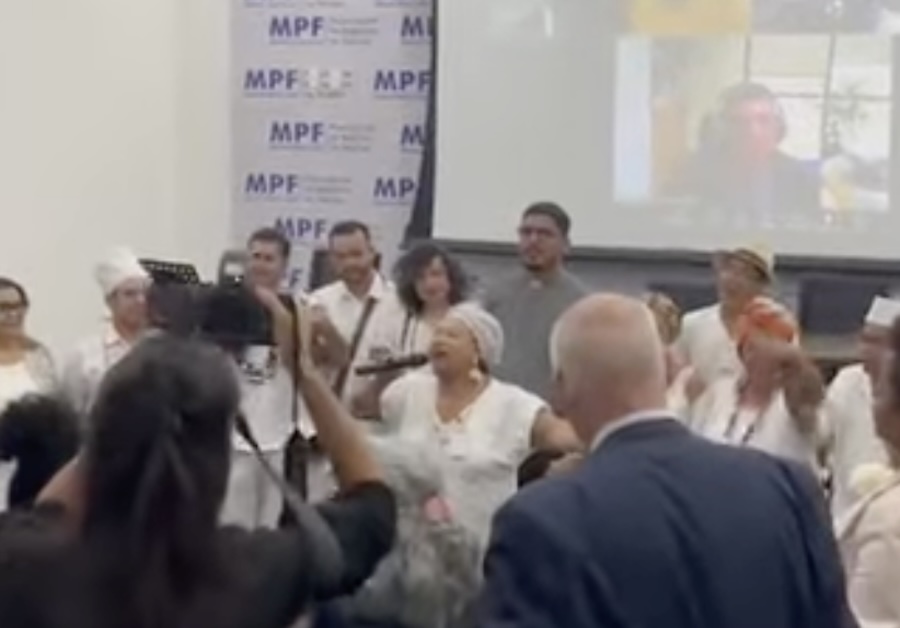
Video of the Umbanda Hymn being sung (Click on image to go to the music)
According to federal prosecutor Janaina Andrade, responsible for monitoring the agreement before the 16th Federal Court of Paraíba, the condition established in the Non-Prosecution Agreement (ANPP) for holding an interfaith ceremony was fulfilled, with the priest’s participation in the ceremony and the apology from the Catholic Church in Paraíba to the Afro-Brazilian religious communities and the family of singer Preta Gil, “further promoting reconstruction and a culture of peace.”
“In our assessment, the closing of the event, with everyone holding hands while the Umbanda Hymn was sung by Mãe Renilda, who has been committed to the religion for 54 years, effectively achieves the reparation sought in the ANPP, building a new path of peace and respect for the Afro-Brazilian faith,” the prosecutor highlighted.
“Beyond the constitutional mandate of secularism, religious freedom needs to be experienced, protected, and fostered daily by all of society,” stated Janaína Andrade. According to her, the moment of peace reconstruction established by the Catholic Church in Paraíba and religious leaders of African origin, as well as with the family of singer Preta Gil, needs to go beyond the fulfillment of a judicial obligation.
“May this interfaith event resonate throughout the country to combat religious racism, which manifests not only in hate speech and oral discourse, but also, for example, from pulpits. May this moment also foster collective reflection on respect, preventing the destruction of sacred sites and images, as recently occurred in João Pessoa,” she added. For her, this moment should also allow for respect for the sculptural works of leading religious figures, such as the sculpture of Mãe Stella de Oxóssi, which was destroyed in Salvador.
“Brazilian society needs to know the history of the enslaved people who came from Africa to Brazil, especially the lack of public policies for slaves considered freed by the Golden Law, who were pushed to peripheral areas,” added the public prosecutor. She further added that “it is necessary to understand the Brazilian cultural importance of the Afro-Brazilian religious communities and to dissociate the image of religions of African origin from evil.”
Paulo Vasconcelos Jacobina, Deputy Attorney General of the Republic, also spoke at the hearing, highlighting the importance of the Gil Family’s participation and the priest’s gesture. “Justice that truly changes things for the better. Our expectation is that this event will teach us, as a community and as a legal community, that things can be transformed into better things through dialogue, forgiveness, and understanding,” said the Deputy Attorney General.
Tolerance and harmony – In his speech during the event, singer Gilberto Gil, father of Preta Gil, who was the target of religious racism, expressed gratitude for the act of reparation. “Our thanks for the act of reparation for this aggression, this act of injustice perpetrated against us, our entire family, our friends, and relatives. I am pleased that reparation is being made, that the aggression, the injustice, is being acknowledged,” said Gil. ” To the priest, his parish, and all those involved in religious life, we also express our gratitude for the rapprochement that is being proposed, that is being made, which I hope will be absolutely sincere and profound, as it is on our part,” he added.
Finally, he declared, “May understanding, harmony, and the harmonization of our habits and ways be in tune with this civilizing gesture of comprehension, repentance, and satisfaction with the prospect of a better future in our multiple, broad relationships, all of us as individuals and as a society,” he said. “May we move forward from here with more understanding and less intolerance,” Gilberto Gil concluded.
Also present remotely, Flora Gil highlighted the importance of the meeting as a possible path forward in the face of the harmful effects of religious intolerance. She emphasized that “intolerance only hinders progress” and that, in the current context, “being tolerant is the best path in the world we live in,” wishing health, peace, and blessings to all participants.
Representing the Archdiocese of Paraíba and the National Conference of Bishops of Brazil (CNBB) – Northeast Region, Father Euclides Marinho stated that the event symbolizes a milestone in the dialogue between religions and in the recognition of shortcomings that require reparation. For him, the meeting expresses “a movement of fraternity,” demonstrating that religion can and should be “a sign to the world of good values, of unity, of fraternity, and of justice.” During the event, Father Euclides honored the family of the deceased singer by performing the song ‘Drão’, written by Gilberto Gil. He was accompanied by the guitarist Davi Franca.
According to Mãe Renilda de Oxóssi, president of the Independent Federation of Afro-Brazilian Cults of the State of Paraíba and coordinator of the Terreiro Women’s Network, the act represented a historic moment for people of African descent. With more than fifty years of religious experience, she stated that she had never witnessed a similar initiative. “I have never seen an act like this. I am seeing it today and I was very happy that someone asked forgiveness in person from people of African descent. Unprecedented,” she celebrated.
Check out the video of moments from the event and Mother Renilda’s speech about ‘forgiveness’.
(Article continued in right column)
(Click here for the original Portuguese version of this article)
Are we making progress against racism?
Latin America, has it taken the lead in the struggle for a culture of peace?
(Article continued from left column)
Reparation – The spiritual leader Rafael Barbosa assessed the meeting as an example to be followed. For him, “this was a very important moment that the Public Prosecutor’s Office is offering us, and which also serves as a reference for the entire community.”
For Pastor Estevam Fernandes, of the First Baptist Church of João Pessoa, the event fulfilled an essential educational role. He described the meeting as “a historic and symbolic afternoon,” in which it became evident that “tolerance overcomes intolerance, forgiveness overcomes difficulties, and mutual respect builds paths to peace.”
Ronaldo Sales, from the Borborema Ecumenical Center for Biblical Studies, highlighted the forward-looking nature of symbolic reparation. According to him, forgiveness and repentance should be understood as a commitment to the future. For Sales, the act inaugurates “the beginning of a process of changing mindsets regarding religions of African origin,” emphasizing the importance of public visibility of gestures of dialogue.
Along the same lines, Alexandra Andrade, from the Borborema Ecumenical Center for Biblical Studies, the Raízes e Gira project, and the Coordination of Affirmative Actions, Diversity and Human Rights (Cadidh) of the Pro-Rectorate for Community Affairs at UFCG, assessed the meeting as a necessary first step. For her, the event signals the importance of going beyond simple tolerance and advancing in education and awareness. “May today be the first step so that we can bring about this education, this awareness, and this respect, planting love among people, regardless of faith,” she stated.
Gustavo Araújo, representative of the Raízes e Gira project, emphasized that religious diversity and freedom of belief are assets of Brazilian society. For him, the act reaffirms the need to promote “increasingly religious freedom and non-discrimination,” highlighting the MPF’s initiative as fundamental in this process.
Iranilza, a Potiguara indigenous woman with a doctorate in religious studies, assessed that the meeting broadens social understanding of the country’s cultural and religious plurality. According to her, “today’s event promotes this dialogue so that all religions and cultures are respected,” especially in a secular state that still faces challenges in this area.
The ombudsman of the Public Prosecutor’s Office, Marcílio Franca, highlighted the procedural nature of building respect for religious diversity. For him, the act represents “a very important step in this journey,” emphasizing that more diverse and plural societies are better able to confront violence and promote social peace.
Also participating in the event, among others, were the chief prosecutor of the MPF unit in Paraíba, Bruno Galvão Paiva; the Federal Prosecutor José Guilherme Ferraz, coordinator of the collective guardianship area in the unit; the state secretary of the MPF, João Monteiro de Lima Netto, as well as employees and interns of the agency; representing the Presidency of the Court of Justice of Paraíba, the judge Graziela Queiroga Gadelha; the Public Prosecutor for Citizenship in João Pessoa, Fabiana Maria Lobo; Jadiele Berto, representing the State Secretariat for Women and Human Diversity; the coordinator for the Promotion of Racial Equality of the City Hall of João Pessoa, Carla Uedler; Francimar Fernandes, president of the Association for Support to Afro-descendant Settlements of Paraíba (AACADE – PB); and the professor from UFPB, Alessandra França.
The case – The interfaith act stems from an investigation based on statements made by Father Danilo during a homily held in July 2025 at the Parish of São José, in the municipality of Areial (PB), and broadcast on digital platforms. The statements constituted the crime of religious racism, as defined in article 20, § 2º-A, of Law nº 7.716/1989, because they went beyond the realm of theological criticism and directly affected religions of African origin, with concrete effects on their communities.
During the course of the investigation, the Federal Public Prosecutor’s Office (MPF) collected testimonies from religious leaders and representatives of civil society, who reported significant social impacts resulting from the statements, such as increased hostility, the distancing of worshippers from religious centers, and the worsening of situations of fear, embarrassment, and stigmatization. The accounts revealed consequences that went beyond the individual level, reaching the daily lives and symbolic security of historically vulnerable religious communities.
Given the body of evidence gathered and the legal classification of the conduct, the Federal Public Prosecutor’s Office (MPF) deemed it appropriate to enter into a Non-Prosecution Agreement (ANPP), an instrument provided for in Brazilian criminal law for situations where there is no physical violence and the minimum sentence is less than four years, provided that the agreement proves sufficient for the reprobation and prevention of the crime. The decision to propose the ANPP was also based on the understanding of the Criminal Chamber (2CCR) of the MPF, as well as doctrinal works.
Commitments made – The ratification hearing was held on January 21, 2026 (Religious Freedom Day), in the 16th Federal Court of Paraíba. The agreement established a series of obligations aimed at holding the investigated party accountable, preventing new discriminatory conduct, and repairing the damages caused, with an emphasis on measures of an educational, symbolic, and social nature.
Among the agreed-upon conditions are participation in courses on racial literacy and religious intolerance, totaling 60 hours of training, as well as the reading and writing of handwritten reviews of works dedicated to racial issues and religions of African origin. The works are: “Justice is a Black Woman,” authored by public prosecutor Lívia Sant’Anna Vaz and federal prosecutor Chiara Ramos; and “Afro-Paraíba Cults: Jurema, Umbanda and Candomblé,” by author Valdir Lima, who is also a Candomblé priest. In addition, the production of a handwritten review of the documentary “Obatalá, the Father of Creation,” which pays homage to Mother Carmen and highlights the historical and cultural importance of Candomblé for Brazil, is also included. The agreement also provides for the payment of financial compensation to the Association for the Support of Afro-descendant Communities (Aacade).
The ANPP establishes specific deadlines for fulfilling the obligations assumed and provides that, in case of unjustified non-compliance, the criminal action may be resumed, taking advantage of the formal confession given by the investigated party at the time of judicial approval of the agreement.
Case No. 0806480-46.2025.4.05.8200
– – – – – –
If you wish to make a comment on this article, you may write to coordinator@cpnn-world.org with the title “Comment on (name of article)” and we will put your comment on line. Because of the flood of spam, we have discontinued the direct application of comments.