DISARMAMENT & SECURITY .
Excerpts from an announcement by Juste Joris Tindy-Poaty
ABSTRACT
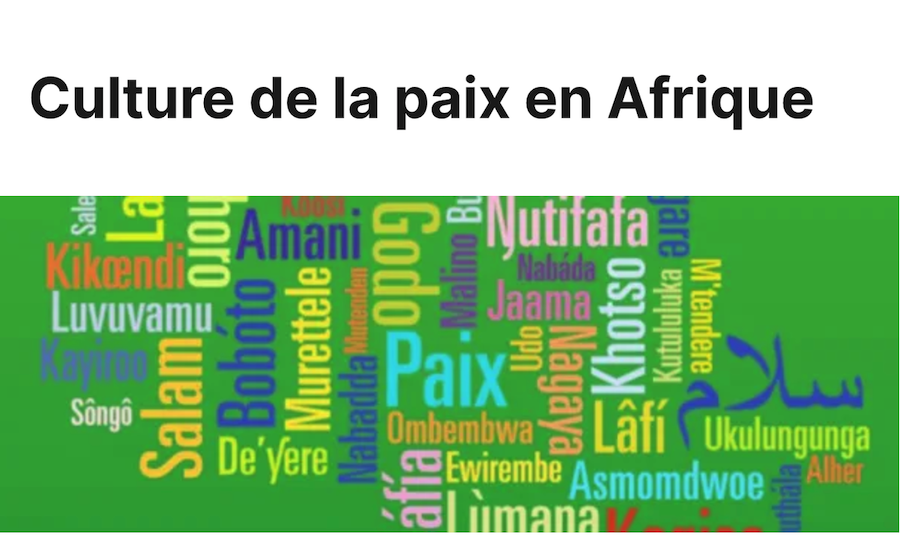
This is a call for contributions to a collective work on the theme of making a culture of peace an officla heritage in Africa. Using a multidisciplinary approach, this work aims to explore and highlight the various processes by which traditional and contemporary African societies have made and continue to make peace, and therefore the culture of peace, a heritage to be preserved and transmitted.
ANNOUNCEMENT
Report
Using a multidisciplinary approach, this collaborative book project aims to explore and highlight the various processes by which traditional and contemporary African societies have made and continue to make peace, and therefore the culture of peace, a heritage to be preserved and transmitted.
The expected contributions, including theoretical reflections, field research, case studies, and examples of best practices, will be organized into two parts: (i) Sources, foundations, and endogenous resources of the culture of peace; (ii) Impacts of external influences, hybridizations and resilience of endogenous practices, challenges, and issues of the culture of peace in contemporary African societies.
I – Sources, Foundations, and Endogenous Resources of a Culture of Peace
This first part will bring together contributions that examine and highlight not only the sources and endogenous foundations of a culture of peace, but also the resources through which African societies have, throughout the centuries, been able to embody and transmit, from generation to generation, the almost innate human disposition toward mutual aid and sociability; and also the meaning of a non-violent relationship and peaceful, symbiotic coexistence between humankind and nature.
The main themes of this first part of the book are as follows:
Theme 1: Culture of Peace: Endogenous Sources and Foundations
Inspired by UNESCO, the concept of a culture of peace is defined by the United Nations as consisting of “values, attitudes and behaviors which reflect and promote conviviality and sharing based on the principles of freedom, justice and democracy, all human rights, tolerance and solidarity, which reject violence and incline towards preventing conflicts by addressing their root causes and resolving problems through dialogue and negotiation, and which guarantee to all the full enjoyment of all rights and the means to participate fully in the development process of their society” (cf. UN General Assembly Resolution 52/13 of 15 January 1998).
How can this concept, as defined, be rooted in traditional African societies? What can be understood by “culture of peace” in the specific context of traditional African societies?
Theme 2: Culture of Peace, Oral Literary Heritage, and Social Practices/Customs/Prohibitions
African oral literary heritage is diverse and rich in tales, epics, songs, rituals, and short genres or proverbs (proverbs, maxims, sayings, etc.). All these constituent elements of African literary heritage, which fall under the art of storytelling, the “oral verbal art” (Ursula Baumgardt), are vehicles of our cultures and, at the same time, of our understanding of living together and peace. What are the elements of oral literatures and what are the practices, customs, and social prohibitions that, on a daily basis, contributed and continue to contribute, in these traditional and contemporary societies, to the prevention of antisocial behavior, the transmission of a prosocial culture, and the promotion of better living together in peace?
Theme 3: Culture of Peace and Endogenous Mechanisms for Conflict Transformation
What mechanisms were conceived and implemented in our traditional societies for conflict resolution and violence prevention, and for conflict transformation? And when violence was unavoidable, how did our traditional societies work towards restoring peace? What symbolic objects, songs, dances, or rituals were used for conflict prevention, reconciliation, and peacebuilding?
Theme 4: Culture of Peace and Traditional Ecology or Ethnoecology
Given that a culture of peace includes harmonious relationships between humans and their natural environment, what knowledge and practices, falling under the umbrella of “traditional ecology” or “ethnoecology” (P. Mouguiama-Daouda and A. Moussirou Mouyama, 2020), did our traditional societies use to preserve biodiversity and protect nature? Can this knowledge and these practices still contribute to environmental preservation and the fight against climate change today?
Theme 5: Institutions and Actors Custodians of the Endogenous Resources of a Culture of Peace
Given that peace is both an intangible and tangible heritage, what institutions and actors in our traditional societies were responsible for safeguarding, preserving, and transmitting a culture of peace? What was the place and role of women, guardians of traditions, in safeguarding, preserving and transmitting the culture of peace in traditional Africa?
II – Impacts of External Influences, Hybridization and Resilience of Endogenous Practices, Challenges and Issues of a Culture of Peace in Contemporary African Societies
Considering the impact of colonization, among other things, there are no longer any strictly traditional African societies. While contemporary African societies are heirs to traditional societies, they have been and continue to be built upon numerous exogenous contributions, such as imported religions (like Islam and Christianity). Consequently, it is clear that “current African identities are now being forged at the interface of cosmopolitanism and indigeneity.”
The themes that will constitute this second part of the book are as follows:
Theme 1: Endogenous Mechanisms and Practices of Peace Culture and Exogenous Influences
How effective and legitimate are endogenous mechanisms and practices of peace culture (such as traditional dialogue, mediation by elders, reconciliation rituals, chieftaincy systems, etc.) in pre-colonial and post-colonial contexts? What is the impact of exogenous models on these endogenous mechanisms and practices? Does this impact lead to the integration of these endogenous mechanisms and practices into formal judicial systems? How do endogenous mechanisms and practices of peace culture coexist with exogenous models? Are endogenous mechanisms and practices and exogenous models complementary, or must a choice be made between them? Are we witnessing resilient mechanisms and practices, or the creation of hybrid mechanisms and practices for conflict transformation?
Theme 2: Culture of Peace and the Challenges of Transitional Justice and Reconciliation
… Under what conditions can transitional justice be an effective and legitimate mechanism for restoring social cohesion and building lasting peace? In practical terms, how has this mechanism reconciled, and how can it reconcile, the opposition between formal and restorative justice and address the challenge of impunity? What is the role of collective memory and Truth and Reconciliation Commissions in collective healing and the prevention of future conflicts and violence?
(Article continued in right column)
Can a culture of peace be achieved in Africa through local indigenous training and participation?
(Article continued from left column)
Theme 3: Culture of Peace and the Democratic Challenge
… Conceived in its essence as a means of peaceful conflict resolution, is democracy in Africa doomed to foster a culture of violence and political instability? What solutions exist in Africa for effective and legitimate electoral mechanisms and systems? How can we initiate democratization processes in Africa that truly aim to consolidate political stability and establish a lasting culture of peace? What alternative systems to pluralist democracy exist to end the culture of violence and political instability in Africa?
Theme 4: Culture of Peace, Public Policies, and Development
… To speak of good governance as “the competence […] to effectively develop policies and ensure their implementation and the delivery of services” is undoubtedly to raise the issue of public policymaking for development. What place do the various political and institutional ecosystems give to the issue of developing and evaluating public policies? Is the creation of effective public policies a priority of national development agendas and a shared culture? Do science and its practitioners benefit, in all African states, from public recognition of their legitimacy to contribute to political decision-making? What is the role of endogenous public scientific research in public policymaking? Does each African state have a “science ecosystem for informing public policy” for sustainable development and peace? Are sustainable development and peace in African states objectives based on the prior construction of a long-term vision and the implementation of coherent and harmonized public policies?
Theme 5: Culture of Peace, Status and Role of Youth and Women
With young people representing 60% of the population in 2020, Africa was already the youngest continent in the world and will remain so until at least 2070 (AFD, 2020, p. 16). This youth demographic certainly poses challenges in terms of meeting social needs, but it is also potentially a lever for transformation and development. Women in Africa are also a potential lever for transformation and development. What is the status of young people and women, and what role do they already play in Africa in promoting and building a culture of peace (in its broadest sense: conflict and violence prevention and management, combating climate change, creating businesses and jobs, etc.)? How is Africa appropriating and implementing UN resolutions 1325 on the rights of women, peace and security, and 2250 on youth, peace and security? With regard to the rights of women and girls in particular, can we truly speak of peace and development without concrete achievements, or even significant progress, in gender equality? Where do African states stand with the implementation of SDG 5 (Achieve gender equality and empower all women and girls)?
Theme 6: Culture of Peace, Mental Health, and Individual Well-being
Before discussing peaceful relationships with other people or the natural environment, a culture of peace is first and foremost about inner peace. Being at peace with oneself means, in particular, being in good mental health, that is, being in “a state of well-being in which [one] can realize one’s own potential, cope with the normal stresses of life, work productively and fruitfully, and make a contribution to one’s community” (WHO, 2022, p. 2). With, according to the WHO, “about one in eight people worldwide [living] with a mental disorder” (2022), mental health is a global concern. Anxiety and depression, the most common mental health disorders, are the second leading cause of long-term disability. What is the state of mental health and well-being in Africa, within families (for children and parents), in schools and universities (for students), and in the workplace for all working individuals? What are the major challenges, consequences, and impacts of mental health in Africa for individuals and societies? What are the potential solutions for optimal mental well-being for individuals in the context of peaceful communities?
Theme 7: Culture of Peace, Education, Culture, Sport, and Media
If “peace is learned” (T. D’Ansembourg and D. Van Reybrouck, 2016), what role do the educational systems of contemporary African societies play in education for a culture of peace, considering both endogenous traditions and external influences? How is, or can, a culture of peace be taught or transmitted to younger generations, in formal and/or informal settings? Are there educational programs or community initiatives in this area? How can culture, sport and the media be involved in this requirement for education in a culture of peace in Africa?
Submission Guidelines
Proposals for contributions in French should be sent to the following addresses: jjtindypoaty@yahoo.fr; jrdoutsona@yahoo.fr; bbdndombi@gmail.com; celestineboupo2@yahoo.fr; nzamickaledamien@gmail.com before March 31, 2026.
Submitted as an abstract (in French and English) not exceeding 300 words with a maximum of 5 keywords, proposals will be reviewed by the Coordination and Editorial Committee, and responses will be sent to contributors according to the schedule below.
The final texts of the contributions will be reviewed by the Scientific and Reading Committee.
The proposal must indicate the relevant section and theme.
Contribution Submission Guidelines
Each contribution must adhere to the structure of a scientific article and be written in 12-point font, 1.5 line spacing (Times New Roman) for the main text and 10-point font (Times New Roman) for footnotes. The complete text of the contribution must not exceed 20 pages (including the bibliography).
Section headings should be numbered as follows:
1. First level, first title (Times 12 bold)
1.1. Second level (Times 12 bold italic)
1.2.1. Third level (Times 11 bold italic)
Below the title of the contribution, please include the author’s full name(s), affiliation(s), city, country, and email address.
References should be formatted according to APA style.
Each contribution must be accompanied by a bio-bibliography of no more than 200 words.
Call for contributions launched: November 10, 2025
Deadline for submitting the abstract of the proposed contribution: March 31, 2026
Deadline for notification of acceptance of the proposed contribution: May 31, 2026
Deadline for submitting the final text of the contribution: July 31, 2026
Publication date: December 2026
Coordination and Editorial Committee
General Coordinator: Dr. Juste Joris TINDY-POATY (Assistant Professor of Philosophy, École Normale Supérieure/Gabon; email address: jjtindypoaty@yahoo.fr; tel.: +241 74 24 44 80)
(Editor’s Note: For members of the Coordination Committee and the Scientific and Reading Committee, and for the bibliography, please consult the original here.)
– – – – – –
If you wish to make a comment on this article, you may write to coordinator@cpnn-world.org with the title “Comment on (name of article)” and we will put your comment on line. Because of the flood of spam, we have discontinued the direct application of comments.