Category Archives: East Asia

First UN conference on tourism and culture opens in Cambodia, seeks to build partnerships

. SUSTAINABLE DEVELOPMENT .

an article by United Nations News Centre

Aimed at bringing together Ministers of Tourism and Ministers of Culture to identify key opportunities and challenges for stronger cooperation between the fields, two United Nations agencies launched the First World Conference on Tourism and Culture today [4 February] in the shadow of the legendary Angkor Wat temple, in Siem Reap, Cambodia.

cambodia
click on photo to enlarge

Statues on the Angkor Wat temple in Siem Reap Cambodia. Photo: UNESCO

The Conference, run by the UN World Tourism Organisation (UNWTO) and the UN Educational, Scientific and Cultural Organization (UNESCO) aims to address the overlap between culture and tourism, tackling the question of how to harness the power of tourism and culture to alleviate poverty, create jobs, protect natural and cultural heritage and promote international understanding.

“Today, cultural tourism – the world’s mosaic of art forms, heritage sites, festivals, traditions, and pilgrimages – is growing at an unprecedented rate,” said Taleb Rifai, UNWTO Secretary-General. “Humanity’s curiosity about cultural heritage is the element that truly differentiates one destination from another.”

Mr. Rifai described the growth of international tourism since the 1950s and the socio-economic contribution made by tourism, accounting for one out of every 11 jobs worldwide, as well as contributing nine per cent to global gross domestic product (GDP) and 30 per cent contribution to total global exports.

Irina Bokova, UNESCO Director-General, joined Mr. Rifai in looking forward to building a new, sustainable partnership that unites tourism and culture and said her goal was to create a positive mutually reinforcing dynamic between the two, working to build sustainability and to benefit local communities.

“Our starting point is to safeguard culture under all its forms, from monuments to living heritage, encompassing traditions, festivals and the performing arts,” said Ms. Bokova. We do so, because culture is who we are. It shapes our identity and is a means to foster respect and tolerance among people.”

She underlined the need to safeguard cultural heritage while moving ahead with sustainable tourism and said she believed that was the Conference’s core message, citing that vision as the route to promoting culture as a driver and enabler of sustainable development.

Cambodia’s Minister of Tourism, Thong Khon, also welcomed delegates, looking forward to the event’s contribution to sustainable conservation and development of tourism and culture.

[Thank you to the Good News Agency for bringing this article to our attention.]

Question related to this article:

How can tourism promote a culture of peace?

Comment by Liliana Mota, October 23, 2013

Why tourism?

Can tourism be seen as an instrument to achieve complicity between people’s minds?

“There is nothing better that connects two people’s mind than a good conversation” The above quote could be used to describe the effect which tourism has on people. Like a great conversation, tourism could be said to play a vital role amongst people all over the world. It fosters communication in all its senses, intercultural dialogue and mutual understanding.

In today’s world it is evident that there is a shortage of moral or ethical values amongst people across the different nations in this world, resulting in a globalised world lacking these morals and ethical values. Ignorance, the failure to consider the needs of others, and selfishness are a few of the ways which hinder us from embracing diversity and a common human perspective, which would result informal empathy, internal moral compassion, tolerance of differences, historical consciousness and interpretation. The above mentioned features are intrinsic, inherent and can be found in the practice of tourism.

Tourism has been emphasized as one of the most effective instruments which continue to tackle to tackle social and economical poverty, as well as encourage the culture of peace practice amongst people. In looking at the UN architecture, one is able to see the growing implications which the tourism sector has on the world and world policies. The touristic phenomenon has achieved a world record of 5% of world’s GDP contribution and is responsible for 235 millions jobs, according to the UNWTO’s data. Often the tourism sector counts more than 20% of the countries’ GDP.

On the negative side of this, it is evident that tourism focuses on economical matters, depriving any focus on the global implications of the constant interaction tourism encourages.

In the literal sense, tourism is nothing more or less than people meeting with the willingness to understand each other’s differences and point of view and simultaneously creating the opportunity for dialogue, mutual understanding and peace to take place.

Apart from tourism, various factors could be seen to play a role in encouraging integration and diversity amongst societies across the world. For example, the cultural segment has played an essential source of people’s integration and inclusiveness in developing countries.

Education has also played a significant role in encouraging integration, and incorporation amongst people all over the world. Education has been reconsidered and proposed to being the catalyst for exchange between countries, cultures and sectors, and most importantly for enhancing the lives of people by granting them the opportunity to leave their poverty stricken lives and societies in exchange a for better future which includes job and exchange opportunities.

In the tourism world, differences play the most essential role, differences among people represents the added-value. Being different is always a positive factor that usually motivates and encourages people to get to move and engage with each other and embrace the differences with the use of spiritual, religious and cultural meanings.

This notion of tourism needs to be addressed in multilateral governance discussions, where all the main actors, the international community, the ministerial and experts, private sector, local institutions and civil society engages are all present, and are all willing to work together in combined efforts and initiatives (from poverty alleviation to the promotion of awareness of sustainable development addressing special needs like regional development, urban planning and protection of natural and cultural landscapes). This combined approach of working at the local level within communities and at the national and international level, in order to reach and engage the poor, has been considered as potentially being the “one possible and effective answer” and effective approach towards the world’s poorest areas where it can make a difference.

Hibakusha of Japan nominated for Nobel Peace Prize

DISARMAMENT & SECURITY .

an article by Colin Archer Secretary‐General, International Peace Bureau (IPB)

To the Norwegian Nobel Committee.

I am pleased to convey to you the IPB’s nomination for the Nobel Peace Prize 2015. A total ban and the elimination of nuclear weapons was the task set out by the very first resolution of the first General Assembly of the United Nations (January 1946), a task that remains unfulfilled. Yet, as seen in the success of the international conferences on the humanitarian impact of nuclear weapons, held in Oslo in 2013 and in Nayarit and Vienna in 2014, momentum is building up once more, and promises to turn this 70th anniversary of the tragedies of Hiroshima and Nagasaki into a milestone on the path to a world free of nuclear weapons.


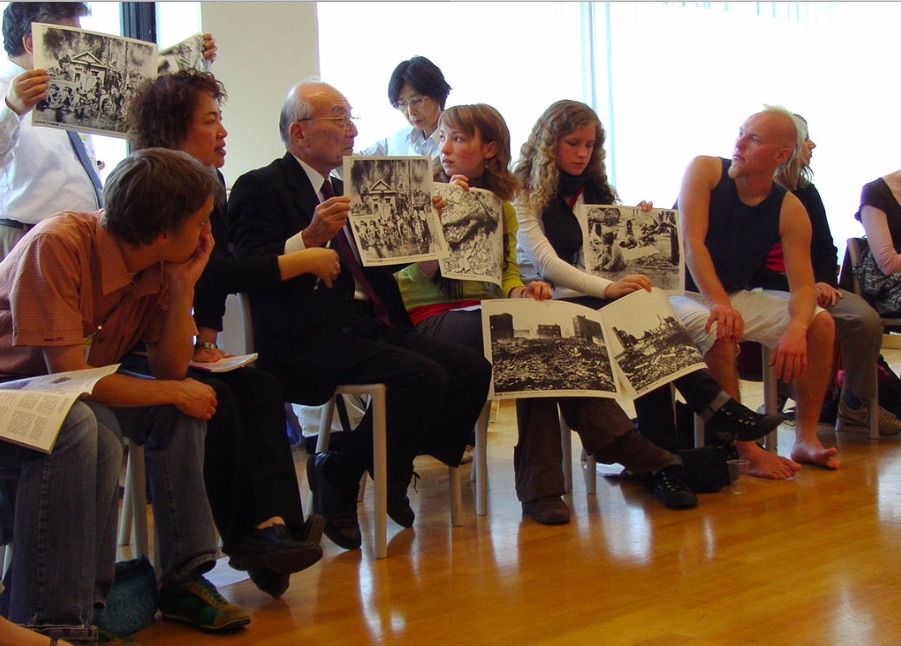
A hibakusha, a survivor of the atomic bombing of Nagasaki, tells young people about his experience and shows pictures. United Nations building in Vienna, during the NPT PrepCom 2007. Photo from Wikimedia Commons

For this reason IPB once again nominates for the Nobel Peace Prize the Hibakusha, those who personally suffered from the atomic bombings of the two cities. They are quite simply extraordinary human beings; not giving in to despair, they became convinced, through their struggle to survive the attacks and the subsequent long years of suffering, that their agonies must never be repeated anywhere. Over these 70 years they have made the choice of activism, unceasingly recounting their experiences and struggles, and working constantly for a total ban and the elimination of nuclear weapons, appealing to governments and peoples all over the world.

We nominate :

1) the Japan Confederation of A­- and H-­Bomb Sufferers Organizations (Nihon Hidankyo), a nationwide independent organization of the Hibakusha. Since its founding in August 1956, it has been working in unity, beyond the difference of beliefs and opinions, encouraging its members to help each other to promote the cause of a ban on atomic and hydrogen bombs, by making known their sufferings and struggles. Their activities are fully worthy of the name, “champion of peace”, in the light of the ideal of disarmament, for which Alfred Nobel established the Nobel Peace Prize.

2) (2) Mr. Sumiteru TANIGUCHI and (3) Ms. Setsuko THURLOW, outstanding representatives of the Hibakusha movement, who have been at the forefront of the efforts of the Hibakusha throughout their lives, calling for a ban and for the abolition of nuclear weapons, based on their own painful experiences.

Background details on all 3 nominees can be found at Annexes 1‐3, below.

IPB believes that the award of the Nobel Peace Prize to these courageous persons, and indeed to a courageous movement, would be a contribution of unique value and extraordinary importance to the worldwide community of nuclear disarmament advocates, itself 70 years old this year.

The continued existence of nuclear weapons threatens the very survival of life on earth. The Norwegian Nobel Committee has recognised this supreme threat in several of its previous awards. We urge the Committee, at this historic moment, to return to this theme and to itself make a courageous choice: to recognise and reward the Hibakusha.

(This article is continued in the discussion board on the upper right of this page)

(The following is continued from the article on the left.)


ANNEX 1: The Japan Confederation of A­ and H­Bomb Sufferers Organizations (Nihon Hidankyo) Address

Gable Bldg. #902 1‐3‐5 Shiba‐Daimon Minato‐ku Tokyo 105‐0012 Japan Phone: +81‐3‐3438‐1897
Fax: +81‐3‐3431‐2113
Email: kj3t‐tnk@asahi‐net.or.jp http://www.ne.jp/asahi/hidankyo/nihon/
Co­chairpersons
Sunao TSUBOI (Mr.) Sumiteru TANIGUCHI (Mr.) Prof. Mikiso IWASA (Mr.)
Secretary General:
Prof. Terumi TANAKA (Mr.)
Founding
August 10, 1956
Organization and Membership
NIHON HIDANKYO is the only nationwide organization of A‐bomb survivors of Hiroshima and Nagasaki (Hibakusha). It has member organizations in all 47 Japanese prefectures, thus representing almost all organized Hibakusha. Its officials and members are all Hibakusha. The total number of the surviving Hibakusha living in Japan is about 190,000, as of the end of 2014. Also there are Hibakusha living in Korea and other parts of the world outside Japan. HIDANKYO is cooperating with them in their effort to defend their living conditions and human rights.
Main Objectives
1) Prevention of nuclear war and the elimination of nuclear weapons, by way of an international agreement for a total ban and the elimination of nuclear weapons.
2) State compensation for the A‐bomb damages. The state responsibility of having launched the war, which led to the damage by the atomic bombing, should be acknowledged, and the state compensation provided.
3) Improvement of the policies and measures on the protection and assistance for the Hibakusha.
Major Activities
1) Telling stories of the Hibakusha to make known their experiences, actual damage and after‐effects of the A‐bombings both within and outside Japan; Sending A‐bomb sufferers to the U.N. and other international fora, nuclear‐weapon states and other countries;
2) Actions for the enactment of a Hibakusha‐aid law providing state compensation for the Hibakusha themselves and bereaved families; Running signature drives, marches, sit‐ins and other forms of action.
3) Providing counseling and other assistance to the Hibakusha in their difficulties on health and living.

Major Actions since the Founding
HIDANKYO has held dozens of petition actions every year to urge both the Japanese government and the Diet to take steps to make known to the world community the full dimension of the damage caused by the A‐bombings and take the lead in promoting public opinion for the prevention of nuclear war and the elimination of nuclear weapons. HIDANKYO also urges the Japanese government to admit Japan’s responsibility for having launched the war, which eventually led to the atomic bombing, and that it should provide state compensation for the bereaved families, as well as the sufferers on whom health damage was inflicted.
The “Hibakusha Aid Law” demanded by HIDANKYO, therefore, is to include a pledge that Japan would make every effort so that there would never be another Hibakusha anywhere.
HIDANKYO is playing a major role in the movement against A and H bombs. Not only taking part in a number of peace events during summer, HIDANKYO sends its representatives all over Japan, who bear witness to their A‐bomb experiences, helping to promote the public awareness on the need for a ban and the elimination of nuclear weapons. Internationally, HIDANKYO sends many Hibakusha overseas, to make heard their appeals for the prevention of nuclear war and the abolition of nuclear arms.
Hibakusha, sent by HIDANKYO, have made contributions to many important international forums, including two UN Special Sessions on Disarmament in 1982 and 1988, the NPT Review Conferences in 2005 and 2010 and its Preparatory Committee sessions, and the three International Conferences on Humanitarian Impact of Nuclear Weapons in March 2013 in Oslo, February 2014 in Nayarit, and December 2014 in Vienna.