All posts by CPNN Coordinator
big Niger photo
big Internet photo

African Media Initiative and URI–Africa Join Forces to Fight Hate Speech
FREE FLOW OF INFORMATION
an article by the United Religions Initiative
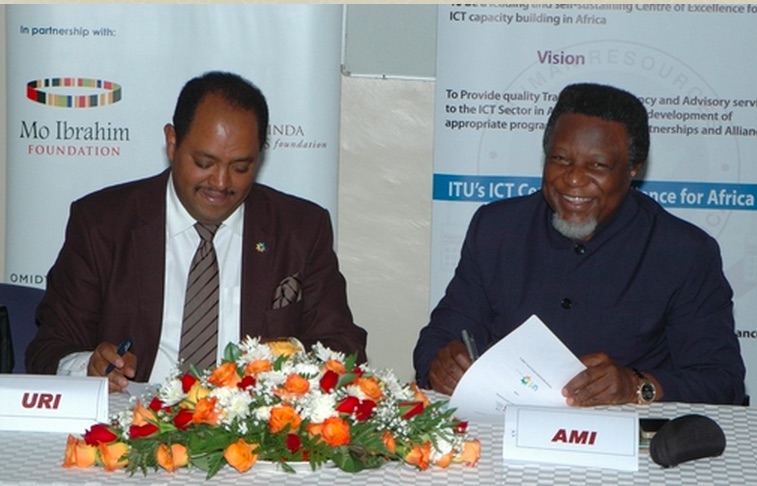
The African Media Initiative (AMI) and United Religions Initiative – Africa (URI) have signed a Memorandum of Understanding to counter violent extremism, radicalization and terrorism in Africa and to combat hatred, prejudice, intolerance and stereotyping on the basis of religion and culture. The agreement [signed in Nairobi, Kenya, February 13] will strengthen the media sector in Africa to ensure and enhance the working partnership on the continent between media, religious leaders and faith-based organizations to promote a culture of peace, inter-religious and intercultural constructive dialogue and harmony.
Click on the photo to enlarge
Ambassador Hailu Mussie Continental Director for URI-Africa with AMI CEO Eric Chinje
The partnership calls for:
The establishment of Departments of Peace in each African country
The establishment of the African Editors-in-Chief Forum to promote a culture of peace
Promotion of peace education in Africa as part of the school curriculum
Promotion of the African Union Interfaith Dialogue Forum
Promotion of the teaching of the Golden Rule “Treat others the way you want to be treated”
To campaign against hate speech in Africa
To engage leaders, journalists, bloggers, writers, poets, cartoonists and citizens in Africa and across the globe, with the aim of bringing the media and the public’s attention to the devastating effects of hate speech
“It is indeed a great pleasure for URI – Africa to join hands with AMI to promote ethical, tolerant and inclusive journalism, good media governance and responsible communications free from hate speech,” says Ambassador Mussie Hailu, Continental Director of URI Africa and Representative at the UN in Nairobi, ECA, UNEP and African Union. “The working partnership established will help combat hatred, prejudice, intolerance and stereotyping on the basis of religion, ethnicity or culture which represents a significant challenge to peaceful co-existence in Africa. We need to promote the teaching of the Golden Rule: “treat others the way you want to be treated” more than ever as it is a practical action and a road map to prevent hate speech and promote human dignity and a culture of peaceful co-existence among people of different religions, cultures and ethnicities,” he adds.
On the occasion of the signing ceremony, Amb. Hailu also appealed to journalists not to cover hateful speech coming from politicians or community and religious leaders and called for media leaders and operators in Africa to lend their full support to efforts to turn the tide against the rise of hate speech on the continent.
“I couldn’t think of a better partner than the inter-religious organization represented by URI-Africa to address the radicalization, violent extremism, and conflict issues we currently face on this continent,” says AMI CEO Eric Chinje. “We want to deepen the reporters’ understanding of hate speech and of the issues of peace and conflict, religious violence and the fight that’s occurring in places like Nigeria and Cameroun, with Boko Haram, or Kenya with Al Shabbab.”
The two organizations have begun work already by partnering to organize the World Interfaith Harmony Week celebration held at the Desmond Tutu Centre in Nairobi last weekend under the theme “Beyond Our Differences.” The event gathered a host of youth as well as religious leaders and practitioners from a number of religious organizations and spiritual traditions to discuss the challenges of religious intolerance, ethnic conflict and terrorism in Africa and how media covers those topics.
Question related to this article:
African journalism and the culture of peace, A model for the rest of the world?
This discussion question applies to the following articles:
Second High Level Media Workshop on the African Peace and Security
Pour une ‘culture de paix’ dans la presse du Cap-Haïtien
Culture de la paix : les journalistes à l’école de l’Idem
Culture of Peace: IDEM workshop for journalists in Mali
Somalia: Somali radio on peace mission
Mali: L’émission «Anka Ben ! – Faisons la paix !» sur Radio Kledu
Mali: The Radio Kledu broadcasts, “Anka Ben ! – Let's make peace !”
Gao, Mali : Les jeunes à l’école de la culture de la paix
Gao, Mali : Youth at school for a culture of peace
Africa: Faire des médias des voies pour la promotion de la culture de la paix
Africa: Creating media channels to promote the culture of peace
African Media Initiative and URI–Africa Join Forces to Fight Hate Speech
big Beirut photo
Discussion: How can there be a political solution to the war in Syria?
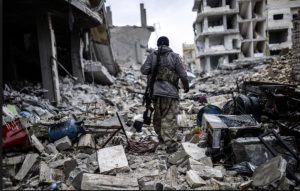
This question applies to the following articles in CPNN:
The international Society Culture of Peace: Solidarity concerts in Athens and Mytilini / Lesbos
Call for a National Debate on U.S. “Regime Change” Policy
IWPR’s Syria Coordinator Wins Landmark Freedom of Speech Prize
International Peace Delegation to Syria 24-30 Nov. 2015
UK: Is dropping more bombs on Syria way to solve refugee crisis?
10 More Ways Syrian Women Are Building Peace and Democracy
Syria: Vienna Conference Final Statement
* * * * * * * * *
In the following article, Wilhelm Langthaler, a Co-convener of PeaceinSyria.org comments on the spirit emerging from the “All Sides Consultation for Political Solution” in Vienna.
Now that the “All sides Consultation for a Political Solution in Syria” is accomplished and is being recognized by all the participants as a success that deserves continuation, the time has come to draw a balance not only of the conference itself, but also of its wider significance. The very fact that around two dozen people from the most diverse and conflicting backgrounds of Syrian society came together and consulted how to overcome the civil war tearing apart the country is extraordinary. But the spirit emerging from the debates reaches far beyond the objective of this single event, giving hope that a movement for a political solution is gaining momentum.
Exchange among the people – not power-brokering
First of all, let us recall the aim of the “All Sides Consultation for a Political Solution” which took place in the “Peace Castle Schlaining” close to Vienna, Austria, from 7-10 March, 2014. The idea was to give a voice to Syrian society in its full diversity, voices emerging from the people who have been silenced and excluded by the powerful. It was not intended to hold negotiations between the conflicting sides and their global and regional sponsors as has failed in Geneva. A consultative forum of personalities not directly representing the sides involved but indeed representing the societal richness was called upon to explore ways to stop the catastrophic bloodshed.
Thus we were not in search of sophisticated and well-balanced formulae of compromise pleasing the foreign powers involved (something which might, however, be necessary to reach in other places), but to give answers concerning how the full rights of the people might be guaranteed. The quest for these rights is what is thought to have sparked the conflict and is at the same time key to ending what has turned into a fratricidal war pitting the components of society against the other, a conflict additionally fuelled by massive international involvement. As Naser al Ghazali, one of the Syrian members of the preparatory committee hailing from Daraa, put it in his introduction: “Democratic rights are not negotiable. It is like pregnancy – you cannot be half pregnant as we will not accept less than full rights.”
The meeting was all about understanding the grievances of the diverse social, political, cultural and confessional components and to develop the mutual trust necessary to reach a ceasefire and to maintain it. . “We are contemplating elements of a new social contract,” as Serbest Nabi, a Kurdish professor of philosophy teaching in Erbil and Mardin, commented.
Tokens of mutual acceptance
“Once when I had to relocate, I donated my library for the use of the community by giving it to the local mosque. So together with my pious friend I checked the books one by one to see whether they were suited or not.” This allegory was recounted to the consultation by the Syrian filmmaker Nidal al Dibs from Sweida, reminding us of a contemporary version of Lessing’s ring parable which happens to be a symbol of European enlightenment.
This cautious but all the more powerful message was understood and adopted by all sides and can exemplify the spirit of the event. Though different, the secular and Islamic camps come together to explore their congruencies. The secularist takes the exigencies of the pious Muslim into account even if he might disagree. The pious friend, who may well have also been a partisan of political Islam, for his part accepts that there are acknowledged positions, milieus and cultures that do not belong to realm of the mosque.
This constitutive principle for the consultation was already recognised implicitly by the very composition of the participants. There were people siding with the government or regarding it as the minor evil, there were what can be called soft and hard opposition inside the country, there were Islamic personalities and Islamists, including the Muslim Brotherhood, there were personalities close to the Coalition, there were Kurds from the different currents. Some came from government-held areas, some from regions under the control of the rebels, some from the Kurdish-dominated north and others from abroad. There were men and women, old and young, affiliated with all the confessional groups, as well as die-hard secularists, comprising the full mosaic of Syria. People pursuing different professions were present: from university professors to grassroots relief workers, from doctors and students to writers and politicians; many of whom are former political prisoners, some even having served decades behind bars.
The necessity to accept and tolerate the diversity of Syrian society was recognised explicitly by everybody – a decisive precondition to end the civil war.
On minorities, majorities and the problems with these concepts
Some from the smaller confessional groups openly addressed their fear of radical Islamism and insisted that their rights as minorities must be guaranteed, such as Otared Haidar, a scholar teaching in Oxford with roots in Salamieh.
Monzer Halloum, an activist professor from Latakia, warned, however, of the dangers of the very concept of minorities which from a certain point on might even further fortify sectarian devisions. He said, “Violence and sectarianism are not an option for us as a democratic movement,” arguing that they came by an escalation driven by the regime and some rebel groups. “We should beware of associating violence with sectarian groups as a whole and thus make false generalisations.” Also Nawal al Yaziji, a women’s activist from Damascus, as well as Tareq Aziziye, a scholar from Homs, insisted on rights associated with the concept of citizenship and not with confessional group affiliations.
Samir Abulaban, a member of the Political Bureau of the Muslim Brotherhood, endorsed the rights of minorities referring to the Damascus Declaration of 2005, and signalled a readiness for the necessary dialogue. He even conceded that mistakes have been committed.
Originating from Homs, a highly mixed city, Samir Abulaban presented his own version of the parable of tolerance to the meeting: When the former Syrian prime minister Fares al Khoury, who happened to come from a Christian family, once appeared in public without a hat – at that time an appalling breach of customs – the Grand Mufti chose to put his own hat on the prime minister accepting to be the one seen without a headpiece.
The spin of the metaphor is somewhat changing fitting to his reciprocal question whether these minorities would in turn abide by the will of the majority. At this stage the discussion could not be continued and there is obviously a need to carry on and deepen these arguments.
Stop the violence by driving a democratic transition
The strong and overarching agreement was on the urgent need to stop the violence. Nidal al Debs even went so far to say there are now only two parties in Syria: “Either against the war or with the war.” Fateh Jamous, a long-term political prisoner from Latakia hailing from the Communist Action Party, and now one of the leaders of the Coalition for Peaceful Change, said that the party for peace was growing. But how to achieve peace once a general cultural mutual acceptance is reached? How to politically pave the way to a lasting ceasefire?
There was implicit consensus that meeting the original democratic demands of releasing political prisoners and now also hostages (from both sides), freedom for political articulation and organisation, and allowing humanitarian relief to be granted will facilitate stopping the violence – something that could be called democratic transition.
Abdulmanem Harah, a relief worker from rebel-held Aleppo, said that the constituencies of the insurgency would be ready to raise the white flag if the other side did so as well. “But it is up to the surgeon to end his operation.”
Aziziye called upon moderate Political Islam to make a strong statement against terrorism – a problematic term as it is being employed mutually by both sides, while also bearing in mind the misuse spearheaded by Washington. Ayman Kahef, the editor-in-chief of the influential business news website syriandays.com coming from Hama, put it more boldly: “How can we grant Isis and Nusra a ceasefire? How can you stop them from continuing?”
At this point Vangelis Pissias, a Greek professor and organiser of the Gaza flotilla, intervened on behalf of the Initiative. The general aim of the organisers was not to condition the Syrians beyond the general principles – yes to democracy, no to foreign intervention – but to provide a framework for Syrians to freely discuss among themselves, which does not, however, exclude dialogue and exchange with the international solidarity movement – another important aim of the event. “We believe that the forces ready for a political solution on both sides must be encouraged and strengthened” thus gradually isolating the hardliners. In this way a socio-political bloc can be constructed that is eventually capable of engineering a ceasefire, and to secure that it is holding by depriving the violent sectarian forces on both sides of their popular support base. The more that the underlying democratic demands can be achieved the better this political project can come into swing.
Refugee drama
As the number of Syrians abandoning their homes is rapidly approaching 10m or close to the half of the population and starvation is spreading, the humanitarian supply becomes pivotal. Many criticised the handling of even misuse of the refugee problem by both sides for their respective political ends – including their foreign donors.
Arif Dalila, the former Dean of the Faculty of Economics at Damascus University, commented that opening borders for Syrian taking refuge abroad would be no solution either as it drained the country of its human resources. Monzer Halloum insisted that the remaining safe areas inside the country must be preserved and extended. “Many people from Aleppo and Damascus flew to the coastal areas regardless of their confessional background”, Nawal al Yaziji highlighted, delivering evidence that there are also countertendencies against sectarianism.
The emerging idea was that the struggle to meet the immediate needs of the refugees must be turned into a lever for a ceasefire and a political solution, really allowing relief to reach the people.
National convention for peace
All of the participants expressed their strong conviction that this positive experience should be repeated on a much larger stage, best in Damascus. This was the proposal of many, including Habib Issa, a leader of the internal opposition recognised across very diverse milieus, who addressed the consultation by a letter as he was not allowed to leave the country. In fact, around half of the invitees who had already accepted could not participate either because they were denied exit, did not receive clearance or did not dare to come.
Arif Dalila, the longest serving political prisoner of the Damascene spring, also called for a national peace conference with the participation of all sides. Such a meeting preferably should take place inside the country but this requires strong guarantees from the government, Dalila said. “Civil society bears a great responsibility but as of now has no power as it has been silenced.” He mentioned Abdelaziz al Khayyer, a peaceful opposition leader, who was kidnapped in 2012 when he wanted to participate in a reconciliation conference, which happened to become the very last public meeting of the internal opposition. Dalila urged the international solidarity movement, the civil society and also the UN to provide an umbrella to these efforts – contrary to the global and regional powers, which were considered by the participants as an integral part of the problem.
Unresolved issues
While the closed deliberations were marked by the described spirit of mutual understanding, differences came to the forefront when it came to going public over the following issues:
To which extent granting rights to the Kurdish people while preserving the unity of Syria? A far-reaching autonomy and decentralisation as put forward by Xaled Issa, the European spokesman of the Kurdish Democratic Union Party (PYD), remained controversial.
Is it possible to secure equal rights to women and civil rights in general while not contradicting Sharia as Mohamad Alsayed, a Sheikh from rebel-held Aleppo demanded? What can be the meaning of a state that is “neither secular nor Islamic”?
As conveners of the consultation, we deliberately intended to position the consultation as complementary to negotiations or any other meeting involving top representatives. Therefore any result in terms of organisation should not put the legitimacy of either side into question – obviously a sensible matter.
While as organisers we are convinced that the political solution is the only viable one with regard to the interest of the vast majority of the Syrian people, the consensual formula emerging was “a political solution is the best solution”. We have to acknowledge that the warring sides both justify their military action (which in the end is only logical). The positive step is that they are seriously considering a political solution and are testing the ground for the conditions of a ceasefire. Most of the participants, however, regarded it as their duty to pressurise all sides, including the involved foreign powers, to accept and work for a political solution.
Similar holds for foreign interference, sanctions and intervention: Everybody claims to defend the sovereignty of the Syrian people and to keep foreign interests out. But while the third-partyists define this as an immediate and primordial demand and a pre-condition for a solution, the ones closer to the conflicting sides conceive that expelling foreign forces is only a possibility upon a ceasefire.
Network for peace
Everybody agreed to continue the efforts for a political solution by involving the whole spectrum of diversity on the level of civil society. It is, however, obvious that at a certain stage a solution can only become possible with direct representatives present. This step cannot be excluded, but must also be undertaken cautiously and gradually and might eventually shift to another, more appropriate forum.
One immediate result is that the participants, together with the Initiative, will constitute a network open to everybody supporting a political solution, whether Syrian or not. Furthermore a committee should be set up charged with preparing the next meeting.
The House of Peace (Beit al Salam), which is at the same time an abstract political concept as well as a concrete physical space, would be the most appropriate venue for a national convention for peace, as referred to above. The Beit al Salam is conceived of as a place inside the country, preferably in Damascus, where a ceasefire is already in place, where free political expression is allowed, and where security for all components of civil society is guaranteed.
The global peace movement is called upon to serve as a political umbrella for this process of building a political democratic solution alongside the United Nations.
Pax Christi International Peace Award 2015: Women Collective for Reflection and Action (Colombia)
FREE FLOW OF INFORMATION
an article by Pax Christi
The 2015 Pax Christi International Peace Award has been granted to the Women, Peace and Security Collective for Reflection and Action (Colectivo de Pensamiento y Acción Mujeres, Paz y Seguridad) in Colombia for making visible and encouraging the essential contribution of women to peacebuilding in their country and for their work to promote an ethical transformation of Colombian society as the path towards sustainable peace. Established in 1988, the Award is funded by the Cardinal Bernardus Alfrink Peace Fund and honours contemporary individuals and organisations who make a stand for peace, justice and non-violence in different parts of the world.
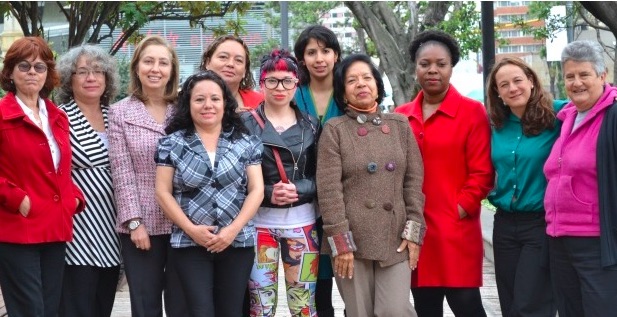
The Women, Peace and Security Collective for Reflection and Action (Colectivo de Pensamiento y Acción Mujeres, Paz y Seguridad)
Founded in October 2011, the Collective is a women’s network that currently brings together women from different social and professional backgrounds (religious, ex-combatants, indigenous, afro-descendants, journalists, academics, human rights defenders, union leaders, etc.), as well as organisations committed to a revolution in ethics as the basis for sustainable and lasting peace in Colombia. With a mission to foster conditions for a permanent and re-humanising dialogue among various sectors – including those traditionally opposed to each other – in different regions of the country, the Collective is in itself an example of how diversity can be embraced and used for positive change in a highly polarized society.
The Collective’s flagship initiative is the “Ethical Pact for a Country in Peace,” a civil society framework agreement for the ethical transformation of Colombia. This initiative points out that in order to achieve lasting peace, efforts beyond official peace talks between the Government and the Revolutionary Armed Forces of Colombia (FARC) will be necessary. The Pact is a 15-point plan promoting a series of value-based steps that Colombian society must undergo for sustainable peace. One highlight is the importance of an inclusive dialogue for peace where women’s participation is actively sought and encouraged.
Through this award, Pax Christi International acknowledges the Women, Peace and Security Collective’s pivotal work in challenging women’s traditionally limited assigned role in the building of peace in Colombia. The Collective has identified many diverse spaces for women’s participation in public dialogue and political debate, including across inter- generational and inter-ethnic divides. At the same time, the Pax Christi International award honours symbolically the important role that women play worldwide in conflict transformation and peacebuilding at the local, national and international level.
The Peace Award Ceremony will take place on Saturday, 16 May 2015, in Bethlehem, Palestine, during the Pax Christi International’s 70th Anniversary celebrations in that city.
Question(s) related to this article:
What is happening in Colombia, Is peace possible?
This discussion question applies to the following articles:
Colombian villagers practice non-violent resistance
Legacy of a Nonviolent Political Leader: Governor Guillermo Gaviria of Colombia
Working for a Culture of Peace in the Valley of the Cauca, Colombia
Remise des Prix de la Fondation Chirac pour la prévention des conflits
Chirac Foundation Prize for Conflict Prevention
The University and the Peace Process in Colombia
La paz supera coyunturas y fronteras (Colombia y Venezuela)
Peace is not stopped by borders (Colombia and Venezuela)
Campesinos colombianos celebran primer acuerdo agrario de paz
Colombian Govt and FARC Reach Agreement on First Stage of Peace Talks
Colombia Campaña de la ONU “La Paz es mía”
UN Campaign in Colombia:
Presidente colombiano reactivará la Comisión Nacional de Paz
Colombian President to Reactivate National Peace Commission
FARC-EP y Gobierno colombiano avanzan en acuerdos para la paz
FARC-EP and Colombia Government advance in their peace accords
Colombia debe ser también la Nación más educada en derechos humanos: Presidente Santos
Colombia should also be the most educated nation in human rights : President Santos
Gabriel García Márquez and the peace process in Colombia
Colombia amanece con un presidente reelecto, esperanzada en la paz
Colombia awakens to hopes for peace with the re-election of their president
Mujer, ruralidad y memoria, entre los temas del congreso de paz (Bogotá, Colombia)
Women, rurality and historical memory among the themes of the Peace Congress (Bogotá, Colombia)
Sonia Ines Goéz Orrego on a speaking tour in the U.S. to share her experience building peace in Colombia
Pax Christi International – Peace Award 2015: Women, Peace and Security Collective for Reflection and Action (Colombia)
Sonia Ines Goéz Orrego on a speaking tour in the U.S. to share her experience building peace in Colombia
FREE FLOW OF INFORMATION
an article by Pressenza International Press Agency (Reprinted according to creative commons licenses 4.0)
The presentation was organized by Colombia Human Rights Committee & Latin America Working Group Education Fund at The Graduate Center, CUNY in NYC.
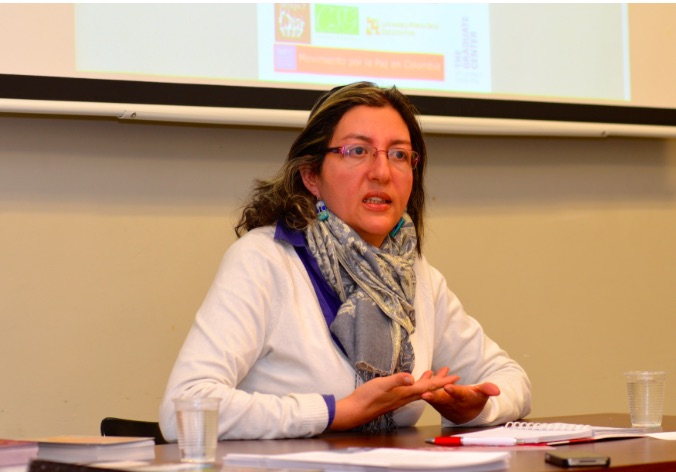
Sonia Ines Goéz Orrego speaking at The Graduate Center, CUNY in NYC on March, 2nd 2015 (Image by David Andersson)
Sonia Ines Goéz Orrego is the executive director of CEDECIS, a community organization working in some of the most violent areas of Medellín. With two decades of experience in community organizing and building a culture of peace, she discussed how people have come together to prevent forced recruitment of young people by gangs, paramilitary, and guerrilla organizations, to train children and adolescents in nonviolence, and to build more resilient and peaceful communities. There are a lot of invisible borders in Medellín.” The 13th District, locally known as the Comuna 13, is known to be one of Medellin’s most troubled and dangerous districts, and is continually suffering from gang warfare and violence. Two powerful crime networks, the Caribbean-based Urabeños and Medellin’s own Oficina de Envigado crime syndicate, have vied for control of the neighborhood for years, causing repeated territorial wars in the streets of Comuna 8.”What’s an invisible border? It’s a place where nobody can be, only those who belong to the combo that controls the territory,”
CEDECIS’s experience is especially relevant today as the Colombian government and FARC guerrillas steadily advance the peace negotiations in Havana, Cuba, that would end the Western Hemisphere’s longest running conflict.
Ms. Goéz is also a representative of the Coordinación Colombia Europa Estados Unidos (CCEEUU), the main network of some 245 Colombian human rights and nongovernmental organizations.
Other articles related to this one:
US and Iran: Track II diplomacy through jazz
… EDUCATION FOR PEACE ..
an article by John Marks, Founder and Senior Advisor, Search for Common Ground
As critical negotiations over the Iranian nuclear program begin this month, an American jazz ensemble, Animation, just finished a jubilant 10-day tour in Iran, arranged by Search. The band made history as the first American musicians to play in Iran’s premier concert hall in over 35 years.
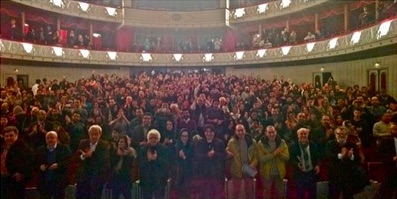
Cellphone photo taken from stage by Bob Beldon, leader of Animation, while playing in Iran.
The Americans were hesitant at first, apprehensive that the trip might be dangerous. They couldn’t have been more wrong. As Bob Belden, the group’s leader, told The New York Times in its article covering the tour:
“Everybody is nice to us here…. This guy comes up to me, an Iranian, asks me where I’m from. I say, ‘America!’ He says, ‘I love you!’ I tell him I’m a jazz musician. He says, ‘I love jazz!’”
The Iranian people showed overwhelming support and enthusiasm for the musicians. After decades of hostility between the two governments, how can Iranians and Americans share such warmth?
Animation’s tour is the most recent in a series of cultural, religious, and scientific exchanges our Track II diplomacy team has organized between Iran and the U.S. When most people think of diplomacy, they think of Track I – official talks between governments. Track II – unofficial contact – can provide an important foundation for official diplomatic success.
“Track II empowers us, citizens, to take control and do what our governments are reluctant to do, to overcome impediments, to break some of the taboos…. With a little bit of courage, particularly in my part of the world, we can achieve positive results.” – Iranian participant
Back in 1996, we gathered a team of Iranians and Americans – influential, non-governmental actors, including former high-level officials – to build trust and increase communication between the two countries. Even during the most difficult years, these unofficial efforts have continued. We’ve supported the nuclear negotiations for over a decade.
But people often make the mistake of thinking that conflicts are resolved mainly through the calculated steps of rational thinkers. We know from neuroscience and from 30+ years of practical peacebuilding that emotional experiences are pivotal in decision-making. They make a lasting impact on people’s worldviews.
“The impact of this series of meetings hosted by Search on my life has been tremendous. Not only have they changed my views, but I’ve chosen a different path in my life because of it…. I now have a totally different understanding of Americans.” – Iranian participant.
Lack of human interactions between Americans and Iranians greatly contributed to the decades of mistrust and misperception between them. At this critical moment in U.S.-Iran relations, a jazz performance offers hope for the future.
Learn more and take action:
• Check out The New York Times article about our jazz tour in Iran.
• Learn more about our Track II work across the Middle East, North Africa, and the U.S.
Thank you,
Latest Discussion
Does Persian culture contribute to a culture of peace?
Latest reader comment:
In response to the question, “Does Persian culture contribute to a culture of peace,” today, I have a simple question of you. Try to imagine a woven piece of “Gold” with its warps and woofs made of cotton and fuzz while its various forming colors resemble a heavenward garden full of wonderful trees, flowers and plants!
In my view, the question is too ordinary to be answered! Any wise man will instantly find it out that “carpet” is the keyword; a loom-woven, felted textile that is being used to cover the floor of halls, rooms and mostly to decorate walls, roofs and palms in favor of those who love elegance, dainty and grace.
But what do you know about the origin of this apparently worthless rug that never attracts anyone and slightly thrown off under your feet being trampled thousands of times each day by you and your family members?
Carpet’s origin of foundation is Iran and its history of production dates back to about 5th century BC when the Achaemenidan Empire was ruling.
The oldest documented carpet of the world is called Pazyryk that has been woven by the order of Cyrus the great in 500 BC in the southern Iranian city of Shiraz and still survives, archaeologists say.
Persian culture since the beginning of its perfection during the 600s BC until today is totally associated with some distinguished arts such as miniature, calligraphy and carpet weaving, so we can claim that these precious arts are considered as the symbols of Persian civilization, in fact.
To the other words, Most of the people who don’t have much information about Iran and its luminous history are closely familiar with the outputs of Persian culture such as its performing and decorative arts.
Carpets are some applicable proofs for the claim that Persian productions are widely being used throughout the world regardless to their nationality.
Saffron and tea are also in the same conditions while originated from Iran but the majority of their international users do not know about the birthplace of these treasure floras.
However we have to keep in mind that Iran is a cradle of carpets and rugs production.
The world’s most professional masters of carpet-weaving are currently working inside traditional looms and workshops of Persian ancient cities such as Kashan, Tabriz, Yazd, Isfahan and Qom and their powerful hands manipulating wools, silk, cotton, chords and yarns to finally ensue the dazzling results that we spread under our feet unconcernedly.
The carpets of highest quality are often woven by hand whereas machine-made carpets gain less quality, credibility and artistic value, so the most people try to pay more so as to buy the hand-woven carpets.
It is necessary to add that the average of time needed for a beautiful illustrated carpet to come out (by hand) is approximately 400 hours and it undoubtedly shows the pure struggles of painstaking weavers who form the carpet knots with their sense of responsibility, love and talent.
Carpets are the most popular souvenirs in Persia and families who want to dispatch gifts to their relatives outside Iran will always choose small-sized tufted or needlefelt carpets with fantastic warp and weft threads which shape spectacular sights of natural and ancient scenes.
The most-used designs for carpets are consisted of abstract natural landscapes ornamented by warm and almost red-spectrum colors.
The dominant equipment used for carpet weaving process are still the traditional instruments of past centuries such as spun and spindles.
USA: Rock solid rules to ensure the internet stays open and free
FREE FLOW OF INFORMATION
an article by Pressenza International Press Agency (Reprinted according to creative commons licenses 4.0) (abridged)
Breaking news: in an historic victory of global importance, the US Federal Communications Commission just passed rock solid rules to ensure the Internet stays open and free for generations to come. . .
Click here to enlarge photo
Just six months ago, we were facing staggering odds. Big corporations like US cable TV giant Comcast had spent more than $750 million lobbying for a corporate- controlled Internet. Google, the biggest lobby in the industry, was refusing to speak up. The FCC chair Tom Wheeler, a former Big Cable lobbyist, was hostile to Net Neutrality.
But against all odds, we’ve pulled off one of the biggest victories in the history of the Internet, in what the New York Times called “the longest, most sustained campaign of Internet activism in history”, won by “an army of Internet activists.”Together, here’s a snapshot of some of the amazing things we’ve done:Submitted tens and tens of thousands of comments to the FCC in support of Net Neutrality, making sure the agency received more comments than ever before on a public consultation.
Flooded FCC offices with thousands of phone calls, to build internal pressure for the agency to do their job and protect the open Internet.
Tied FCC chairman Tom Wheeler to his past as a former Big Cable lobbyist on social media and his personal Twitter account, forcing him to publicly choose a side.
Helped turn out hundreds of people to emergency rallies and vigils across the country, including outside the White House.
Organized tens of thousands of people to speak up online and on the phone to demand Google publicly support real Net Neutrality.
Pulled off a creative protest to bring Internet slow lanes to life by literally putting private buses transporting Google employees to work in a SumOfUs-created “Slow Lane”.
Worked together with a huge coalition of amazing groups like Demand Progress, Free Press, Fight for the Future, Color of Change, and too many others to count.
And it worked! Following each piece of the campaign President Obama, FCC chairman Tom Wheeler, and Google all came out in support of Net Neutrality — and now the FCC has adopted an official decision to protect Net Neutrality.
But even though we’ve won this crucial fight, we must stay vigilant.
Big telecom corporations like Verizon and Comcast are already working with conservatives in the US Congress to try and undermine our win. We need to be ready to put the pressure on again in the coming months to make sure we don’t lose an inch of our progress.
Up against corporate millions, this decision to protect Net Neutrality is a massive victory for citizen campaigning. Thanks to all of us, we can finally say 2015 was the year we won Net Neutrality. Let’s keep working together to make sure it stays that way.
Thanks for all you do,
Taren, Paul, Nick, Nicole, and the team at SumOfUs
Latest Discussion
Is Internet freedom a basic human right?
Here are additional remarks from the speech by Mary Robinson.It has been inspiring to see how new communications technologies have allowed us to expand the space for public debate in recent years. The internet has enabled an explosion of information and expression worldwide, and while I am sceptical about claims that Twitter and Facebook ‘caused’ events like the Arab Awakening, it is evident that social media was an indispensable tool in the dissemination of uncensored information and the coordination of public protests in the region.
This raises questions concerning the role of companies and highlights a critical gap – many business leaders are taking major decisions on their own, often without a firm understanding of their impacts on human rights. To help mainstream respect for human rights in corporate decision-making, the European Commission has embarked on a project to develop guidance for three critical industry sectors, including information and communication technologies, which are so important in today’s world. My colleagues at the Institute for Human Rights and Business and Shift are working with the Commission to develop this guidance in order to give practical meaning to the UN Guiding Principles on Business and Human Rights, which were adopted in 2011.
As these tools become more accessible to people around the world – by 2020 there will be an estimated 5 billion people with access to the internet – civil society becomes better-equipped to engage in public life. Citizens have used mobile phones and internet platforms to record human rights abuses, pressure leaders to become more accountable, and connect and work together across borders. As one young Egyptian told us, “the only borders now are on maps.”
At the same time, our expectations are getting higher – and this is a good thing. When we are used to finding information freely available online, we expect to have the right to access that information without restriction. When we see various world leaders on Twitter, we expect to be able to contact our own leaders directly through such platforms. The more we grow accustomed to voicing our opinions online, the more we resist being silenced.
I believe this is part of a broader global trend towards greater participation. There is such a strong desire now to be consulted – really consulted, not just in a tokenistic way – and to be involved in government as opposed to just being objects of someone else’s policy decisions. We must embrace this trend; by supporting greater inclusivity and participation in governance, we will strengthen the development of democracy worldwide.