All posts by CPNN Coordinator
Gobiernos respaldan nuevas funciones para la Comisión de la Mujer
. IGUALDAD HOMBRES/MUJERES .
un artículo de la ONU Mujeres
La Comisión de la Condición Jurídica y Social de la Mujer de las Naciones Unidas concluyó hoy [20 marzo] su 59º período anual de sesiones con un acuerdo alcanzado por los Estados Miembros de las Naciones Unidas sobre las medidas para impulsar sus esfuerzos en favor de la igualdad de género y el empoderamiento de las mujeres.

Haga click en la foto para ampliarla
Los Gobiernos que asistieron a la reunión acordaron nuevos métodos de trabajo de modo que la Comisión continúe fijando las normas referidas a la Declaración y Plataforma de Acción de Beijing de 1995 y afiance su función en la formulación de políticas mundiales y la coordinación de las acciones para su aplicación. Estos afirmaron las aportaciones fundamentales de la Comisión a la configuración de la histórica agenda sobre desarrollo sostenible posterior a 2015, cuya adopción está programada para septiembre en una cumbre mundial de Jefas y Jefes de Estado y de Gobierno.
Como el principal organismo de las Naciones Unidas para promover los compromisos intergubernamentales con la igualdad de género y el seguimiento de la Plataforma de Beijing, la Comisión reorientará su labor en coordinación con la del Consejo Económico y Social y el Nuevo Foro Político de Alto Nivel de las Naciones Unidas. Esto consolidará los esfuerzos para incorporar la igualdad de género en todos los debates y medidas mundiales sobre desarrollo sostenible.
Puesto que un gran número de ministras y ministros de gobierno se hacen presentes ahora en la Comisión, los Estados Miembros acordaron crear un segmento ministerial que será inaugurado en el próximo período de sesiones de 2016. Se espera que éste incremente la visibilidad de las preocupaciones actuales y que ofrezca oportunidades para demostrar un compromiso político de alto nivel para acelerar el progreso hacia la igualdad de género, el empoderamiento y la realización plena de los derechos humanos de las mujeres.
Expresando su felicitación a los Estados Miembros, la sociedad civil y el sistema de las Naciones Unidas por “un periodo de sesiones contundente, dinámico y ambicioso”, la Directora Ejecutiva de ONU Mujeres, Phumzile Mlambo- Ngcuka, dijo en su alocución: “Somos conscientes de que no existen atajos para el logro de la igualdad de género, el empoderamiento de las mujeres y los derechos humanos de las mujeres y las niñas. A partir del camino que hemos recorrido, sabemos que quedan más desafíos por delante. Sabemos que debemos seguir trabajando sistemática e inquebrantablemente para producir la transformación en el seno de la familia, la sociedad, la economía y los espacios político y público”.
Los Gobiernos acordaron afinar el foco del tema de examen anual de la Comisión. En adelante, los estudios de caso demostrarán las lecciones aprendidas en la aplicación de los compromisos asumidos en las sesiones anteriores de la Comisión. El Secretario General emitirá un informe especializado sobre los avances en el tema, a partir de datos nacionales y demás material pertinente. El proceso ayudará a superar las brechas entre las promesas hechas y un cambio cuantificable, y ofrecerá evidencias concretas acerca de cómo las normas internacionales pueden trasladarse en diferencias significativas en las vidas de las mujeres y las niñas.
Este 59º periodo de sesiones albergó diversas mesas redondas y paneles de alto nivel sobre temáticas cruciales, que van desde el aumento de la financiación para la igualdad de género a las responsabilidades de los hombres y los niños y la mejora en la desagregación de los datos en función del género. Los debates sobre las lecciones extraídas de los Objetivos de Desarrollo del Milenio darán nueva forma a la agenda de desarrollo posterior a 2015.
( Clickear aquí para la version francês o aquí para la version inglês)
Pregunta(s) relacionada(s) al artículo
Does the UN advance equality for women?
The following article by Lyndal Rowlands in the Inter Press Service, suggests that the UN is not making much progress on its commitments for women’s equality:
2015 marks anniversaries for two significant commitments made to increasing women’s participation at peace tables.
Yet despite the Beijing Platform for Action and the Security Council Resolution 1325 both committing to increasing women’s participation in peace building 20 and 15 years ago, respectively, there has been very little progress to report.
The latest available statistics show that women made up only 9 per cent of negotiators at peace tables between 1992 and 2011. That the most recent data is from 2011 shows that more work is needed even in basic areas such as data collection and reporting of women’s participation in peace building.
IPS summarises here four reasons we should value women’s participation at the peace table more, based on discussions at the 59th Commission on the Status of Women (CSW) over the past week.
Beijing Platform for Action Section E
Women and Armed Conflict Diagnosis
Strategic objective E.1. Increase the participation of women in conflict resolution at decision-making levels and protect women living in situations of armed and other conflicts or under foreign occupation. Actions to be taken.
Strategic objective E.2. Reduce excessive military expenditures and control the availability of armaments. Actions to be taken.
Strategic objective E.3. Promote non-violent forms of conflict resolution and reduce the incidence of human rights abuse in conflict situations. Actions to be taken.
Strategic objective E.4. Promote women’s contribution to fostering a culture of peace. Actions to be taken
Strategic objective E.5. Provide protection, assistance and training to refugee women, other displaced women in need of international protection and internally displaced women. Actions to be taken.
Strategic objective E.6. Provide assistance to the women of the colonies and non-self-governing territories. Actions to be taken.
Women Bring Commitment and Experience to the Peace Table
Often the first people invited to participate in formal peace negotiations are the people holding the guns and the last are women who have expertise in building lasting peace.
Zainab Bangura, Special Representative of the Secretary-General on Sexual Violence in Conflict, told a CSW side event on Tuesday last week, “In the Central African Republic, the only community where they were not killing each other was a community where the Christian women said, ‘These Muslim women are our sisters.’
“Why? Because the women in the community said, ‘We have lived together for the last 100 years’,” Bangura said.
In the Phillipines, Irene Santiago was a member of the government panel that negotiated peace with the Moro Islamic Liberation Front. Santiago came to the table with years of experience working with Christian, Muslim and Indigenous women leaders for peace.
Speaking at a CSW side event at the International Peace Institute (IPI) on Thursday, Santiago said that she knew that her years of experience working with civil society for peace stood her in good stead to make a significant contribution to formal peace negotiations, which she did.
Speaking with IPS, Santiago said women’s voices not only have to be heard, but that they also have to be acted on.
“For women. It’s almost never always about themselves, it’s always about our children, our husbands but also about our communities,” Santiago told IPS.
In Africa, women have fought to be included in peacemaking, even when their contributions have not been recognised.
Bineta Diop, Special Envoy on Women Peace and Security to the African Union, says that mediators need to be held accountable when they only invite the people who hold guns to the peace table and ignore women’s contributions.
“I have been involved in many crises where women were knocking at the door and saying we want to be at the table,” Diop said.
Ambassador Anwarul Chowdhury, known as the father of Security Council Resolution 1325, said that the determination of African women to be involved in peace negotiations should be seen as an inspiration by other countries.
Despite serious difficulties, war and conflict, African women have shown continued determination to hold their countries accountable, Chowdhury said.
Gender Equality in Peace Time Prevents Conflict
Also speaking at the IPI, Valerie Hudson, co-author of ‘Sex and World Peace’, said that her research has shown that the way women are treated within a country is one of the most accurate indicators of the quality of relations that country will have with other countries.
Diop agreed with Hudson, saying that countries that are likely to fall into conflict have higher levels of discrimination and inequality.
“Discrimination against women, especially the non-participation and non-inclusion of women in democracy is … one of the root causes of the conflict,” Diop said.
Ambassador Choudhury agreed with these sentiments, telling IPS, “I believe that no country can claim that their country is not in conflict if women’s rights are denied, if women’s equality is not ensured, if women’s participation at all participation levels is not there.
“I think that if we women are violated, if women’s equality of participation is not there we cannot say that we are at peace, we are in conflict with ourselves. This is a conflict which is happening within ourselves and within the countries. We don’t have to go into the traditional description of conflict, civil conflict or fighting with another country,” Chowdhury added.
Dr. Youssef Mahmoud, Senior Adviser at the International Peace Institute also speaking at the IPI event said, “A world where 51 per cent are ignored is a dangerous world for everyone. I can’t imagine why any men would be indifferent to this.”
Women Are Active In Civil Society
Several discussions at the CSW questioned why militaries were the primary actors in peace building, while non-governmental organisations (NGOs) and civil society’s expertise was not called on.
Related IPS Articles
U.S. Honours 10 “Extraordinary Women” for Courage and Leadership
Meet the 10 Women Who Will Stop at Nothing
Women Walk for Peace in the Korean Peninsula
Santiago told IPS that civil society, especially women, have a lot to contribute to humanise, to concretise, and to make peace negotiations relevant to people’s lives.
Winnie Kodi from the Nuba mountains in Sudan told reporters on Monday that civil society was vital to helping indigenous communities like her own that have been affected by conflict. She said that the main way her people were able to have their voices heard was by working together with NGOs and civil society.
Chowdhury told IPS he is advocating for the U.N. and governments to hold more consultations with civil society, saying that the involvement of women and of civil society is very important.
Santiago also called for renewed focus on the important role of NGOs in the area of women, peace and security,
“Again I see that why are we focusing on the UN as the locus of change,” she said. “To me it is not, it is the means, it is an important audience, but it is not the locus of social change.
“Let us form the global civic networks that we need to bring about the local global and civil change that we need” Santiago said.
Women Challenge The Causes of Conflict
Challenging militarism and militarisation was another theme discussed during the first week of the CSW, particularly by civil society groups at the parallel NGO forum.
Choudhury told IPS that increased militarism and militarisation is slowing down efforts for equality. “Increasing militarism and militarisation has really been effecting women in a very negative way. This is something that women should stand up against, we should all stand up against,” Chowdhury said.
Militarisation is also affecting indigenous women and men. Maribeth Biano, from the Asian Indigenous Women’s Network, told reporters on Monday that Indigenous women are hugely affected by militarisation in Indigenous territories.
Back to top
Profile PM MAIL
Les gouvernements approuvent de nouveaux rôles pour la Commission de la condition de la femme
. . . EGALITE HOMMES/FEMMES . . .
un article par ONU Mujeres
La Commission de la condition de la femme a conclu aujourd’hui [20 mars] sa 59e session annuelle par un accord avec les États membres des Nations Unies concernant les mesures pour stimuler ses initiatives en faveur de la promotion de l’égalité des sexes et de l’autonomisation des femmes.
Cliquez sur le photo pour l’élargir
Les gouvernements participant à la réunion ont convenu de nouvelles méthodes de travail pour que la Commission continue à fixer les normes relatives à la Déclaration et le Programme d’action 1995 de Beijing et pour renforcer son rôle dans la formulation des politiques et la coordination d’actions à l’échelle mondiale en matière de mise en œuvre. Ils ont affirmé les contributions essentielles de la Commission dans le façonnement du programme majeur de développement durable pour l’après-2015, dont l’adoption par un sommet mondial de chefs d’États et de gouvernements est prévue en septembre 2015.
En tant qu’organe principal des Nations Unies de promotion des engagements intergouvernementaux en faveur de l’égalité des sexes et de suivi du Programme d’action de Beijing, la Commission poursuivra l’harmonisation de son travail avec celui du Conseil économique et social et du nouveau Forum politique de haut niveau des Nations Unies. Ceci renforcera les initiatives d’intégration de l’égalité des sexes à travers l’ensemble des actions et des débats mondiaux sur le développement durable.
Comme maintenant un grand nombre de membres de gouvernement participent à la Commission, les États membres ont convenu de créer un segment ministériel qui démarrera lors de la prochaine session en 2016. Il est destiné à donner une plus grande visibilité aux préoccupations actuelles et à offrir des possibilités de démontrer un engagement politique de haut niveau pour accélérer les progrès vers l’égalité des sexes, l’autonomisation des femmes et la réalisation pleine des droits humains des femmes.
Félicitant les États membres, la société civile et le système des Nations Unies pour « l’énergie, le dynamisme et la perspicacité de la session », la directrice exécutive d’ ONU Femmes, Phumzile Mlambo-Ngcuka, a déclaré dans son discours : « Nous sommes tous bien conscients qu’il n’y a pas de remède miracle pour la réalisation de l’égalité des sexes, de l’autonomisation des femmes et des droits humains des femmes et des filles. Compte tenu du chemin que nous avons parcouru, nous savons que d’autres défis nous attendent. Nous savons que nous devons continuer à travailler, de manière systématique et sans relâche, pour instaurer une transformation dans nos familles, nos sociétés, nos économies et nos espaces politiques et publics », a-t-elle ajouté.
Les gouvernements ont convenu de cibler davantage les efforts sur le thème de l’examen annuel de la Commission. Pour l’avenir, des études de cas démontreront les enseignements qui ont été retirés de la mise en œuvre des engagements pris lors des sessions antérieures de la Commission . . .
La 59e session comprenait un éventail de tables rondes et de panels de haut niveau portant sur des sujets essentiels, depuis le renforcement des financements pour l’égalité des sexes aux responsabilités des hommes et des garçons, en passant par une amélioration des données ventilées par sexe. Les discussions sur les enseignements qui ont été retirés des objectifs du Millénaire pour le développement renforceront le façonnement du programme de développement pour l’après-2
(Cliquez ici pour une version espagnole de cet article ou ici pour une version anglaise.)
Pregunta(s) relacionada(s) al artículo
Does the UN advance equality for women?
The following article by Lyndal Rowlands in the Inter Press Service, suggests that the UN is not making much progress on its commitments for women’s equality:
2015 marks anniversaries for two significant commitments made to increasing women’s participation at peace tables.
Yet despite the Beijing Platform for Action and the Security Council Resolution 1325 both committing to increasing women’s participation in peace building 20 and 15 years ago, respectively, there has been very little progress to report.
The latest available statistics show that women made up only 9 per cent of negotiators at peace tables between 1992 and 2011. That the most recent data is from 2011 shows that more work is needed even in basic areas such as data collection and reporting of women’s participation in peace building.
IPS summarises here four reasons we should value women’s participation at the peace table more, based on discussions at the 59th Commission on the Status of Women (CSW) over the past week.
Beijing Platform for Action Section E
Women and Armed Conflict Diagnosis
Strategic objective E.1. Increase the participation of women in conflict resolution at decision-making levels and protect women living in situations of armed and other conflicts or under foreign occupation. Actions to be taken.
Strategic objective E.2. Reduce excessive military expenditures and control the availability of armaments. Actions to be taken.
Strategic objective E.3. Promote non-violent forms of conflict resolution and reduce the incidence of human rights abuse in conflict situations. Actions to be taken.
Strategic objective E.4. Promote women’s contribution to fostering a culture of peace. Actions to be taken
Strategic objective E.5. Provide protection, assistance and training to refugee women, other displaced women in need of international protection and internally displaced women. Actions to be taken.
Strategic objective E.6. Provide assistance to the women of the colonies and non-self-governing territories. Actions to be taken.
Women Bring Commitment and Experience to the Peace Table
Often the first people invited to participate in formal peace negotiations are the people holding the guns and the last are women who have expertise in building lasting peace.
Zainab Bangura, Special Representative of the Secretary-General on Sexual Violence in Conflict, told a CSW side event on Tuesday last week, “In the Central African Republic, the only community where they were not killing each other was a community where the Christian women said, ‘These Muslim women are our sisters.’
“Why? Because the women in the community said, ‘We have lived together for the last 100 years’,” Bangura said.
In the Phillipines, Irene Santiago was a member of the government panel that negotiated peace with the Moro Islamic Liberation Front. Santiago came to the table with years of experience working with Christian, Muslim and Indigenous women leaders for peace.
Speaking at a CSW side event at the International Peace Institute (IPI) on Thursday, Santiago said that she knew that her years of experience working with civil society for peace stood her in good stead to make a significant contribution to formal peace negotiations, which she did.
Speaking with IPS, Santiago said women’s voices not only have to be heard, but that they also have to be acted on.
“For women. It’s almost never always about themselves, it’s always about our children, our husbands but also about our communities,” Santiago told IPS.
In Africa, women have fought to be included in peacemaking, even when their contributions have not been recognised.
Bineta Diop, Special Envoy on Women Peace and Security to the African Union, says that mediators need to be held accountable when they only invite the people who hold guns to the peace table and ignore women’s contributions.
“I have been involved in many crises where women were knocking at the door and saying we want to be at the table,” Diop said.
Ambassador Anwarul Chowdhury, known as the father of Security Council Resolution 1325, said that the determination of African women to be involved in peace negotiations should be seen as an inspiration by other countries.
Despite serious difficulties, war and conflict, African women have shown continued determination to hold their countries accountable, Chowdhury said.
Gender Equality in Peace Time Prevents Conflict
Also speaking at the IPI, Valerie Hudson, co-author of ‘Sex and World Peace’, said that her research has shown that the way women are treated within a country is one of the most accurate indicators of the quality of relations that country will have with other countries.
Diop agreed with Hudson, saying that countries that are likely to fall into conflict have higher levels of discrimination and inequality.
“Discrimination against women, especially the non-participation and non-inclusion of women in democracy is … one of the root causes of the conflict,” Diop said.
Ambassador Choudhury agreed with these sentiments, telling IPS, “I believe that no country can claim that their country is not in conflict if women’s rights are denied, if women’s equality is not ensured, if women’s participation at all participation levels is not there.
“I think that if we women are violated, if women’s equality of participation is not there we cannot say that we are at peace, we are in conflict with ourselves. This is a conflict which is happening within ourselves and within the countries. We don’t have to go into the traditional description of conflict, civil conflict or fighting with another country,” Chowdhury added.
Dr. Youssef Mahmoud, Senior Adviser at the International Peace Institute also speaking at the IPI event said, “A world where 51 per cent are ignored is a dangerous world for everyone. I can’t imagine why any men would be indifferent to this.”
Women Are Active In Civil Society
Several discussions at the CSW questioned why militaries were the primary actors in peace building, while non-governmental organisations (NGOs) and civil society’s expertise was not called on.
Related IPS Articles
U.S. Honours 10 “Extraordinary Women” for Courage and Leadership
Meet the 10 Women Who Will Stop at Nothing
Women Walk for Peace in the Korean Peninsula
Santiago told IPS that civil society, especially women, have a lot to contribute to humanise, to concretise, and to make peace negotiations relevant to people’s lives.
Winnie Kodi from the Nuba mountains in Sudan told reporters on Monday that civil society was vital to helping indigenous communities like her own that have been affected by conflict. She said that the main way her people were able to have their voices heard was by working together with NGOs and civil society.
Chowdhury told IPS he is advocating for the U.N. and governments to hold more consultations with civil society, saying that the involvement of women and of civil society is very important.
Santiago also called for renewed focus on the important role of NGOs in the area of women, peace and security,
“Again I see that why are we focusing on the UN as the locus of change,” she said. “To me it is not, it is the means, it is an important audience, but it is not the locus of social change.
“Let us form the global civic networks that we need to bring about the local global and civil change that we need” Santiago said.
Women Challenge The Causes of Conflict
Challenging militarism and militarisation was another theme discussed during the first week of the CSW, particularly by civil society groups at the parallel NGO forum.
Choudhury told IPS that increased militarism and militarisation is slowing down efforts for equality. “Increasing militarism and militarisation has really been effecting women in a very negative way. This is something that women should stand up against, we should all stand up against,” Chowdhury said.
Militarisation is also affecting indigenous women and men. Maribeth Biano, from the Asian Indigenous Women’s Network, told reporters on Monday that Indigenous women are hugely affected by militarisation in Indigenous territories.
Back to top
Profile PM MAIL
USA: Discipline Reformers Get A “Restorative” Lesson
TOLERANCE AND SOLIDARITY .
an article by Aliyya Swaby, New Haven Independent
While giving a presentation in a high school classroom, Lola Garcia-Blocker had to ask a student being particularly disruptive to leave the room. Instead of sulking or causing a ruckus, the student left calmly—and later sought her out to apologize for misbehaving.

Velazquez: Students should learn to self-advocate.
That is what it looks like, Garcia-Blocker said, when a school successfully implements a culture of “restoration” instead of punishment. The student “repaired” the harm by asking for forgiveness and restored his relationship with a member of the community. Garcia-Block, the Board of Ed’s “career pathways director,” is part of a working group designing a “restorative practices” plan as a better way to deal with discipline problems in New Haven’s schools.
After delving into the district’s existing code of conduct for a few meetings, the working group got their first lesson this past Thursday in how schools can go about creating that culture while breaking an existing “cycle of fear.”
The ultimate goal of the group is figure out how to decrease suspensions and expulsions while increasing methods such as peer mediation that “restore” the offender’s relationship with the school community. The teachers union received a $300,000 grant to implement restorative practices in a handful of public schools, part of a larger city initiative to keep troubled kids in school instead of pushing them out into violence.
Kyisha Velazquez, who has for eight years headed the district’s juvenile review board, gave a short presentation on the philosophy of restorative justice to get all members of the working group on the same page. Velazquez has been working since the fall at King/Robinson School to implement restorative programs to help “kids who have struggled the most in school.” Instead of just suspending or expelling those students, school staff creates circles—of “victims,” “offenders” and the whole community—to “process with them over and over and over their behavior that has harmed the community,” she said.
Ultimately, schools should aim to turn a “cycle of fear” into a “cycle of hope,” in which members who harm others then go through a process of building community, leading to a stronger fabric that prevents future harm, Velazquez said. Students work on an action plan based on three questions: what is the harm, how can it be repaired and who is responsible for carrying out that repair?
The student who disrupted Garcia-Blocker’s classroom could have also repaired the harm indirectly done to the rest of the students, she said. When someone acts out and agrees to restorative action, someone needs to “take on the task of holding him accountable to finish” carrying out those actions, Velazquez said. “If not, that’s where the disconnect is.”
Restorative practices include restitution, reparation boards, community services, family group conferencing, letters of apology, circle sentencing and victim/offender mediation— implemented in a way that is “all-inclusive,” she said.
(This article is continued in the discussion board on the right side of this page.)
Discussion question
Restorative justice, What does it look like in practice?
(Article continued from left side of this page.)
In a recent case, a student’s father, in a fit of road rage, chased down a fellow driver who cut him off, while the student was in the back seat. The other driver and the student’s sibling got into a physical fight. The student hit the driver in the head. Velazquez said it was clear that the student was in the wrong, but “also the dad has some issues.” Family conferencing was necessary in order to address the root of the problem.
In another situation, several kids attacked a neighbor who was chronically ill. Through a juvenile review board, it was decided that the students would help the woman clean and take out her trash, as community service to repair the harm done by the attack.
Velazquez said this was restorative for the whole neighborhood, since the situation could have otherwise escalated and posed a larger danger.
Parent Megan Ifill said restorative practices also help when students are expelled from one school and placed in another. They can “process professionally why they have to go to another school” before starting anew somewhere else, she said.
And involving the student in the process of determining what the harm is helps prevent future harm, she said.
“A lot of kids don’t know why they’re saying sorry,” she said. “In your process, you take what the kid is willing to be sorry for” and repair that harm done. The student might not be sorry for having hit someone, but might be sorry for forcing his or her parents to take time off work to deal with the situation, for example.
Garcia-Blocker reminded the group that students are not the only ones who may benefit from restorative practices. Adults should also be held responsible if they harm others in the school community. “We have adults in our school … that escalate situations” and want to call the police when students act out, she said. She urged group members to change their language to reflect that reality.
Kids “crave” the healing that comes with restoration, said parent JoAnne Wilcox. She said she uses some of those practices in her own home, in order to move away from a system of punishment and rewards.
Velazquez said she has also been working with students to help them advocate for themselves in situations where they may not be at fault.
At the next meeting, according to Gemma Joseph Lumpkin, executive director for district strategy and coordination, the group will discuss a transcript of an expulsion hearing.
Nonviolent Peaceforce: Women’s Peacekeeping Teams incorporated into South Sudan communities
EDUCATION FOR PEACE .
an article by Nonviolent Peaceforce
The formation of Women’s Peacekeeping Teams (WPTs) is an important part of the programming of the Nonviolent Peaceforce (NP) in South Sudan. In various communities where NP is based, NP supports the development of teams of roughly 10 women who work to support each other and their community on protection issues that target women. Specifically, issues that women are in a unique position to improve. NP helps to create the space for the women to begin their work, builds capacity and confidence – but the inspiring and life-changing work is done by the women on the teams. This was demonstrated once again during the recent visit of Country Director Tiffany Easthom to the WPTs that NP supports in Northern Bahr el Ghazal. Read about her visit:
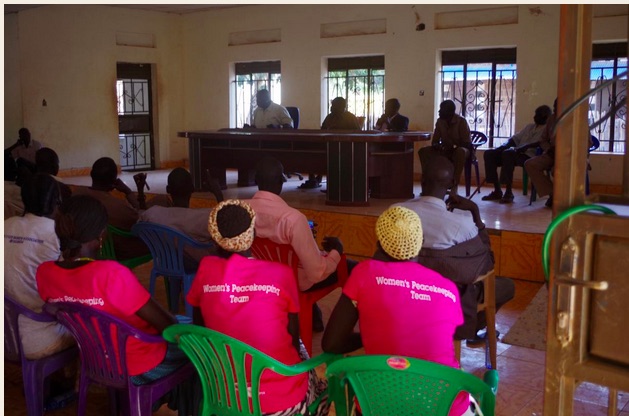
Click on photo to enlarge
Arriving into the small village of Malual Baa in Northern Bahr el Ghazal State, the primary thought we were all having was simply getting out of the land cruiser. After nearly two hours of bouncing along dirt tracks, through clouds of dust we were more than eager to get our feet onto solid ground. As the vehicle came to a stop, all thoughts of discomfort disappeared immediately when the 37 women who were waiting for us under the shade of a giant acacia tree leapt to their feet singing a song they had composed just for our arrival. They sang about their identity as a Women’s Peacekeeping Team (WPT), about how NP had brought them together and how they were now working for peace and security everyday in their communities. As we jumped down, we were wrapped up in the big hugs and the vigorous handshakes so famous in this country.
This warmth and excitement would be the tone for the next two days we spent with this Women’s Peacekeeping Team (WPT), learning about how they were progressing with their work and facilitating a training on Risk Analysis and Security Planning. We began our visit by hearing the members of the WPT share the cases they have been working on. The cases ranged from domestic violence, to sexual assault, reconciliation to inter-family disputes. The women stood up one by one, reporting back on the cases they had worked on and how they were now being approached by members of the their own community to provide advice, as well as, support. Mary, an exuberant member of the WPT with deep dimples shared that “since being part of the WPT, the men here treat me with respect. They now see me as a serious person”.
Angelina, more serious and suffering from a tooth ache, spoke slowly and intentionally. “The Chiefs’ court now refers cases to us, the WPT. They tell people that the WPT are good at solving problems and making reconciliation.” I was completely moved by this statement, the fact that the local judiciary process is now recognizing the WPT as a legitimate and effective option for conflict resolution is ground breaking. Angelina went on to say “As the WPT, we women are working together for peace. Usually we do not do this, sometimes we don’t even live peacefully with each other but now we are a team and it is our right and our responsibility to make peace”.
Question for this article:
Can peace be guaranteed through nonviolent means?
We have the advantage of an independent evaluation of the Nonviolent Peaceforce initiative in the Philippines conducted by Swisspeace. The evaluation is very favorable, although in the end, as one reads through it, gets the impression that such initiatives can help but cannot bring peace by themselves.
Here is the executive summary:
Nonviolent Peaceforce in the Philippines can look back at more than two years of unique, relevant contributions and constructive engagement in one of the most difficult, political and volatile, contexts to work in: Being the only international non-governmental organization working with and living in close proximity to the most conflict-affected population in Mindanao, NP in the Philippines was able to support and enhance local structures of cease-fire monitoring, early warning, cross-community dialogues, human rights protection, to offer civilian protection and help to reduce the high levels of community violence.
The accepted offer to NP in the Philippines in late 2009 by the conflict parties GRP and the MILF to join the International Monitoring Team1 (IMT) and its Civilian Protection Component is a direct expression and result of its successful contributions to non-violence and violence reduction of the last two years.
To keep up the important work of NP’s project in the Philippines in the years to come, it is essential to ensure that the activities and objectives of NPP are based on a strategically and conceptually sound footing. This seems even more important given that NPP is going through a remarkable consolidation and expansion phase at the time of report-writing.
The re-focus on its key mandate, strengths and strategic advantages in Mindanao gives NP the opportunity to further enhance its unique work in the area of nonviolence, peacekeeping and peace building.
ONU Mujer: Bachelet destacó participación de mujeres en puestos de poder
. IGUALDAD HOMBRES/MUJERES .
un artículo de Jimena Colombo, El Ciudadano (abreviado)
Esta mañana comenzó la cumbre organizada por el organismo ONU Mujer y el Gobierno de Chile, bajo el lema “Las Mujeres en el Poder y en la Toma de Decisiones: Construyendo un Mundo Diferente” en la Estación Mapocho. El evento cuenta con la participación de distintas autoridades y ex autoridades internacionales como son el secretario de Naciones Unidas Ban Ki Moon y la directora ejecutiva de ONU Mujeres, Phumzile Mlambo- Ngcuka (sucesora de Bachelet en dicho cargo). La Cumbre pretende ser un espacio para tratar el empoderamiento y los derechos de las mujeres alrededor del mundo. Además de tratar el impacto de la participación de las mujeres en cargo de liderazgo y garantizar su participación en la toma de decisiones.
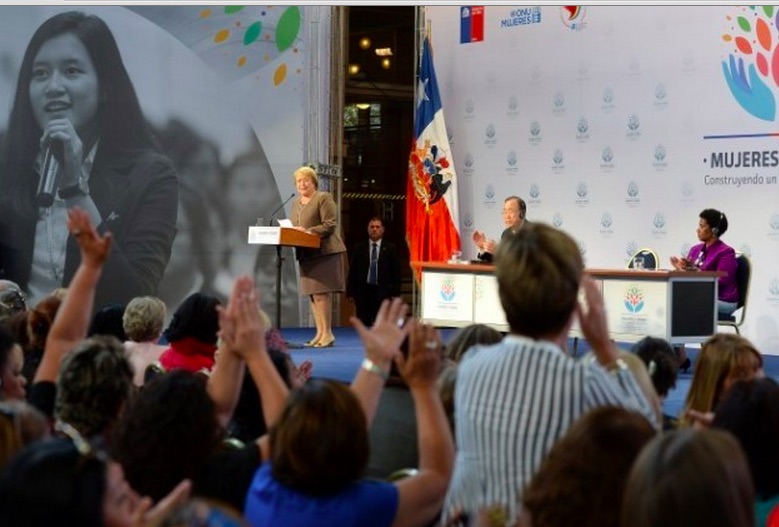
Haga clic en la foto para ampliarla
La Presidenta Michelle Bachellet
En la inauguración de esta cumbre que se desarrollará hasta mañana, la Presidenta Michelle Bachellet aprovechó la instancia para referirse a los avances en materia de género, además de mencionar las medidas que se toman para facilitar el desarrollo de las chilenas, repasó los logros legislativos que impactan a las mujeres y los que están por venir. Bachelet señaló que “en materia de liderazgo estamos modificando nuestra legislación y nuestras instituciones, para que respondan adecuadamente a los desafíos modernos en equidad”.
Bachelet además se refirió a todas las mujeres que ocupan importantes cargos políticos y sociales, se refirió a la Presidenta del Senado, Isabel Allende, a la dirigente de la CUT, Bárbara Figueroa, a su segunda administración y a las dirigentes estudiantiles. Sin embargo, reparó en que “esto podría significar que Chile es el paraíso para las mujeres. Sabemos que no, pero es una buena señal”. Luego se refirió a la reforma al sistema binominal y “la presencia de las mujeres en el parlamento sólo alcanza el 16% (…) por eso es una gran noticia que la reforma al sistema electoral ya aprobada permita perfeccionar nuestra democracia y además asegurar que al menos un 40% de las candidatas al poder legislativo sean mujeres. Como saben muchos de nosotros, yo quería que fuera el 40% de las elegidas no de las candidatas, pero bueno partimos por lo menos”.
La mandataria también se refirió al proyecto de ley que despenalizará el aborto terapéutico bajo tres causales y lamentó que este sea discutido por una mayoría de legisladores hombres; “Hace unas semanas enviamos un proyecto de ley para despenalizar la interrupción del embarazo que en Chile está prohibido bajo cualquier circunstancia (…) Este es un proyecto en el que las personas pueden tener distintas opiniones y requieren un debate democrático, y va a ser discutido en un parlamento compuesto en un 84% por hombres. Ese es el tipo de sesgo que tenemos que corregir” señaló Bachelet. . .
( Clickear aquí para la version inglês.)
Pregunta(s) relacionada(s) al artículo
Do women have a special role to play in the peace movement?
Comentario más reciente:
The 30 articles in CPNN linked to this question make it clear that women indeed have a special role to play in the peace movement. See the following for an historical explanation of why this is true.
Una argentina presidirá la Corte Penal Internacional
. IGUALDAD HOMBRES/MUJERES .
un articulo del Infonews
Los jueces de la Corte Penal Internacional (CPI) eligieron este miércoles en una sesión plenaria a la magistrada argentina Silvia Fernández de Gurmendi, como presidenta de esa instancia durante el periodo 2015-2018. En tanto, las vicepresidentas de la CPI durante el mismo ejercicio serán las juezas Joyce Aluoch, de Kenya, y Kuniko Ozaki, de Japón.

Haga clic en la foto para ampliarla
la magistrada Silvia Fernández de Gurmendi
[Nota del editor: Esta es la primera vez que la Corte Penal Internacional ha tenido un liderazgo exclusivamente femenin.]
Tras su elección, la jueza Fernández declaró sentirse honrada y se comprometió a estar a la altura del cargo, según informó radio ONU.
“Haré todo lo posible para estar a la altura de la confianza que mis compañeros jueces han depositado en mí… También ilusionada de colaborar con todos los jueces y demás órganos de la Corte, así como con la Asamblea de los Estados Partes, la sociedad civil y la comunidad internacional en general, en cumplimiento del importante mandato de la CPI por el bien de la justicia, la paz y el imperio de la ley”, dijo.
La Presidencia de la CPI coordina con los diferentes órganos y consulta con la Fiscalía en temas de interés mutuo. De acuerdo con el Estatuto de Roma, el tratado fundacional de la CPI, la Presidencia es responsable de la correcta administración de la Corte, con la excepción de la Oficina del Fiscal.
( Clickear aquí para la version inglês )
Pregunta(s) relacionada(s) al artículo
Do women have a special role to play in the peace movement?
Comentario más reciente:
The 30 articles in CPNN linked to this question make it clear that women indeed have a special role to play in the peace movement. See the following for an historical explanation of why this is true.
Comisión de la Condición Jurídica y Social de la Mujer: Implementación de la Plataforma de Acción de Beijing
. IGUALDAD HOMBRES/MUJERES .
un articulo de la ONU Mujeres
El año 2015 supone un hito importante: el 20º aniversario de la Cuarta Conferencia Mundial sobre la Mujer y la adopción de la Declaración y Plataforma de Acción de Beijing, que protagonisará la 59ª sesión de la Comisión de la Condición Jurídica y Social de la Mujer (CSW59).
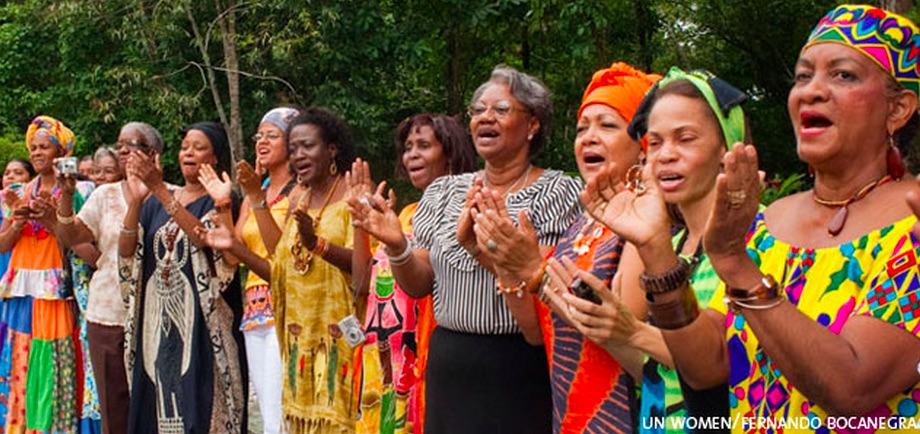
Haga clic en la foto para ampliarla
En esta reunión anual de alto nivel, que tendrá lugar en la Sede de las Naciones Unidas en Nueva York del 9 al 20 de marzo de 2015, líderes y activistas mundiales harán balance del progreso y los retos pendientes para implementar este acuerdo histórico para la igualdad de género y los derechos de las mujeres. Los Estados que trabajaron en la Plataforma en 1995 identificaron 12 esferas de especial preocupación, y todas ellas siguen siendo a fecha de hoy retos importantes.
Antes del 20º aniversario de la Plataforma de Acción de Beijing, ONU Mujeres lanzó en 2014 una campaña mundial titulada “Empoderando a las mujeres / Empoderando a la humanidad / ¡Imagínalo!”, para recordar los aspectos urgentes que impulsaron la iniciativa de Beijing y dar vida a una nueva generación que aborde los temas relacionados con la igualdad de género.
Como preparativo para la sesión de la Comisión, 166 países, una cifra sin precedentes, también han realizado revisiones nacionales sobre la condición de la mujer y se han obtenido contribuciones importantes de la sociedad civil. Estos insumos, junto con el informe del Secretario General de las Naciones Unidas sobre la implementación de Beijing, ocuparán un lugar destacado en la CSW59, donde las y los líderes analizarán el progreso y formularán recomendaciones concretas para acelerar sus esfuerzos y garantizar que la igualdad de género y el empoderamiento de las mujeres estén presentes en las vidas de las mujeres y las niñas de todo el mundo.
Cada año, la CSW atrae a miles de miembros de ONG y cientos de representantes nacionales de los cuatro rincones del planeta para debatir aspectos críticos para las mujeres, llamar la atención y mover a la acción. Este año se ha marcado un nuevo récord: más de 1.100 ONG y un total de 8.600 representantes se han registrado para participar.
Hay miles de historias que explicar. Conozca a algunas y algunos de los héroes, líderes y protagonistas que asistirán y descubra qué es lo que la generación post-Beijing cree que se necesita para hacer realidad la Plataforma de Acción. ¡Imagínelo!
( Clickear aquí para la version inglês y aquí para la version francês )
Pregunta(s) relacionada(s) al artículo
Does the UN advance equality for women?
Comentario más reciente:
The following article by Lyndal Rowlands in the Inter Press Service, suggests that the UN is not making much progress on its commitments for women’s equality:
2015 marks anniversaries for two significant commitments made to increasing women’s participation at peace tables.
Yet despite the Beijing Platform for Action and the Security Council Resolution 1325 both committing to increasing women’s participation in peace building 20 and 15 years ago, respectively, there has been very little progress to report.
The latest available statistics show that women made up only 9 per cent of negotiators at peace tables between 1992 and 2011. That the most recent data is from 2011 shows that more work is needed even in basic areas such as data collection and reporting of women’s participation in peace building.
IPS summarises here four reasons we should value women’s participation at the peace table more, based on discussions at the 59th Commission on the Status of Women (CSW) over the past week.
Beijing Platform for Action Section E
Women and Armed Conflict Diagnosis
Strategic objective E.1. Increase the participation of women in conflict resolution at decision-making levels and protect women living in situations of armed and other conflicts or under foreign occupation. Actions to be taken.
Strategic objective E.2. Reduce excessive military expenditures and control the availability of armaments. Actions to be taken.
Strategic objective E.3. Promote non-violent forms of conflict resolution and reduce the incidence of human rights abuse in conflict situations. Actions to be taken.
Strategic objective E.4. Promote women’s contribution to fostering a culture of peace. Actions to be taken
Strategic objective E.5. Provide protection, assistance and training to refugee women, other displaced women in need of international protection and internally displaced women. Actions to be taken.
Strategic objective E.6. . …continuación.
African Women’s Journal: African Women in Power/Politics
. WOMEN’S EQUALITY .
an article by Nebila Abdulmelick, Head of Communications, FEMNET communications (abridged)
In this issue of the African Women’s Journal, dubbed African Women in Power/Politics, we seek to explore both the individual and collective experiences of past, aspiring or current women in power/politics. . .
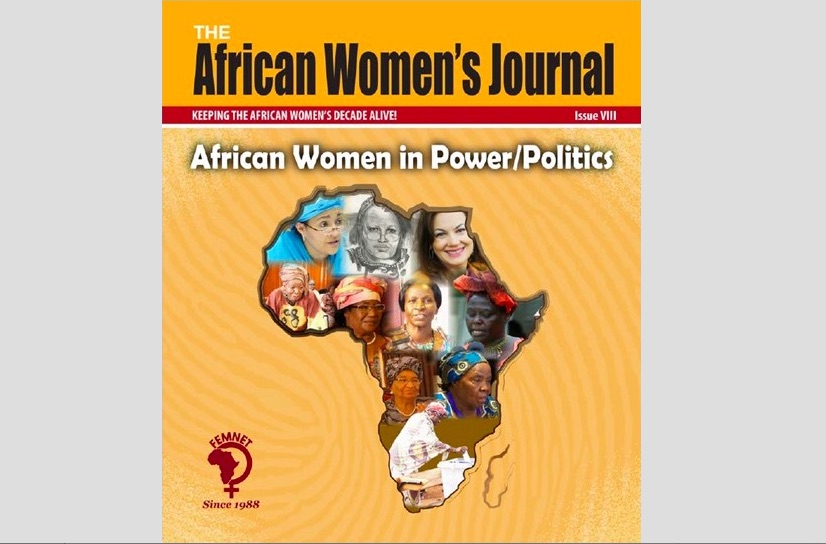 Click on photo to enlarge
Amina Mohammed shares her personally journey, from growing up in North-East Nigeria to her current position as special Advisor to Ban Ki Moon on Post-2015. She challenges us that it is not enough to simply have a seat at the table, but we must speak truth to the establishment and make that seat count for the countless who are not at the table. She reminds us that each of us must play our part, using our positions of power, small as they may be, to create a just and prosperous world where all people realize their rights and live with dignity and hope.
Annie Devenish takes a closer look at an eco- feminist and ultimately political movement; the Green Belt Movement, as well as the trailblazing woman at its forefront; Wangari Maathai. This case study provides an alternative model of leadership and participation; with women tapping into power through taking control of natural resources and articulating their struggles and concerns.
Bertha Rinjeu introduces us to a number of resilient women who find innovative ways around the threats, public shame and humiliation they face while on their political journeys. She touches on culture, patriarchy and strategies women employ to overcome obstacles placed in their paths to power.
Gavaza Maluleke looks at women fighting both a racist and sexist apartheid in South Africa – in particular focusing on the role of rural women, and the multiple ways in which women can participate and tap into power – both as individuals, and perhaps most importantly, as a collective.
Louisa Khabure delves into patriarchy, political global violence and the increasingly monetized nature of campaigns. She presents the nature and extent of challenges women face when seeking political leadership and examines this within the context of a broader political culture in Kenya. She also proposes actions to remedy the ills of the political landscape.
Aminatta L. R. Ngum presents the case of Pauline Nyiramasuhuko, who ironically held the position of Minister of Family Welfare and the Advancement of Women’s Affairs in Rwanda and who was the first and only woman tried and convicted for the crime of genocide as well as rape as an act of genocide by the International Criminal Tribunal for Rwanda.
Nimmo Elmi takes a look at the case of women in Somalia relegated to the private sphere despite their active engagement prior to the civil war. Through Serah Kahiu and Sara Longwe’s reflections of their own political journeys in Kenya and Zambia respectively, we come to understand that the personal is truly political.
Whether we engage at local, national, regional or global levels, we continue to wrestle with power, make our voices heard and bring about lasting change which can be felt by the coming generations. We’ve heard a few of the stories and journeys here in this issue, but of course there are countless others whose stories have neither been told nor heard.
A lutta continua.
Question for this article:
Can the women of Africa lead the continent to peace?
This question pertains to the following articles:
South Sudanese women take the lead in local peace building
Women take ownership of Great Lakes peace efforts
Les Femmes de Mali S'engagent pour la Paix
The Women of Mali Engage for Peace
Meet the Tanzanian Woman Who Said No to a Forced Marriage
International Women´s Day: Interview With Leymah Gbowee (Liberia)
Announcing: Women of Congo Speak Out!
Samba-Panza’s election represents a bright future for African women in politics
Nobel Women wrap up delegation to eastern Congo
Towards the creation of a network of women for a culture of peace in Africa
Meet Carine Novi Safari, Democratic Republic of Congo
Esther Abimiku Ibanga, Founder and president of The Women Without Walls Initiative to receive the Niwano Peace Prize
African Women's Journal: African Women in Power/Politics
Foundation de la paix mondiale, D.R. Congo: Vision, Mission, Activités et Projets 2015
. . . TOLERANCE ET SOLIDARITE . . .
un article par Mukhuta Muhiana John, Foundation de la paix mondiale, D.R. Congo (abrégé)
1. LA VISION
La vision sur la création de la fondation de la paix mondiale fut née en 1999 par Monsieur John MUKHUTA MUHIANA vivant les événements souciant et massacreurs en république démocratique du Congo son pays d’origine, en Afrique son continent et dans le monde entier sa planète Terre ; non seulement sur plan physique mais aussi sur le plan spirituel. . .
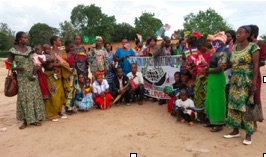
2. LA MISSION
La fondation de la paix mondiale est une association sans but lucratif créée et œuvrant en république démocratique du Congo. Son champ d’activités étant toute la population du monde en général et celle de la R.D. Congo en particulier, la FPM a pour objectif majeur la restauration de la culture de la paix à travers les enseignements ou séminaires qu’elle organise pour ainsi transmettre les messages de la paix. Pour ainsi atteindre cette mission telle qu’assignée, la FPM se propose de faire revenir la population à la conscience individuelle tout comme collective en vue de changer et améliorer les manières de vie, permettant au développement de trouver sa place dans ce monde. . .
5. LES ACTIVITES
Les activités des mamans
Les mamans étant les éducatrices de toutes les couches de la population, se retrouvent aussi dans les activités organisées par la fondation de la paix mondiale du fait que la paix concerne tout le monde et n’épargne personne, en raison du bien-être de l’humanité. Car éduquer une femme, c’est éduquer une nation et ce, appuyé par des projets dits « Empowerment of women » c’est-à-dire leur doter des moyens d’auto-prise en charge pour subvenir aux besoins de leurs familles. Le projet pilote a été initié sur base de 60 femmes scindées en 4 groupes dont 15 membres chacun, et pourra s’étendre sur plusieurs car la demande est effective.
6. LES PROJETS A COURT TERME ET A LONG TERME
A court terme : Construction d’un village de la paix sur un terrain de plus de cinq hectares propre à la fondation de la paix mondiale, avec à son sein : l’école de la paix- l’orphelinat- les internats (garçons et filles)- la bibliothèque- les maisons des encadreurs- les maisons de visiteurs- une clinique- le stadium, etc. Project en cours d’exécution et qui recherche encore des financements auprès des gens de bonne volonté ou bailleurs de fonds pour sa matérialisation.
A long terme : Nous avons acquis un nouveau terrain de plus de 10 hectares à Kasaji à travers notre antenne/Kasaji. Ce terrain abritera les constructions de l’Université de la paix, et même temps nous voulons installer les antennes de la FPM partout en R.D. Congo et pourquoi pas à l’extérieur du pays. . .
( Cliquez ici pour une version anglaise)
Question liée à cet article:
Can you add to this analysis of the Democratic Republic of the Congo?
This discussion question applies to the following articles:
Moving towards the culture of peace and non-violence in Democratic Rep
North-Kivu, Congo: Peace is needed to stop the use of child-soldiers in the clashes
Local Voices Saying No to War in North Kivu
A Peace Message on the Cell Phones
Un Message de Paix dans nos Portables
Our Actions for a Culture of Peace in the Democratic Republic of the Congo
Nos Actions pour une Culture de Paix en République Démocratique du Congo
Letter from Kivu, Congo
News from JFDHOP (Democratic Republic of Congo)
Foundation de la paix mondiale, D.R. Congo: Vision, Mission, Activités et Projets 2015
World Peace Foundation, DR Congo: Vision, Mission, Activities and Projects in 2015