TOLERANCE & SOLIDARITY .
An article by Denis Chabrol in Demerara Waves
Former Chairman of the Caribbean Community (CARICOM), Jamaica’s Prime Minister Andrew Holness and current Chairman, St Kitts and Nevis Prime Minister Dr Terrance Drew called for humanitarian relief to Cuba and said the region could be an interlocutor between Washington and Havana to seize the opportunity for political and economic reforms in that communist-ruled island.
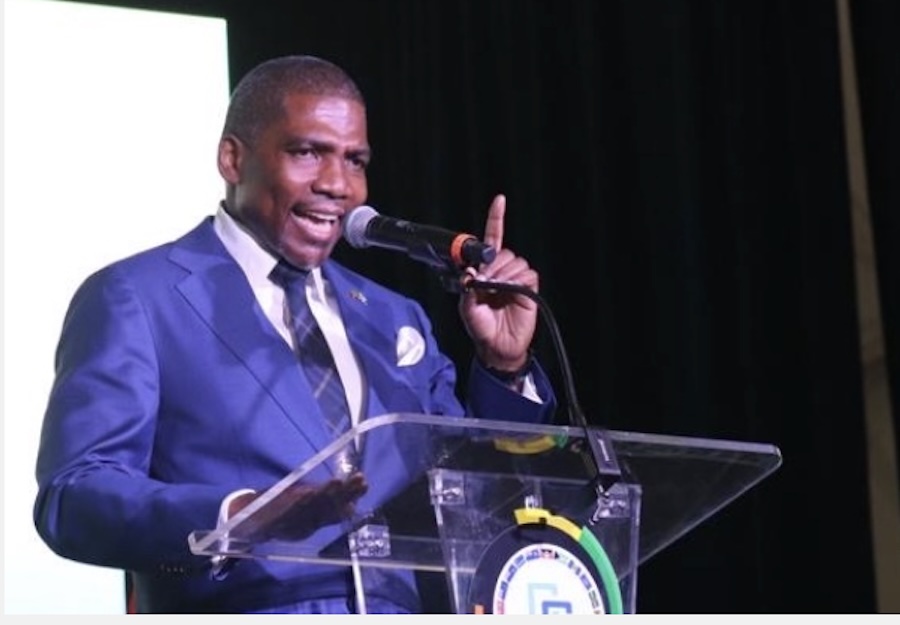
CARICOM Chairman, St Kitts and Nevis Prime Minister Dr Terrance Drew addressing the opening of the summit (CARICOM Secretariat picture)
“This moment, therefore, calls not for rhetoric, but for responsible statecraft, even as we encourage support for humanitarian relief,” Mr Holness told the opening of the mid-term summit of CARICOM leaders in St Kitts, less than one day before regional leaders, including Guyana’s President, Irfaan Ali, are due to meet with United States (US) Secretary of State Marco Rubio
He added that Jamaica supports constructive dialogue between Cuba and the US aimed at de-escalation, reform, and stability. “We believe there is space, perhaps more space now than in years past, for pragmatic engagement that protects the Cuban people from any further deterioration in their circumstances and instead promotes national and regional prosperity,” said the Jamaican PM, regarded as a moderate US ally.
For his part, CARICOM Chairman, Dr Drew said the regional grouping could be an interlocutor between Washington and Havana to address concerns. “And the community must serve as a conduit to ensure that there is communication and dialogue between the forces that be, so that the best opportunity can be had,” he said.
CARICOM member states are pursuing capitalism and Western-style freely-elected government, but during the reign of Venezuela’s socialist governments of Hugo Chavez and Nicolás Maduro, several historically left-leaning CARICOM governments especially in the Eastern Caribbean had up to earlier this year enjoyed more than cozy relations with Venezuela.
But Mr Holness said that with the “shifting” geopolitical environment, the time has come for CARICOM member states to broker improved conditions there. “This may well be a moment of opportunity, a moment for transition, for recalibration, for a new chapter. CARICOM can play a constructive role, not as an ideological bloc, but as a community of democratic states offering cooperation, economic reform, and social development,” he said.
Mr Holness said “clarity and courage” should be the key ingredients in addressing the situation in Cuba whose doctors and teachers have served across the Caribbean.
(Continued in right column)
Solidarity across national borders, What are some good examples?
(Continued from left column)
Under intense pressure of government officials and their immediate families losing their American visas, Guyana and several other Caribbean countries have scrapped their decades-old Cuban Medical Brigade agreements over Washington’s concerns about forced labour that it says amounts to human trafficking.
The Jamaican leader lamented the plight of Cubans at a time when the US has further tightened its more than 64-year-old trade and economic embargo since the removal of the Venezuela President from office.
The Trump administration has warned of tariffs if any country supplies fuels to Cuba. “Its people are part of our shared history. But today, the Cuban people face severe economic hardship, energy shortages, and growing humanitarian strain. Jamaica is sensitive to the struggles of the Cuban people,” Mr Holness said.
Weeks of no supplies have forced the virtual closure of the airport to international flights because refuelling is impossible.
Dr Drew, who studied in Cuba and said he was in contact with Cubans on the Spanish-speaking island, appealed for regional unity in bringing urgent relief to Cuba now beset by food shortages, electricity outages and garbage pileups. “I can only feel the pain of those who treated me so well when I was a student. I can feel their challenges and their difficulties. I do not get involved in their politics, but as a matter of humanity, it is challenging. I would say it is almost impossible not to feel the pain that (is) the pain that is conveyed to me in messages and calls from those who I lived among,” he said.
Without naming the US, the Jamaican PM cautioned that “humanitarian suffering serves no one” before issuing a grim warning that the current conditions could spell several crises for the rest of the Caribbean. “Apart from our fraternal care and solidarity with the Cuban people, it must be clear that a prolonged crisis in Cuba will not remain confined to Cuba. It will affect migration, security, and economic stability across the Caribbean basin,” he said.
Dr Drew also feared that worsening conditions in Cuba, with a population of nine to 12 million, could adversely impact CARICOM member states whose combined population is fewer than 10 million. “A destabilized Cuba will destabilize all of us…Therefore, if a state within our community is so destabilised, it will affect all of us in the region. And as a matter of course, it is important that the community looks at the humanitarian issue in Cuba, treats it extremely seriously,” he said.
Mr Holness urged careful consideration and collective action, even as he stated categorically that Jamaica favours democracy, human rights, political accountability, and open market-based economies.
He said Jamaica does not believe that long-term stability can exist where economic freedom is constrained and political participation is limited. “This is not a moment for division in our community. It is a moment for maturity, for principled realism, and if we act wisely, for positive change in our hemisphere,” he said.
Trinidad and Tobago’s Prime Minister, Kamla Persad-Bissessar – an unabashed US ally who has credited the presence of American troops in the Caribbean for 42 percent or 257 fewer murders in her country – chastised those CARICOM member states for supporting Cuba.
She accused sister member-governments of engaging in double standards by coming to power through democratic elections but at the same time supporting communism.
– – – – – –
If you wish to make a comment on this article, you may write to coordinator@cpnn-world.org with the title “Comment on (name of article)” and we will put your comment on line. Because of the flood of spam, we have discontinued the direct application of comments.