. . DEMOCRATIC PARTICIPATION . .
An article from France Info
From Paris to Marseille, orchestras play the film’s epic song before protesters who raise three fingers in the air as a rallying sign—symbols that have become universal for uniting struggles against authoritarianism.
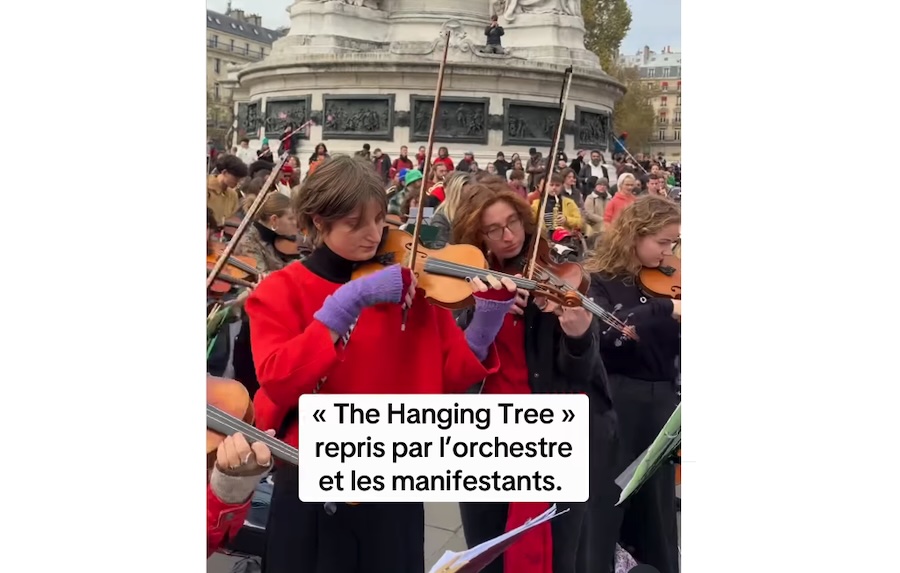 Video of the rally in Paris
The song is frequently chosen to accompany social media footage of the crowds of high school students who have been demonstrating for several weeks. “The Hanging Tree” is also played and sung during these protests; it has been performed by the “Orchestre du Nouveau Monde” at the Place de la République in Paris, as well as by other orchestras—such as in Marseille on Thursday, November 5 —during the major day of mobilization against the high cost of living.
Surrounding the musicians, protesters hold up three fingers—the index, middle, and ring fingers. Both this music and this gesture are symbols drawn from the *Hunger Games* saga, a new installment of which is set to be released in theaters on November 18th. Originally a literary series by Suzanne Collins, first published in 2008, it went on to achieve immense international success.
To understand why protesters draw references from it, one must delve into the dystopian world of *The Hunger Games*. Suzanne Collins depicts an imaginary, post-apocalyptic society built upon the ruins of North America. It is ruled by President Snow, who maintains the Capitol’s power through fear and the repression of the workers living in the 12 districts that make up Panem. Each year, he organizes a series of brutally cruel televised games in which 24 teenagers—two selected from each district, one boy and one girl—are forced to kill one another until only one survivor remains. A young woman named Katniss, played by Jennifer Lawrence, becomes the symbol of the rebellion by convincing the youths to unite—rather than kill each other—in order to overthrow the regime.
(article continued in right column)
Is there a renewed movement of solidarity by the new generation?
(article continued from left column)
The gesture of solidarity from the film—three fingers raised—is being widely adopted at protests. A phrase also appears on placards: “If we burn, you burn with us”—a sentiment now directed at the French government.
The dystopian story, which explores themes such as class struggle, repression, media manipulation, and rebellion, has crossed over into reality through these symbols displayed on the streets. “The fact that this song resonates with people—the way it fits into these stories—and that people can take it and imbue it with even greater meaning, is very moving. But it’s also truly surreal,” director Francis Lawrence recently admitted, reflecting on this appropriation in France.
“The Hunger Games” also made an appearance during the midterms.
Fiction recently bled into American reality as well. Amidst the coverage of the midterm election results on Tuesday, November 3, a promotional spot for the upcoming sixth installment of the saga aired on both CNN and Fox News. It was interpreted by some as an implicit call from the studios to vote for the Democratic side. In the clip, the President of Panem begins a propaganda speech before the image is scrambled, interrupted by a call to rebellion: “Break the machine.” A few hours earlier, the series’ iconic star, Jennifer Lawrence, had posted a photo of herself on social media with three fingers raised, urging people to go out and vote.
This gesture, which has become a universal call to rebellion against authoritarianism, has been adopted in numerous protests around the world—from the Umbrella Movement in Hong Kong to the Black Lives Matter movement. As early as 2014, students in Thailand raised three fingers to protest against a military coup, as did protesters in Myanmar in 2021. In both of these countries, the gesture is considered illegal and can even lead to imprisonment.
(Click here for the original French version of this article.)
– – – – – –
If you wish to make a comment on this article, you may write to coordinator@cpnn-world.org with the title “Comment on (name of article)” and we will put your comment on line. Because of the flood of spam, we have discontinued the direct application of comments.