FREE FLOW OF INFORMATION
by CPNN
The School Day of Non-Violence and Peace is celebrated on January 30.
This year the day was celebrated in Spain, Mexico and Cuba.
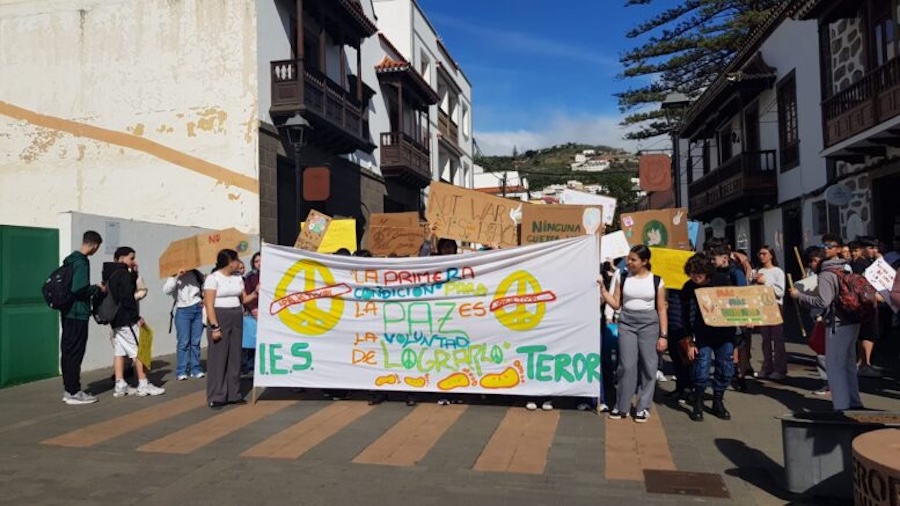
March by the students in Teror.
According to Wikipedia, this day was proposed by the Spanish poet Llorenç Vidal Vidal in Majorca in 1964 as a “starting point and support for a pacifying and non-violent education of a permanent character.”
Vidal chose the date of January 30 to commemorate the great prophet of non-violence and peace, Mahatma Gandhi, who was assassinated on this day in 1948.
It was popularized in France in the 1970’s by the Gandhian disciple Lanza del Vasto in his utopian Communauté de l’Arche.
The day is recognized by UNICEF in Spain.
In Palma, on the Island of Mallorca in Spain, 3,500 primary and secondary school students took part in the School Day of Non-Violence and Peace event. The celebration included the reading of a peace manifesto by student representatives, followed by a concert by the musical group Pèl de Gall. Afterwards, doves were released, a universal symbol of peace and of the commitment to promoting coexistence and the peaceful resolution of conflicts.
In the Mediterráneo secondary schools in Spain, representatives from each secondary school group read their manifestos on behalf of their classes, linking their pledges to the chain of commitments from the previous group. This gesture symbolized the unity of all students in a shared commitment to positive and respectful coexistence. The grand finale was a reading of the poem “White Souls” by the high school students.
In schools of Zaragoza, Spain, there were artistic creations and exhibitions, fundraisers and charity runs, speeches and poems, music, games, and gatherings in the playground between students of different grades… all promoting peace, non-violence, and kindness.
In the Huerto Escolar Ecológico school in the Canary Islands of Spain, students made presentations for peace and non-violence on their school radio station.
In the Tafira – Nelson Mandela secondary school of the Canary Islands, students listened to “Poetry Committed to Peace” played over the school’s public address system during the first few minutes of each class and the 7th-grade students prepared an “Images for Peace” exhibition.
In the Teror secondary school , also in the Canary Islands, the event began with a march by the students, carrying a banner with the slogan ‘The first condition for peace is the will to achieve it’, and chanting in unison, “Who are we? IES de Teror. What do we want? Peace.” In the Manifesto for Peace read by the students, they also emphasized this message: “Peace is not just the absence of war. Peace is respect, dialogue, equality, and justice.”
The secondary school of La Aldea de San Nicolás in the Canary Islands presented the official video clip of the song “Let us live in peace”. This audiovisual project is the result of intensive collaborative work aimed at raising awareness among the school community and the general public about the importance of coexistence, mutual respect, and the peaceful resolution of conflicts.
In Salamanca, Spain, the event included the reading of a manifesto, accompanied by a musical performance by a teacher from the Divino Maestro school, followed by the formation of a large circle for peace. Afterwards, the Mayor of Salamanca received a delegation from the school in the Reception Hall.
Continued in right column)
(Click here for the article in Spanish)
How can we be sure to get news about peace demonstrations?
(Continued from left column)
In Villacañas, Spain, a large globe, the work of local artist Manuel García Mochales,was installed in the Plaza de España. Throughout the day, the various participating schools added their artwork and messages to this piece, transforming it into a collective symbol of Villacañas’ commitment to peace. The celebration also included musical accompaniment and the performance of a song that was sung together by all attendees, highlighting the importance of education as a fundamental pillar for building a culture of peace.
In Barcelona, Children from Turó Blau School, Elisenda de Montcada School Institute, Bosc de Montjuïc Institute, Pedralbes Institute, and Caterina Albert Institute shared a series of learning experiences and reflections on “Invisible Violence”. The event was facilitated by the Escola de Cultura de Pau.
Ecologistas en Acción. based in Madrid, took part in the planting of olive trees on the occasion of the School Day of Non-Violence and Peace on January 30. This is part of the campaign entitled “There is no peace without justice.” of the Palestinian Tide platform, comprised of more than 60 educational organizations.
In Lleida, Catalonia, Spain, A total of 1,500 children participated in the commemoration of the School Day of Non-Violence and Peace. The boys and girls left messages of peace on maps installed in the squares of Pau Casals, Magnolias and Sant Jordi. The schools Sant Jordi, Minerva, Sant Josep de Calassanç, Països Catalans, Enric Farreny, Màrius Torres, Parc de l’Aigua, El Carme, Frederic Godàs, Esperança, Maria Rúbies, Joan Oró, Santa Anna, Sant Jaume Les Heures, Santa Maria de Gardeny and FEDAC participated.
In Cieza, Spain, the San José Obrero School in Cieza once again transformed its commemorative day for the School Day of Non-Violence and Peace into a pedagogical and artistic experience. This time, students and teachers climbed onto the deck of a ship to present the play “Pirates of the Sea of Peace”. With the theme that “peace is not conquered, it is built,” students and teachers explored diverse cultures to understand how each people live in harmony, learning the values of each place and performaing a traditional dance from each region.. During the performance, they docked at various ports to receive lessons from each community they visited, including China, Hawaii, Africa, India and Mexico.
The Football Club of Seville, Spain celebrated the day by a series of actions with the Entre Amigos Association in the Polígono Sur neighborhood to combat school absenteeism and bullying.
In Santander, Spain, to celebrate the School Day of Non-Violence and Peace, the mayor placed a plaque to rename the park next to La Anunciación Scholl as “La Paz Park” and a group of children from the school sang a song for peace..
In Peñaranda, Spain, the school community of La Encarnación celebrated Peace Day in the school auditorium. The students carried symbols related to this commemoration, and a manifesto in favor of peace and against violence was read..
In Vitoria-Gasteiz , in the Basque region of Spain, a total of 1315 students from all the Church schools in the capital of Alavesa – shared a central event in the New Cathedral for the School Day of Non-violence and Peace. The program included testimonies from several students, music, a prayer, and a manifesto for peace.
In Léon, in the Northwest of Spain, the educational community of the Divina Pastora School commemorated the School Day of Non-Violence and Peace. Students from each grade level created a peace pledge.
In Zocalo Monclova, Mexico, an event was held at the Ignacio Zaragoza Secondary School with educational and municipal authorities. The municipal government reiterated its commitment to promoting initiatives that strengthen a culture of peace in schools.
In the Yucatan, Mexico, the State Center for Social Crime Prevention held a soccer tournament to commemorate the School Day of Non-Violence and Peace.
In Holguín, Cuba, the group Friends of Cuba, based in Victoria, Canada, held a solidarity meeting at the “Ronald Andalia Nieves” school, coinciding with the School Day of Non-Violence and Peace. Accompanied by representatives from the Party, the Government, and the Cuban Institute of Friendship with the Peoples, as well as neighbors and local students, the visitors participated in political and cultural activities and planted a tree as a symbol of brotherhood and commitment to a fairer world.
– – – – – –
If you wish to make a comment on this article, you may write to coordinator@cpnn-world.org with the title “Comment on (name of article)” and we will put your comment on line. Because of the flood of spam, we have discontinued the direct application of comments.