… EDUCATION FOR PEACE …
Excerpts from two *Gaceta UNAM* articles: September 8 and
September 14.
Peace demands far more than the absence of conflict. It entails defending rights, addressing the root causes of discontent, and creating conditions for full participation in shared life, stated UNAM Rector Leonardo Lomelí Vanegas.
Inaugurating UNAM’s Second National Culture of Peace Week, he emphasized that this culture “is learned and built day by day in homes, classrooms, workplaces, streets, institutions, and the public sphere. It manifests in how we treat others, in our willingness to listen, and in our capacity to take responsibility for our actions.”
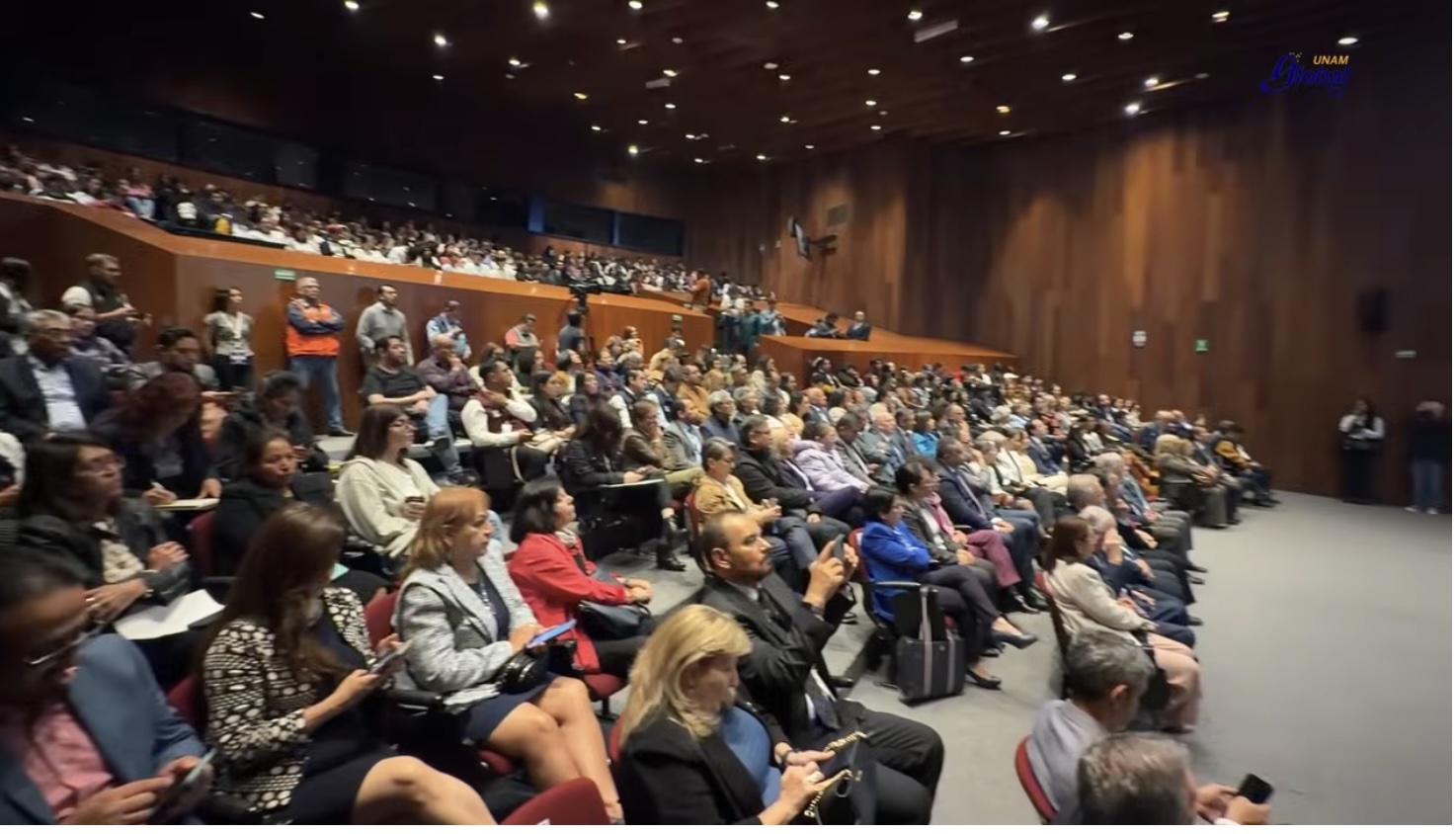
Frame from video of event
He also noted that universities bear specific responsibilities: generating rigorous knowledge regarding the causes and manifestations of violence; training individuals capable of preventing and addressing it; and examining our own institutional practices. . . .
Dedicated to youth
Earlier, Enrique Javier Ochoa welcomed the holding of UNAM’s Second National Culture of Peace Week, an event analyzing the challenges in this area. He added that strengthening the culture of peace is an imperative, as is the commitment to diplomacy and cooperation in a world where deaths resulting from armed conflict are rising exponentially.
At the Alfonso Caso Auditorium, Leticia Cano welcomed attendees to the gathering dedicated to young people—agents of peace who also demand social justice and respect for inalienable rights, and who embrace with hope the creation of societies based on substantive equality and democratic environments where “their voices matter, are heard, and are taken into account.”
According to Daniel Giménez, his country—Norway—defends peace by supporting multilateralism, strengthening international law, and protecting fundamental rights; they view peace as something built through international negotiations as well as within schools, universities, and various other spheres. Furthermore, young people are creating support networks, community-based proposals, and new forms of participation.
Dionisio Meade, President of the Board of Directors of Fundación UNAM, agreed that young people represent an asset in which hopes for transformation are invested, as they can turn conflicts into opportunities for dialogue, prevent violence, and foster inclusion. To this end, the Foundation and PUCPAZ formalized a partnership to provide 84 university high school students with a 10-month scholarship, enabling them to become agents of peace within their respective campuses.
Francisco Gorjón Gómez, Director of the Culture of Peace program at the Autonomous University of Nuevo León, noted that the national university system faces the challenge of contributing to the building and maintenance of peace. He emphasized the need to “speak of peace from a place of peace”—rather than merely reacting to violence—and to ensure that educational curricula include the development of peace-building skills. He also stressed the importance of being proactive, rather than waiting until violence occurs to discuss this value.
(Continued in right column)
(Click here for a Spanish version of this article)
University campus peace centers, What is happening on your campus?
Is there progress towards a culture of peace in Mexico?
(Continued from left column)
For Estefani López Cruz—a member of the “Peace-Weaving Community” (Comunidad Tejedora de Paz) within the UNAM high school system and a student at the College of Sciences and Humanities (CCH) Oriente campus—peace is something one learns, then practices, and finally spreads to others. She noted that it can be put into action through the way problems are resolved: without shouting, by incorporating diverse ideas, and by caring for shared spaces.
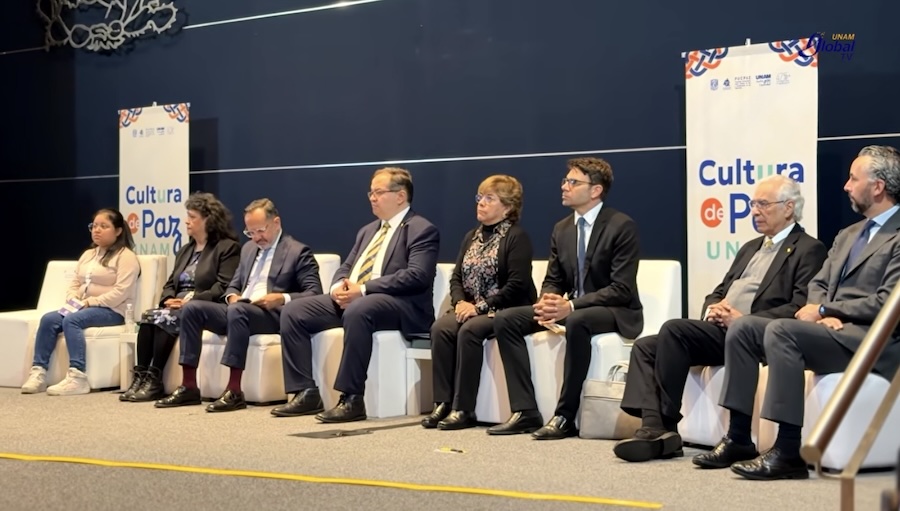
Frame from video of event
Economics strengthens university reflection on the culture of peace
As part of UNAM’s Second National Week of the Culture of Peace (2026), the Faculty of Economics opened a forum for analysis and reflection on a phenomenon currently affecting democratic coexistence: the use of hatred as both a form of discourse and a political strategy.
In the Jesús Silva Herzog Great Hall, Manuel Torres Aguilar—Director of the UNESCO Chair on Conflict Resolution at the University of Córdoba, Spain—delivered a keynote lecture titled “Hatred: Discourse and Political Strategy.” In it, he examined the mechanisms by which prejudice, discrimination, and exclusionary rhetoric can escalate into acts of collective violence.
During the subsequent discussion, Lorena Rodríguez León, Director of the Faculty of Economics, highlighted the importance of addressing these issues from within the university—and specifically from the perspective of economic sciences. She noted that processes of violence and exclusion possess structural dimensions requiring interdisciplinary study, while also emphasizing the role of the public university as a space of resistance, critical thinking, and the construction of alternatives.
For her part, Leticia Cano Soriano, Director of UNAM’s University Program for a Culture of Peace, highlighted the importance of creating spaces for dialogue *with* university youth, rather than merely *about* them. She emphasized that a culture of peace requires community participation, critical analysis, and collective commitment in the face of contemporary scenarios of violence and polarization.
Alicia Cabezudo, a professor at the University of Rosario in Argentina and a specialist in peace education, agreed that building a culture of peace demands an interdisciplinary perspective and the strengthening of values such as solidarity, cooperation, empathy, and respect.
The event concluded with a call to recognize that, in the face of discourses seeking to divide and dehumanize, educational institutions bear a fundamental responsibility: to generate knowledge, strengthen critical thinking, and foster communities capable of building societies that are more just, united, and peaceful.
– – – – – –
If you wish to make a comment on this article, you may write to coordinator@cpnn-world.org with the title “Comment on (name of article)” and we will put your comment on line. Because of the flood of spam, we have discontinued the direct application of comments.