FREE FLOW OF INFORMATION .
An article by Fausto Lara Flores in Vístazo (translation by CPNN)
The current situation of violence in Ecuador is not an isolated phenomenon, but rather part of a global context marked by transnational criminal networks, black economies, and structural threats that transcend national borders.
This is the analysis of Dr. Carlos García Torres, research professor at the UNESCO-UTPL Chairs, who emphasizes that the country faces problems linked to powers and organizations that operate on a global scale. In this scenario, a culture of peace emerges as a strategic solution.
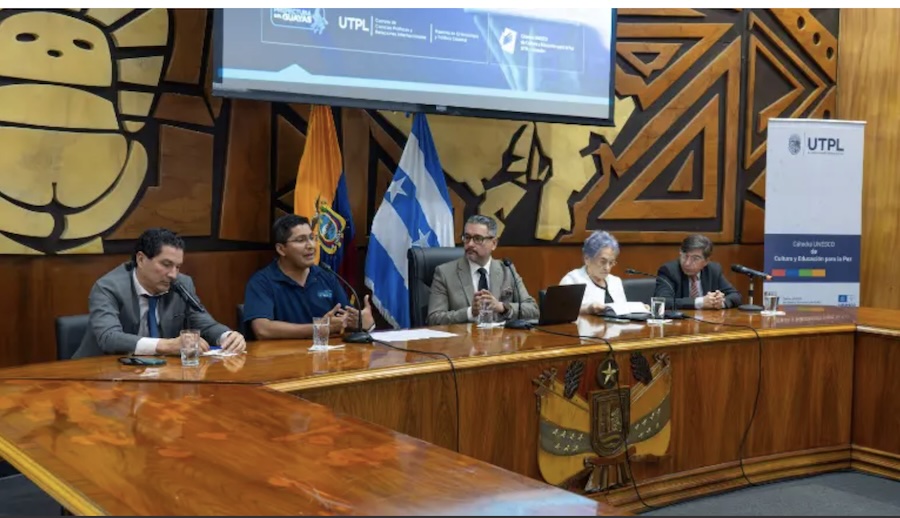
The Universidad Técnica Particular de Loja (UTPL) organized the Security, Conflict, and Peace Summit in Guayaquil. (Photo courtesy of UTPL)
The notion of a culture of peace arose with the creation of the United Nations Educational, Scientific and Cultural Organization (UNESCO), based on the premise that if war originates in the minds of people, it is also in the minds that peace must be built. This principle remains fully relevant in the current context, both in the face of global threats and internal challenges stemming from drug trafficking and organized crime.
According to Dr. García Torres, fostering a culture of peace involves reactivating human values that have historically sustained social cohesion. “A society with a strong social fabric is resilient to diverse threats, whether criminal, economic, political, or natural. A culture of peace, then, acts as the glue that binds society together and strengthens its capacity to respond,” he states.
(article continued in right column)
(Click here for the original Spanish version of this article.)
Latin America, has it taken the lead in the struggle for a culture of peace?
(article continued from left column)
During the Security, Conflict, and Peace Summit, organized by the Universidad Técnica Particular de Loja (UTPL) in Guayaquil, concrete examples of promoting this culture of peace were presented.
In neighborhoods plagued by violence, expressions such as poetry shared on social media and other cultural initiatives offer alternative meanings to populations exposed to the influence of drug trafficking. These actions demonstrate that violence prevention is not limited to coercive measures, but requires educational and cultural programs that reorient life plans.
The UNESCO-UTPL partnership has yielded significant results in three dimensions: social engagement, academic development, and research.
° The Student Network for Peace stands out, comprised of young people from Ecuador, Peru, and other countries, who coordinate concrete actions to promote peaceful coexistence.
° Furthermore, ongoing training in a Culture of Peace, aimed at the National Police and the general public, strengthens institutional and civic capacities.
° In the field of research, the UNESCO Chair in Culture and Education for Peace promotes specialized academic production in collaboration with the Institute for Peace and Conflict Studies at the University of Granada.
“Conflict is inherent to the human condition; therefore, peacebuilding is an ongoing task. Proper conflict management requires non-violent resolution, the philosophical foundation of a culture of peace,” adds Dr. García Torres.
For this reason, it is important that the State and civil society work together to develop public policies that enable this continuous construction of a culture of peace, thereby improving social and human conditions.
– – – – – –
If you wish to make a comment on this article, you may write to coordinator@cpnn-world.org with the title “Comment on (name of article)” and we will put your comment on line. Because of the flood of spam, we have discontinued the direct application of comments.